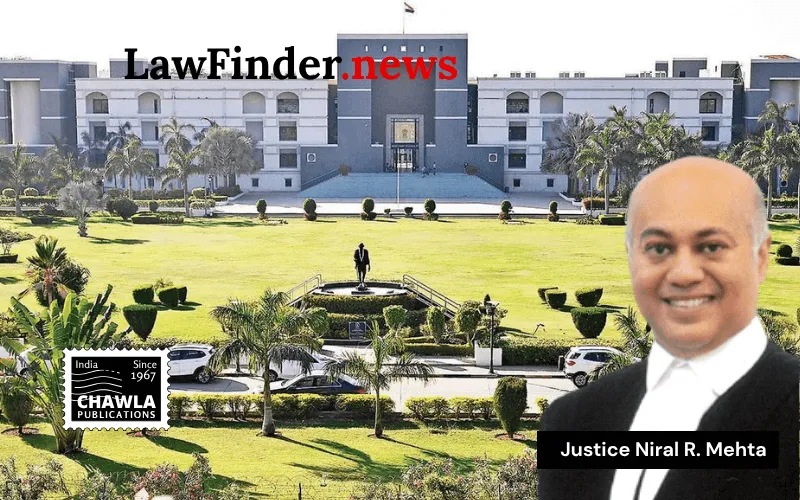
Court Upholds Apex Court's Interpretation, Declines Jurisdiction Under Section 29A of Arbitration Act
In a significant ruling, the Gujarat High Court, presided over by Justice Niral R. Mehta, dismissed the petitions filed by Abhishek Suresh Mehta and others seeking an extension of the mandate of an arbitral tribunal. The petitioners had approached the High Court under Section 29A(4) and (5) of the Arbitration and Conciliation Act, 1996, arguing for an extension based on Rule 34.6 of the Arbitration Centre (Domestic and International), High Court of Gujarat Rules, 2021.
The dispute involved arbitration proceedings under the aegis of the Gujarat High Court’s Arbitration Centre, with Hon'ble Ms. Justice H.N. Devani (Retd.) as the sole arbitrator. Although the arbitration had reached an advanced stage, the tribunal had not pronounced the award due to the complexity and volume of the case record, prompting the petitioners to seek further extensions beyond the statutorily allowed period.
The Court's decision was heavily influenced by the recent Supreme Court judgment in Jagdeep Chowgule v. Sheela Chowgule, which clarified that any extension of an arbitral tribunal's mandate beyond the statutory period must be sought from a court defined under Section 2(1)(e) of the Act, i.e., the Principal Civil Court or a High Court with original jurisdiction. The Supreme Court had asserted that institutional rules or party agreements cannot override statutory provisions.
Justice Mehta's judgment underscored that party autonomy in arbitration is not absolute and is bound by statutory constraints. The Court reiterated that while institutional rules can supplement statutory provisions, they cannot supplant them, and any inconsistency must yield to the law as interpreted by the Supreme Court. The ruling emphasized that the statutory scheme of Section 29A reflects a legislative balance between party autonomy and judicial oversight, and any extensions beyond the prescribed period require court intervention.
The Court dismissed the petitions as not maintainable and directed the petitioners to seek relief from the competent court. In a related Miscellaneous Civil Application, the Court rejected a review request based on the Apex Court's subsequent decision, citing the statutory limitations on review grounds.
This judgment holds significance for arbitration proceedings in India, reinforcing the judicial framework and limitations on party autonomy in extending arbitral mandates. The Court also directed the Registry to consider amending the Arbitration Centre Rules to align with the Supreme Court's interpretation.
Bottom line:-
Extension of the mandate of an arbitral tribunal under Section 29A(4) of the Arbitration and Conciliation Act, 1996 must be sought from the Court as defined in Section 2(1)(e) of the Act, irrespective of institutional arbitration rules or prior agreements between the parties. Party autonomy cannot override statutory provisions.
Statutory provision(s): Arbitration and Conciliation Act, 1996 Sections 2(1)(e), 29A(4), Civil Procedure Code, 1908 Order XLVII Rule 1
Abhishek Suresh Mehta v. M/s Parth Developers, (Gujarat) : Law Finder Doc id # 2934585