Court holds sanction by Principal Commissioner under Section 151(i) of Income Tax Act invalid for notice issued after three-year period; amendment to Section 151 by Finance Act, 2023 held prospective and not retrospective
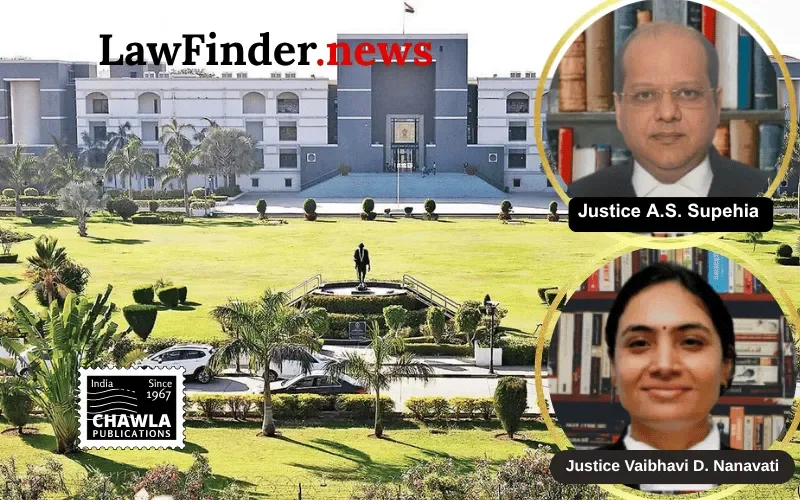
In a landmark judgment dated October 23, 2026, the Division Bench of the Gujarat High Court comprising Justices A.S. Supehia and Vaibhavi D. Nanavati set aside the reassessment proceedings initiated against Ritaben Arvindbhai Patel for the Assessment Year (AY) 2018-19. The petitioner challenged the jurisdiction of the Income Tax authorities in issuing a notice under Section 148 of the Income-tax Act, 1961, and the sanction granted under Section 151(i) by the Principal Commissioner of Income Tax, Central Circle 3, Surat.
Background
The petitioner, a co-owner of a parcel of land in Village Vav, Surat, had sold her 16.66% share for Rs.8,43,250. The Income Tax Department, acting on incriminating documents and loose papers seized during a survey at a third party's premises (M/s Saral Infra), alleged that she received undisclosed "on-money" amounting to Rs.29,42,074. Based on this material, the Assessing Officer issued a show-cause notice under Section 148A(b) on March 19, 2022, allowing the petitioner time to respond. After receipt of her reply on March 28, 2022, the Assessing Officer passed an order under Section 148A(d) and issued a notice under Section 148 on April 1, 2022, after obtaining sanction from the Principal Commissioner of Income Tax (PCIT) on the same date.
Legal Issue
The petitioner contended that the sanction granted by the PCIT was without jurisdiction because the notice and sanction were issued after the three-year period from the end of the relevant assessment year (AY 2018-19 ended on March 31, 2019; three years expired on March 31, 2022). According to Section 151 of the Income Tax Act as it stood on April 1, 2022, for reassessment notices issued after three years, sanction had to be obtained from a higher authority - the Principal Chief Commissioner of Income Tax or equivalent, not the PCIT. The petitioner argued that the proviso to Section 151, which allows computation of the three-year period by excluding certain time under Section 149, was inserted only by the Finance Act, 2023, with effect from April 1, 2023, and thus could not retrospectively validate the sanction granted in April 2022.
The Revenue argued that the time allowed to the assessee to respond to the show-cause notice under Section 148A(b) must be excluded in computing the three-year period, thus the sanction by the PCIT was valid as it fell within the extended period. They further contended that Sections 149(2) and 151 must be read harmoniously, and that the 2023 amendment was clarificatory and retrospective in nature.
Court's Findings
1. Jurisdiction and Competent Authority:
The Court reiterated that obtaining sanction from the competent specified authority under Section 151 is a strict jurisdictional requirement for issuing reassessment notices under Section 148. As per the law applicable on April 1, 2022, where the notice is issued after three years from the end of the relevant assessment year, sanction must be granted by the Principal Chief Commissioner or equivalent (Section 151(ii)). Since the sanction in this case was granted by the PCIT (Section 151(i)), who lacked jurisdiction beyond three years, the sanction and consequent reassessment proceedings were held invalid.
2. Non-retrospective Operation of Proviso to Section 151:
The Court examined the proviso to Section 151 inserted by the Finance Act, 2023, which allowed exclusion of periods under various provisos to Section 149(1) in computing the three-year limit for determining the competent authority. The Court held that this proviso operates prospectively from April 1, 2023, supported by the legislative history, the Memorandum explaining the Finance Bill, 2023, and the CBDT Circular No. 1/2024. There was no express or implied intention for retrospective operation. The Court followed binding Supreme Court precedents establishing that jurisdictional amendments affecting vested rights must be expressly made retrospective to have such effect.
3. Interplay of Sections 149 and 151:
The Court emphasized that Section 149 (limitation for issuance of notice) is expressly made subject to Section 151 (sanctioning authority). However, prior to the Finance Act, 2023 amendment, the exclusions or extensions under provisos to Section 149(1) could not be imported to determine the competent authority under Section 151. The insertion of the proviso in Section 151 was a substantive amendment and could not validate sanctions granted before April 1, 2023.
4. Merits of Reassessment:
On merits, the Court observed that the impounded loose papers and statements did not establish any direct or live link between the petitioner and the alleged undisclosed income. The petitioner had sold the land to buyers other than the person whose statement was relied upon by the Revenue. No evidence was produced to show that the third party or Mr. Sunil Patel acted as a broker or that the petitioner was involved in on-money transactions. Hence, the reassessment was liable to be quashed even on merits.
Conclusion
The Gujarat High Court quashed the sanction dated April 1, 2022, the order under Section 148A(d), and the notice under Section 148 issued on the same day, holding all to be without jurisdiction. The Court made the rule absolute, allowing the writ petition filed by Ritaben Arvindbhai Patel.
This judgment clarifies the strict application of jurisdictional limits in reassessment proceedings and affirms the prospective operation of amendments affecting the authority competent to grant sanction. It also highlights the necessity of establishing a direct link between seized material and the assessee before initiating reassessment.
Bottom Line:
Income Tax - Reassessment - Sanction under Section 151 of Income-tax Act, 1961 - For A.Y. 2018-19, where notice under Section 148 and order under Section 148A(d) were issued on 01.04.2022, i.e. after expiry of three years from end of relevant assessment year, sanction by Principal Commissioner under Section 151(i) was without jurisdiction - Proviso inserted in Section 151 by Finance Act, 2023 for computing three-year period after excluding time under provisos to Section 149(1) is prospective from 01.04.2023 and cannot retrospectively validate earlier sanction - Reassessment also liable to be quashed on merits where impounded loose papers recovered from third party did not disclose any direct live link with assessee.
Statutory provision(s):
Income-tax Act, 1961 Sections 148, 148A, 149, 151; Finance Act, 2023 (Proviso to Section 151)