Bombay High Court upholds cognizance taken in 2021 against politician's 2011 speech; reaffirms that Section 295A IPC protects religious sentiments when insults are deliberate and malicious, not merely careless
In a significant judgment reinforcing protections for religious sentiments under criminal law, the Bombay High Court (Aurangabad Bench) has dismissed a criminal application seeking to quash proceedings against Akbar Uddin, a Legislative Assembly member from Andhra Pradesh, for allegedly making derogatory remarks against religious figures during a public speech delivered in December 2011.
THE CASE AND CHARGES
The applicant faced charges under Sections 295A and 298 of the Indian Penal Code following a private complaint filed in 2013 by Rajasingh T. Naval Singh Lodh, who claimed to have discovered a YouTube video containing the contentious speech. The complaint alleged that Mr. Uddin used offensive language targeting Lord Shriram and his religious community. An FIR was subsequently registered, investigation concluded, and a charge-sheet filed in March 2021, leading to cognizance being taken in November 2021.
LIMITATION PERIOD DEFENSE REJECTED
The applicant's primary argument centered on a procedural technicality: that since the speech was delivered on December 8, 2011, and cognizance was taken on November 15, 2021—nearly a decade later—the proceedings were time-barred under Section 468 of the Code of Criminal Procedure, which prescribes a three-year limitation for offenses punishable with up to three years imprisonment.
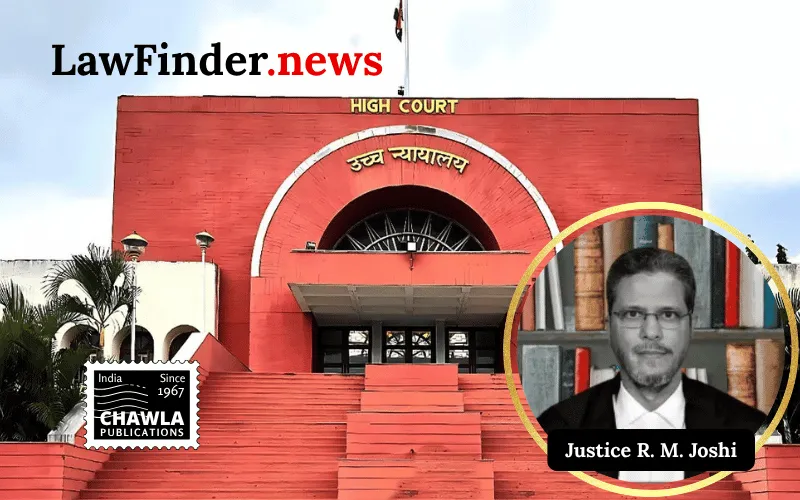
Justice R. M. Joshi, however, rejected this contention, relying on recent Supreme Court precedent in Ghanshyam Soni v. State of Delhi (2025), which established that the relevant date for computing limitation is the date of filing the complaint (January 3, 2013), not the date cognizance is taken by the magistrate. Since the complaint was filed within three years of the alleged offense, the Court held that the proceedings were not barred by limitation.
PRIMA FACIE CASE ESTABLISHED
On the substantive merits, the High Court found that the impugned statements made by the applicant disclosed a prima facie offense under Sections 295A and 298 IPC. Justice Joshi observed that the remarks in question appeared to mock religious figures and were clearly designed to wound the religious sentiments of Hindu believers.
The Court emphasized that while the applicant initially framed his speech in the context of discussing the Allahabad High Court's judgment in the Ram Janmabhoomi case, the specific statements allegedly made—which the Court declined to reproduce to avoid unnecessary publicity—went far beyond this legal discussion. The Court noted: "Prima facie, it could be said that in a planned and predetermined manner it was said so. On the face of it, there is nothing to indicate that it was made hurriedly or carelessly; on the contrary, it appears to be a measured statement."
CONSTITUTIONAL FRAMEWORK AND FREEDOM OF SPEECH
The judgment provides crucial clarification on the relationship between fundamental rights and criminal law protections for religious sentiments. Citing the landmark decision in Ramji Lal Modi v. State of U.P. (1957), the Court reaffirmed that Section 295A is constitutionally valid as it imposes reasonable restrictions on freedom of speech under Article 19(1)(a) of the Constitution.
Critically, the Court distinguished between protected and unprotected speech: "Section 295A does not penalize any and every act of insult to or attempt to insult the religion or the religious beliefs of a class of citizens, but it penalizes only those acts of insults which are perpetrated with the deliberate and malicious intention of outraging the religious feelings of that class. Insults to religion offered unwittingly or carelessly or without any deliberate or malicious intention do not come within the section."
THE DELIBERATION AND MALICE TEST
Justice Joshi provided important guidance on interpreting Section 295A's twin requirements of "deliberation" and "malice." Deliberate acts are those done for a purpose in a planned and decided manner, while malicious acts are those intended to cause hurt, whether physical or emotional. The Court observed that intent must be ascertained from the overall facts and circumstances, with particular attention to the tone, pitch, and manner of utterance.
The Court emphasized: "The vocabulary itself is not the meaning of words but the way it is spoke, its tone which would carry emotions of person that would set true meaning of what is intended to be communicated. The intent always would be subtle and invisible layer, which could be gathered from the way words are spoken."
REJECTION OF COMPARATIVE CASE LAW
The applicant had cited several judgments, including Harijinder Singh @ Zinda v. State of Punjab (2025), Sudheer Rikhari v. State of Goa (2021), and Dulal Ghosh v. State of Tripura (2021), arguing that those cases established principles protecting political speech from religious offense charges. The Court, however, found these inapplicable because in those cases, the accused either lacked the requisite intent or had raised specific pleas that their statements were misinterpreted.
By contrast, in the instant case, the applicant made no specific claim of lacking intent to wound religious sentiments. The Court noted: "In the instant case, there is no dispute about the fact that the Applicant during the speech has uttered apparently outrageous statements hurting religious sentiments of the class of persons. Pertinently, even in the application no specific plea is raised that Applicant had no intent to hurt religious sentiments of a class of persons."
QUASHMENT CRITERIA NOT SATISFIED
Applying the established guidelines from State of Haryana v. Bhajan Lal (1992), the Court held that none of the categories justifying quashment were satisfied. The complaint was not absurd, improbable, or frivolous; there was no indication of abuse of process or malafide prosecution; and sufficient material existed to proceed with trial.
CONCERNS ABOUT ONLINE PERSISTENCE
In a notable observation, the Court expressed serious concern that the speech in question remained accessible on YouTube despite cognizance having been taken. Justice Joshi stated: "Once cognizance is taken by the competent Court in respect of the contents of any speech, its availability on the public platform would only lead to perpetuating and continuation with the insult of the religious feelings of a class of persons."
The Court expressed hope that the government would take appropriate steps to address this matter, though it acknowledged lacking appropriate parties to issue direct directions.
BROADER IMPLICATIONS
The judgment represents a significant pronouncement on the balance between free speech protections and religious sentiments in Indian constitutional law. It clarifies that while freedom of expression is a fundamental right, it is not absolute and must yield to the legitimate state interest in protecting religious harmony and public order.
The Court stated unequivocally: "Freedom of speech is not an unfettered right of any individual and it is always subject to reasonable restrictions. Tolerance cannot be misconstrued/misunderstood to there being a license to intentionally hurt the religious feelings of others."
The decision reinforces that even high-ranking political figures cannot claim immunity from criminal prosecution for inflammatory remarks targeting religious beliefs when made with deliberate and malicious intent.
Bottom Line:
Section 295A IPC penalises only deliberate and malicious acts intended to outrage religious feelings, not unwitting or careless acts. Freedom of speech is not unfettered and does not extend to insulting religious beliefs intentionally.
Statutory Provisions
Section 295A, IPC; Section 298, IPC; Section 468, Code of Criminal Procedure, 1973; Section 482, Code of Criminal Procedure, 1973; Article 19(1)(a), Constitution of India, 1950
Akbar Uddin v. State of Maharashtra, (Bombay)(Aurangabad Bench) : Law Finder Doc id 2970317