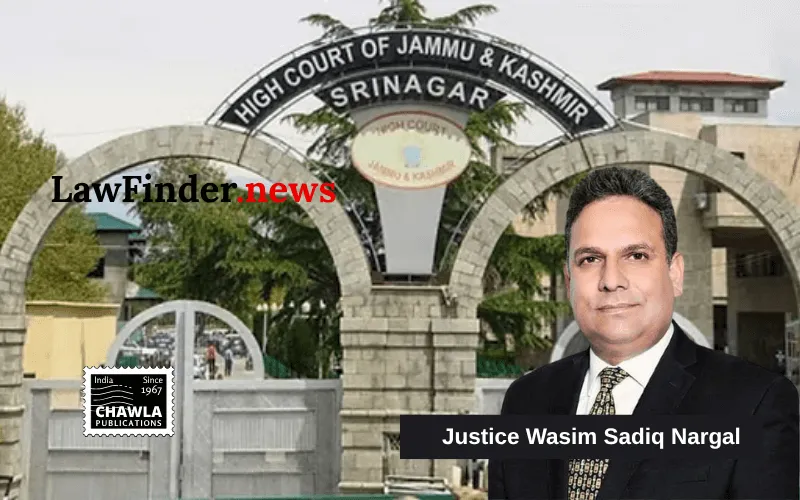
Wasim Sadiq Nargal, J. warns of coercive action against JMC Commissioner and allied departments for inadequate implementation of fire safety, parking norms, and building regulation compliance orders
In a significant administrative rebuke, the Jammu & Kashmir and Ladakh High Court has directed the Jammu Municipal Corporation (JMC) Commissioner to file a fresh and comprehensive affidavit strictly adhering to previously issued court directions regarding compliance with building regulations, parking norms, and fire safety clearances. The order was passed by Justice Wasim Sadiq Nargal in OWP No. 122/2002 on August 27, 2026.
Background and Previous Court Directions
The present order emerges from proceedings initiated following an earlier detailed order dated July 2, 2026, wherein the High Court had issued elaborate directions to the Commissioner, JMC, to file comprehensive affidavits detailing action taken against defaulting commercial establishments, hotels, coaching institutes, and public-facing buildings operating within the municipal jurisdiction.
Key Issues Identified
According to the High Court's observations, the affidavit filed by the respondent (JMC Commissioner) did not adequately address the specific directions previously issued by the Court. The petition was supported by learned senior counsel Rahul Pant, who contended that the submission was "deficient" and did not meet the required standards of compliance. This deficiency prompted the Court to emphasize the necessity of a fresh affidavit prepared in strict conformity with the detailed operational directions.
Detailed Directions Previously Issued
The July 2, 2026 order, which forms the backdrop of the current judgment, contained comprehensive directives requiring the Commissioner, JMC, to furnish information regarding:
- 1. Total number of establishments: Hotels, commercial establishments, coaching institutes, and similarly situated buildings operating within JMC jurisdiction
- 2. Regulatory compliance status: The number of establishments granted proper building permissions and occupancy/completion certificates
- 3. Construction violations: Establishments found to have constructed in deviation from, or without, sanctioned building plans, with specific details of the nature and extent of deviations
- 4. Parking facility deficiencies: Establishments lacking mandatory parking facilities as per applicable Building Bye-laws, Master Plan, and statutory regulations
- 5. Fire safety status: Establishments operating without requisite Fire Safety Clearance/No Objection Certificate from the Fire and Emergency Services Department or possessing deficient fire safety installations
- 6. Inspection mechanism: Whether periodic inspections are conducted by JMC and competent authorities, and the mechanism adopted for such inspections
- 7. Enforcement action: Details of action already taken against defaulters, including issuance of notices, sealing, demolition, prosecution, cancellation of permissions, and other coercive measures
Time-Bound Action Plan Required
The Court had specifically mandated that the Commissioner, JMC, must place on record a time-bound action plan indicating measures proposed to ensure compliance with statutory provisions by all establishments within its jurisdiction. Additionally, a comprehensive survey was ordered to identify establishments functioning without sanctioned building plans, lacking mandatory parking facilities, operating without fire safety clearances, or functioning without other mandatory statutory permissions.
Inter-Departmental Coordination
A critical aspect of the judgment emphasizes the necessity for coordinated action among multiple government departments. The Court directed the Commissioner, JMC, to coordinate with:
- - Director, Fire and Emergency Services
- - Vice Chairman, Jammu Development Authority
- - Inspector General of Police (Traffic)
- - All other concerned departments
This multi-departmental approach reflects the Court's recognition that effective enforcement of building regulations and public safety standards requires synchronized efforts across administrative silos.
Current Order and Fresh Directions
Unsatisfied with the compliance level, Justice Nargal has now directed that:
- 1. Fresh affidavit within one week: The JMC Commissioner must file a detailed affidavit strictly conforming to the July 2, 2026 directions, disclosing steps taken or proposed against all defaulters
- 2. Advanced copy requirement: The affidavit must be forwarded to learned counsel for respondents before the next hearing date
- 3. Threat of coercive action: Failure to comply positively shall result in the Court initiating appropriate coercive proceedings against the Commissioner, JMC; Director, Fire and Emergency Services; Vice Chairman, Jammu Development Authority; and Inspector General of Police (Traffic)
- 4. Senior representation: The Court directed senior law officers and advocates to appear before the Court on September 3, 2026, to appraise regarding implementation status and steps taken by respective departments
Significance of the Judgment
This judgment underscores the High Court's commitment to ensuring that public safety standards are not compromised through administrative apathy or incomplete compliance with court orders. The emphasis on building regulations, fire safety, and parking norms reflects the Court's concern for public welfare and institutional accountability.
The threat of coercive proceedings signals that the Court will not tolerate further delays or inadequate responses. Such judicial intervention is particularly critical in urban development scenarios where multiple establishments may be operating in violation of statutory requirements, potentially endangering public safety.
Next Steps
The matter has been listed for hearing on September 3, 2026, as case number 1 in the cause list, indicating its priority status. The Registry has been directed to forward copies of the order to all concerned departments, ensuring that all stakeholders are duly notified of the Court's expectations and the consequences of non-compliance.
Bottom Line:
Compliance with Court Orders - Directions issued by the High Court to the Commissioner, Jammu Municipal Corporation, and other associated departments for effective implementation of statutory requirements related to building regulations, parking norms, and fire safety measures.
Statutory Provisions
Jammu & Kashmir Building Bye-laws, Indian Penal Code, Municipal Corporation Act, Jammu Development Authority Regulations.
ADM. Jammu Municipality v. Surat Singh, (Jammu & Kashmir And Ladakh)...: Law Finder Doc id #2970353