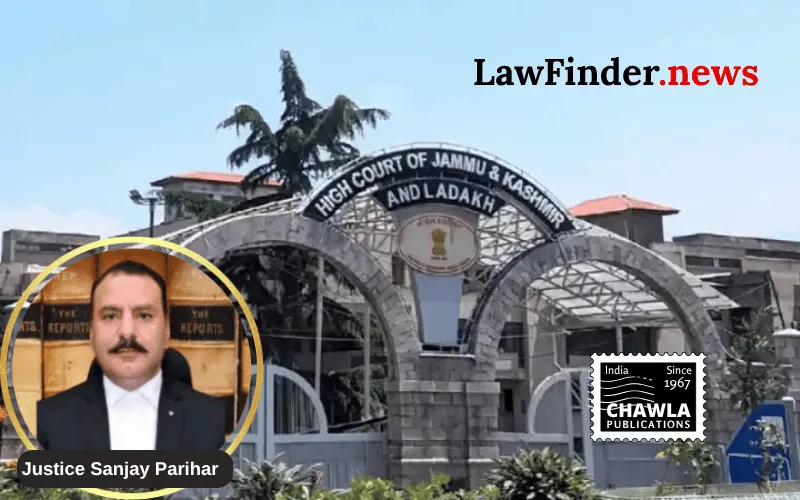
Jammu and Kashmir and Ladakh High Court said allegations of fabricated judicial records strike at the sanctity of justice, but allowed interim bail to the advocate accused considering her cooperation, recent entry into the profession, and personal circumstances.
Srinagar, Sept. 22: The Jammu and Kashmir and Ladakh High Court on Monday declined to quash an FIR alleging fabrication of judicial records and forged court decrees used to secure mutation of land in Baramulla, observing that the accusations were grave and had a direct bearing on the sanctity of the justice delivery system.
Justice Sanjay Parihar, while hearing a petition challenging FIR No. 99/2026 registered at Police Station Baramulla under several provisions of the Bharatiya Nyaya Sanhita, 2023, held that the material collected during investigation was sufficient to continue the probe and that no case was made out for interference at the threshold.
The case arose from a complaint filed by a Sub-Judge after an anti-corruption official sought certified copies of a civil court order and decree in the matter titled “Rabia Rashid v. Abida Malik.” When the original judicial file could not be traced, and the certified copies produced by the ACB raised doubts, a fact-finding inquiry was ordered. That inquiry, according to the court, prima facie pointed to a conspiracy involving court staff, beneficiaries and other persons to fabricate judicial records and use them to secure mutation entries over land.
The High Court noted that the allegations were not limited to an ordinary fraud, but involved the alleged creation of a fictitious civil proceeding and the fabrication of judicial records. It also recorded that the investigation had already led to the arrest of several accused persons, including a practicing advocate and a revenue official, while a retired judicial officer had also come under scrutiny.
Given the seriousness and breadth of the allegations, the court ordered that the investigation be transferred from the local police to the Crime Branch of the Union Territory of Jammu and Kashmir. It further directed the Inspector General of Crimes, Kashmir, to constitute a Special Investigation Team comprising senior officers and to submit periodic status reports to the Registrar (Vigilance) of the High Court.
At the same time, the court granted interim bail to advocate Tabinda Nazir, one of the accused in the case, pending completion of investigation. The judge noted that she was at the nascent stage of her legal career, had cooperated with the investigation, had no previous criminal antecedents, and had already undergone about 15 days of custodial interrogation. The court also took into account her personal circumstances, including that she is the mother of a breastfeeding infant.
Without expressing any opinion on the merits of the prosecution case, the court said that at the bail stage it was not required to conduct a meticulous examination of evidence or make findings on guilt or innocence. It therefore admitted her to interim bail subject to a surety bond of Rs. 1 lakh and a personal bond of the same amount, and clarified that her custody after filing of the charge-sheet would be governed by the trial court.
The court’s order underscores a dual approach: a strict view on alleged tampering with judicial records, and a measured, humanitarian approach in granting temporary relief to an accused advocate during investigation.
Bottom Line :
Quashing of FIR alleging fabrication of judicial records and forged decrees to secure mutation of land was refused at investigation stage; considering seriousness of allegations affecting sanctity of judicial records, investigation was transferred to Crime Branch and SIT was directed. Interim bail was granted to an advocate-accused considering her recent entry into profession, cooperation in investigation, absence of criminal antecedents, custody undergone, and personal circumstances, without commenting on merits.
Statutory provision(s): Sections 61(2), 316(5), 318(4), 337, 339, 340(2) of the Bharatiya Nyaya Sanhita, 2023