Allahabad High Court rules that ad hoc appointment made without statutory qualifications is void ab initio and cannot be cured through subsequent regularization orders, distinguishing between irregular and illegal appointments in educational services.
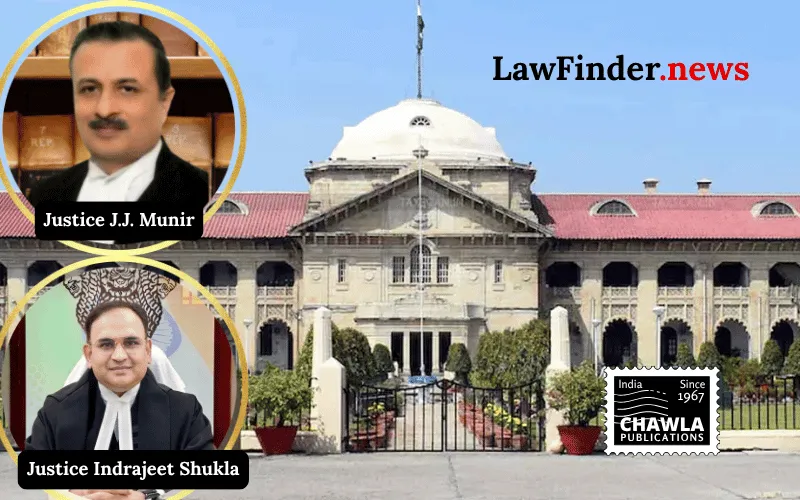
In a significant judgment addressing the intersection of employment law, educational standards, and administrative procedures, the Allahabad High Court has delivered a landmark decision that will have far-reaching implications for teacher appointments in educational institutions across Uttar Pradesh. The Division Bench, comprising Justice Indrajeet Shukla and Justice J.J. Munir, has upheld the fundamental principle that an appointment made in violation of statutory qualification requirements is void ab initio and cannot be ratified or regularized through subsequent administrative orders.
The Case Background:
The case involved Yogendra Singh, who was appointed on an ad hoc basis as a Lecturer in Biology at Kalyankari Shakubhara Inter College, Kuralsi, Muzaffarnagar, on October 21, 1986. However, Singh possessed an M.Sc. in Agriculture (Botany discipline), rather than the statutorily mandated M.Sc. in Zoology or equivalent qualifications prescribed under the Intermediate Education Act, 1921, and the Regulations framed thereunder. The Committee of Management, acknowledging the absence of the required qualification in Zoology, still appointed Singh "in the interest of students."
When his services were terminated on July 31, 1989, Singh filed a writ petition challenging the termination, claiming that it lacked the required prior approval from the District Inspector of Schools. Under the protection of an interim order passed by the court on September 20, 1989, Singh continued in service for over three decades, eventually being promoted to the position of Principal in 1999, and retiring in 2023 after approximately 37 years of service.
The Central Legal Issue:
The core question before the High Court was whether an appointment made without fulfilling the mandatory statutory qualifications could be sustained or regularized through subsequent administrative orders, particularly given Singh's long tenure of service under a court-ordered interim protection.
The Court's Landmark Ruling:
The High Court has categorically held that an appointment made in contravention of statutory qualification requirements is void ab initio—null from its very inception. This illegality cannot be cured by:
1. Lapse of time or long continuance in service - The Court rejected the argument that 37 years of continuous service could somehow legitimize an fundamentally illegal appointment.
2. Subsequent regularization orders - The regularization order dated September 4, 1995, passed under Section 33-A of the U.P. Secondary Education Services Selection Board Act, 1982, could not cure the foundational defect because it failed to certify that Singh possessed the prescribed qualifications. The Court noted that the regularization order merely mentioned "M.Sc." without specifying the subject discipline, which appeared to be a deliberate omission.
3. The doctrine of ratification - The Court held that ratification applies only to acts that are procedurally defective but otherwise lawful. An act that is inherently prohibited by law or void ab initio cannot be ratified, as ratification cannot validate an act that is fundamentally illegal.
Distinguishing Irregular from Illegal Appointments:
A critical distinction emerged from the judgment: the difference between an "irregular appointment" and an "illegal appointment." The Court, relying on recent Supreme Court precedent, clarified that:
- An irregular appointment involves procedural defects where the appointee is otherwise qualified and the post is sanctioned. Such appointments can potentially be cured.
- An illegal appointment is void ab initio, such as when the appointee is ineligible, lacks statutory qualifications, or the post does not exist. Such appointments cannot be validated.
Singh's appointment fell squarely within the category of illegal appointments because he fundamentally lacked the essential qualification prescribed by statute—a condition precedent for any valid appointment.
The Writ Jurisdiction Issue:
Singh had argued that the termination order violated Section 21 of the 1982 Act, which requires prior approval from the Board before dismissing or removing a teacher. The Court rejected this argument, holding that Section 21 protections apply only to teachers duly and validly appointed through the prescribed selection process. Since Singh was never a validly appointed teacher, he could not claim the protection of Section 21.
Furthermore, the Court noted that even if the termination order lacked formal approval, granting a writ of certiorari would revive an illegal appointment, which is impermissible. The discretionary jurisdiction of the High Court under Article 226 cannot be exercised in a manner that perpetuates illegality.
The Salary Recovery Issue:
While affirming that the appointment was void ab initio and the termination order valid, the Court departed from the Single Judge's direction for complete recovery of salary. It held that directing recovery of the entire salary drawn over decades, after actual work was performed under the court's interim protection, would be:
1. Disproportionate and harsh - After 37 years of actual service and discharge of duties
2. Potentially violative of Article 23 of the Constitution - Which prohibits forced labor and traffic in human beings
3. Not the appropriate remedy - Recovery directions are best left to administrative authorities as guardians of public funds
Therefore, the Court set aside the recovery direction while affirming the illegality of the appointment and the validity of the termination.
Implications for Educational Administration:
The judgment carries several important messages for educational administrators and institutions:
- 1. Mandatory compliance with statutory qualifications - Schools and colleges cannot appoint teachers lacking prescribed qualifications, regardless of circumstances or claims of student interest.
- 2. Committee resolutions cannot override statutory requirements - The fact that the Committee of Management passed a resolution acknowledging Singh's lack of qualification but appointing him anyway does not legitimize the appointment.
- 3. Long service does not create substantive rights - The concept of "litigious employment"—continuation under an interim court order—does not create enforceable rights or entitlements to absorption or regularization.
- 4. Public funds protection - The Court emphasized that teachers in aided institutions draw salaries from the public exchequer, and therefore, only statutorily qualified appointees can claim such benefits.
Procedural Safeguards:
The Court highlighted the significance of the First Removal of Difficulties Order, 1981, which governs ad hoc appointments and mandates strict compliance with essential qualifications as prescribed in Appendix 'A' of the Regulations framed under the Intermediate Education Act, 1921. These requirements are not merely directory but mandatory conditions precedent to valid appointment.
The Court's Concern:
In parting observations, the Division Bench expressed serious concern about the overall functioning of the education system, noting that a teacher unqualified in the subject matter taught students for decades. The Court directed that the Director of Secondary Education be made aware of such instances to prevent similar future occurrences.
Conclusion:
This judgment represents a firm reaffirmation of the rule of law in public employment and educational administration. It demonstrates that the courts will not tolerate—and will actively prevent—the perpetuation of illegality through delay, length of service, or administrative orders that fail to address foundational defects. However, it also shows judicial sensitivity by refusing to order complete salary recovery when an employee has genuinely performed duties under court protection, striking a balance between upholding legality and avoiding disproportionate consequences.
The decision sends an unambiguous message: statutory qualifications for educational positions exist to protect students and maintain educational standards, and they cannot be circumvented through administrative convenience or subsequent regularization orders. In the hierarchy of legal principles, compliance with statutory mandates supersedes considerations of continuance, seniority, or even years of actual service.
Bottom Line:
An ad hoc appointment made without fulfilling the statutory qualifications prescribed under the Uttar Pradesh Secondary Education Services Selection Board Act, 1982, and the associated regulations, is void ab initio and cannot be ratified or regularized through subsequent orders, including regularization orders passed under Section 33-A of the said Act.
Statutory Provisions:
Uttar Pradesh Secondary Education Services Commission and Selection Board Act, 1982, Section 18; Intermediate Education Act, 1921; Constitution of India, Article 14.