Court Observes Serious Civil Dispute Underlies FIR; Clarifies SC/ST Act Applicability Only If Victim Present and Belongs to Scheduled Caste by Birth
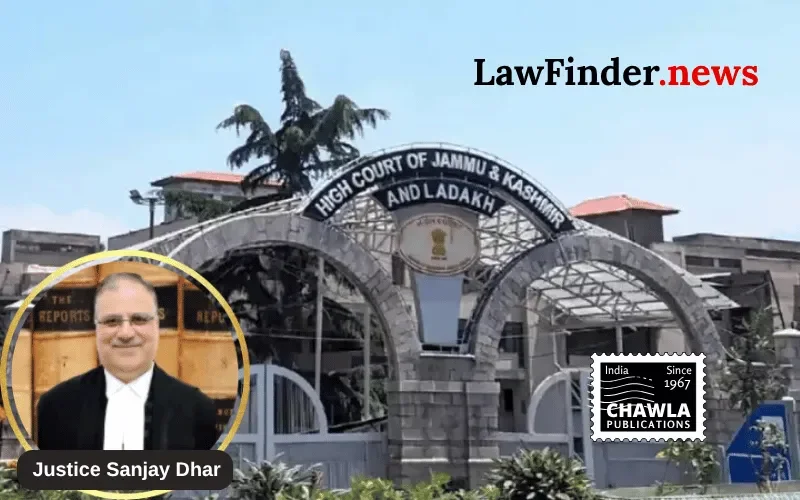
In a significant judgment delivered on October 8, 2026, the Jammu & Kashmir and Ladakh High Court granted bail to petitioners accused under the Scheduled Castes and Scheduled Tribes (Prevention of Atrocities) Act, 1989 ("SC/ST Act"), along with charges under the Bharatiya Nyaya Sanhita, 2023 ("BNS"). The case arose from a complaint alleging caste-based abuses and intimidation linked to a property dispute involving a petrol pump dealership in Bishnah, Jammu.
The complainant, Mrs. Rupali Gupta, had alleged that the petitioners used caste-based slurs such as "Chamar" and "Chamarin" against her and her husband, Vinod Kumar Hans, who belongs to a Scheduled Caste (SC) and suffers from 75% permanent disability. The FIR, registered as No. 0124/2016, charged the petitioners under Sections 79, 351(2), 352, and 3(5) of the Bharatiya Nyaya Sanhita, 2023, and Section 3 of the SC/ST Act.
However, the Court meticulously analyzed whether the ingredients of the SC/ST Act offences were prima facie made out. The Court highlighted two crucial points:
1. Caste Identity by Birth, Not Marriage:
The complainant herself was not a member of a Scheduled Caste, although married to one. Citing Supreme Court precedent in Sunita Singh v. State of Uttar Pradesh (2018), the Court reiterated that caste identity is determined by birth and cannot be invoked by marriage. Hence, caste-based insults hurled at the complainant could not attract the SC/ST Act provisions.
2. Presence in Public View Necessary:
The Court relied on the Supreme Court's ruling in Asmathunnisa v. State of Andhra Pradesh (2011), which clarified that for offences under Section 3(1)(r) and (s) of the SC/ST Act, the targeted member of the Scheduled Caste must be present in public view when the insult or abuse is made. Here, Vinod Kumar Hans was not present at the scene due to his disability. The Court held that abuses hurled behind his back did not satisfy the requirement of "public view" and presence, thus prima facie not constituting an offence under the SC/ST Act.
Furthermore, the Court observed that the offences under the BNS Sections 79, 351(2), and 352, relating to insult to modesty, criminal intimidation, and assault, were punishable with imprisonment ranging from two to three years and were not severe enough to deny bail outright.
The Court also took note of the ongoing serious civil dispute between the parties concerning ownership and operations of the petrol pump and the land in question. The petitioners claimed to have paid the entire sale consideration, whereas the complainant alleged coercion and fraud. Both parties had filed suits in civil courts regarding the property and dealership rights, which complicated the criminal allegations.
Given these circumstances, the Court concluded that the FIR might have been lodged as an act of vengeance in a civil dispute context. The Court granted bail to the petitioners, subject to conditions including furnishing bail bonds, cooperating with the investigation, avoiding tampering with witnesses, and refraining from leaving the Union Territory without prior permission.
The Court permitted the investigation to proceed but restrained filing the charge sheet without its permission. The complainant was also directed to clarify whether she had filed the civil suit and authenticated the pleadings therein.
This judgment provides critical judicial guidance on the application of the SC/ST Act, emphasizing the necessity of the victim's presence and caste identity by birth for offences under Sections 3(1)(r) and (s). It also underscores the careful balancing act courts must perform when criminal proceedings intersect with ongoing civil disputes.
Bottom Line:
SC/ST Act - For attracting Section 3(1)(r) and (s), the insult or abuse must be directed against a member of Scheduled Caste/Scheduled Tribe and such person must be present within public view - Wife not belonging to Scheduled Caste cannot invoke caste-based insult provisions merely because her husband is a Scheduled Caste member - Existence of serious civil dispute is a relevant circumstance for grant of bail.
Statutory provision(s):
Scheduled Castes and Scheduled Tribes (Prevention of Atrocities) Act, 1989 Section 3(1)(r), 3(1)(s); Bharatiya Nyaya Sanhita, 2023 Sections 79, 351(2), 352, 3(5); Section 528 of BNSS, 2023
Devinder Singh v. Union Territory of J&K, (J&K and Ladakh) : Law Finder Doc Id # 2994631