Court clarifies suit by individual claimant on common village land not necessarily a representative suit; permits amendment and impleadment for complete adjudication, dismisses supervisory jurisdiction plea.
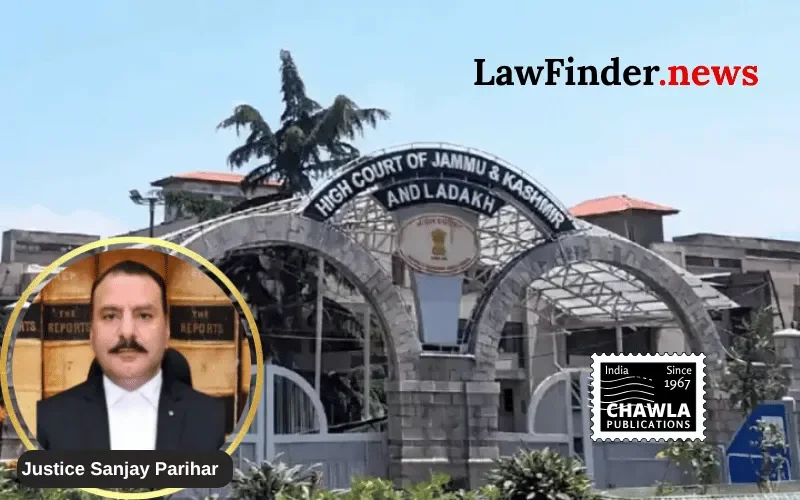
The Jammu & Kashmir and Ladakh High Court, in a recent judgment dated October 22, 2026, delivered by Justice Sanjay Parihar, has dismissed a petition challenging the Trial Court's orders permitting impleadment of additional defendants and consequential amendment of plaint in a civil suit concerning the distribution of common village land in village Chutuk.
The suit was instituted by Mohammad Hussain, claiming to be a resident of village Chutuk and asserting his right to be included among the beneficiaries of more than 300 kanals of non-cultivable land recorded in favor of the villagers. The plaintiff sought a declaration and injunction against five defendants initially, who were alleged members of a committee distributing the village land. The defendants contested the claim, disputing the plaintiff's residential status and entitlement.
During the pendency of the suit, the Trial Court allowed the plaintiff to implead additional villagers as defendants and to amend the plaint's cause title and relief clause accordingly. The petitioner villagers opposed this, arguing that the suit should have been instituted in a representative capacity under Order 1, Rule 8 of the Civil Procedure Code (CPC), and that the amendments altered the nature of the suit and caused prejudice.
The High Court examined whether the suit was a representative suit or an individual claim. It observed that although the land is common village property, the plaintiff's claim was personal - to be included as a beneficiary - and thus the suit did not require representation under CPC provisions. The Court emphasized that a suit by an individual for enforcement of his own right, even if it concerns property in which others have interest, does not automatically become a representative suit.
Further, the Court upheld the Trial Court's discretion to allow impleadment and amendment to facilitate a complete adjudication of the controversy. It highlighted that such procedural provisions aim to avoid multiplicity of litigation and that no irreparable prejudice was caused since defendants were granted opportunity to file written statements against the amended plaint.
The High Court also addressed the maintainability of the suit, clarifying that the absence of a prayer for possession did not render it non-maintainable at interlocutory stages, as the core issue was the plaintiff's entitlement to inclusion among beneficiaries, which required trial and evidence.
Moreover, the Court rejected the contention that the subsequent extension of a status quo order to the newly impleaded defendants was improper, reasoning that such measures were necessary to preserve the subject matter and avoid rendering the suit infructuous.
Invoking its supervisory jurisdiction under Article 227 of the Constitution of India, the petitioners sought to set aside the Trial Court's orders. However, the High Court reiterated the limited nature of supervisory jurisdiction, stating it is not appellate and should be exercised sparingly only in cases of jurisdictional error, perversity, or manifest injustice. Finding none in the present case, the petition was dismissed.
The Court directed the Trial Court to proceed with the suit expeditiously and clarified that its observations were confined to the present petition without expressing any opinion on the merits of the parties' claims.
This decision reinforces the principle that suits asserting individual rights over common village land do not necessarily require representation and that courts have wide discretion to allow amendments and impleadment to ensure effective justice.
Bottom Line:
Civil Procedure Code - Suit by person claiming inclusion among beneficiaries of common village land is not necessarily a representative suit under Order 1, Rule 8 CPC - Trial Court can permit impleadment of additional defendants and consequential amendment of plaint to facilitate complete adjudication - Supervisory jurisdiction under Article 227 is limited and cannot be invoked absent jurisdictional error, perversity or manifest injustice.
Statutory provision(s):
Civil Procedure Code, 1908 - Order 1, Rule 8; Constitution of India - Article 227
Villagers of Chutuk v. Mohammad Hussain, (J&K and Ladakh) : Law Finder Doc Id # 3004100