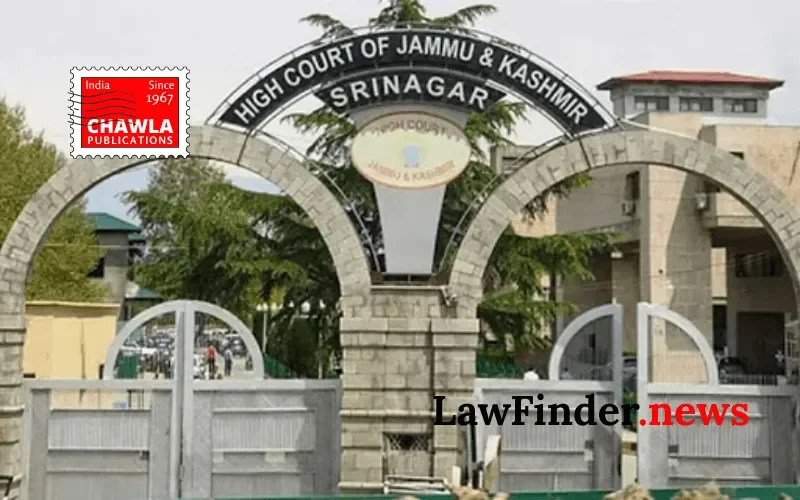
Court Rules Repeated Theft Allegations Constitute Law and Order Issues, Not Public Order Threat; Emphasizes Preventive Detention as Exceptional Measure
In a significant judgment delivered on October 21, 2026, the Jammu & Kashmir and Ladakh High Court (Division Bench, Srinagar) set aside the preventive detention order issued against Tariq Ahmad Dar under the Jammu and Kashmir Public Safety Act, 1978 (PSA). The Court ruled that the detention could not be sustained as the allegations against Dar pertained to repeated cases of theft and house trespass, which amounted to ordinary law and order violations rather than a disturbance of public or social order.
The detention order in question, dated December 13, 2025, was passed by the District Magistrate of Kulgam under Section 8(1)(a)(i) of the PSA, aiming to prevent Dar from acting in a manner prejudicial to the maintenance of public order. However, Dar challenged the order through a Habeas Corpus Petition (HCP No. 21 of 2026), which was initially dismissed by a Single Bench. Aggrieved, Dar approached the Division Bench via a Letters Patent Appeal (LPA No. 254 of 2026).
The Court extensively examined the nature of the offences attributed to Dar, which included involvement in eleven FIRs related to lurking house trespass, house breaking, and cattle theft across multiple districts-Kulgam, Anantnag, and Shopian. The Court noted that these offences, while punishable under ordinary criminal law, did not fulfill the statutory threshold of causing disturbance to public or social order as required under Section 8(3)(b) of the PSA.
Drawing on well-established legal precedents, including the Supreme Court's rulings in Ram Manohar Lohia vs. State of Bihar, Arun Ghosh vs. State of West Bengal, and recent judgments such as Ameena Begum vs. State of Telangana, the Court reiterated the essential distinction between "law and order" and "public order." The Court emphasized that not every breach of law results in public disorder; rather, preventive detention laws are reserved for exceptional situations where the act affects the community or public at large, disturbing the even tempo of public life.
The Court observed that Dar was already facing prosecution in criminal courts, with chargesheets filed and bail granted in the respective cases. The ordinary criminal justice system was deemed sufficient to address the allegations without resorting to preventive detention, which is a severe curtailment of personal liberty and must be applied sparingly.
Further, the Court found that the detaining authority failed to demonstrate how the ordinary law enforcement machinery was inadequate to deal with Dar's alleged offences. The invocation of the PSA appeared to be an abuse of process, lacking proper application of mind. The Court also rejected claims that Dar was not supplied the complete detention record or that grounds of detention were not communicated in a language he understood, as the record showed compliance with procedural safeguards.
Highlighting the constitutional balance between individual liberty under Articles 21 and 22 and the collective liberty of society, the Court underscored that preventive detention must be grounded in subjective satisfaction that is well-reasoned and justified by material indicating a threat to public order.
Concluding its detailed analysis, the Division Bench quashed the detention order and directed the authorities to release Tariq Ahmad Dar forthwith. The judgment serves as a crucial reminder that preventive detention cannot be used as a tool to bypass or supplement ordinary criminal proceedings, especially where such proceedings are ongoing and effective.
Bottom Line:
Preventive detention under Jammu and Kashmir Public Safety Act, 1978 cannot be sustained where allegations relate to repeated theft/house trespass cases amounting only to law and order issues and not disturbance of public order/social order; ordinary criminal law being sufficient, detention order is liable to be quashed.
Statutory provision(s):
Jammu and Kashmir Public Safety Act, 1978 Section 8(1)(a)(i), Section 8(3)(b), Section 13; Constitution of India, 1950 Articles 21, 22(5)