First Appellate Court's reversal on limitation and paternity claims set aside; Court underscores correct application of Section 6 Limitation Act and Section 50 Evidence Act in inheritance dispute
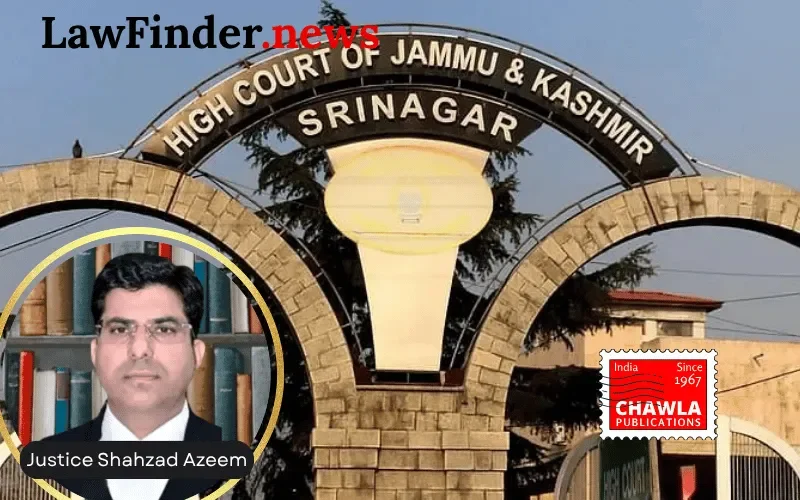
In a significant judgment delivered on October 23, 2026, the Jammu & Kashmir and Ladakh High Court, presided over by Justice Shahzad Azeem, allowed a civil second appeal filed by Mst. Themu, restoring the trial court's decree that declared her the rightful daughter of the deceased Sonu and entitled to a half share in ancestral property. The judgment critically examined the approach of the First Appellate Court, which had earlier dismissed the suit on grounds of limitation and failure to prove paternity.
The appellant, Mst. Themu, had filed a suit in 1982 seeking a declaration of her status as the only daughter of Late Sonu and claiming her share in the property. Sonu had died in 1963 when Themu was a minor. The respondents disputed her paternity and raised pleas including limitation. The trial court, after evaluating both documentary and oral evidence including testimonies of family acquaintances and revenue records, decreed the suit in favor of Themu. However, the First Appellate Court reversed this decree in 2012, citing that the suit was barred by limitation and that paternity was not satisfactorily proved.
On appeal, the High Court scrutinized the First Appellate Court's reasoning and found multiple legal misapplications. The court emphasized that limitation does not begin to run against a minor until they attain majority under Section 6 of the Limitation Act, 1963. Mere denial of rights in mutation proceedings during minority was held insufficient to trigger limitation. The Court relied on the precedent set by the Supreme Court in Mst. Rukhmabai v. Lala Laxminarayan, AIR 1960 SC 335, which held that the right to sue accrues only upon a clear and unequivocal threat to the right.
Further, the High Court underscored that the First Appellate Court had deviated from the appellant's pleadings and evidence without any contrary evidence from the respondents, which was impermissible. The Court also dealt with the proof of paternity under Section 50 of the Evidence Act, 1872. The evidence included testimonies of domestic help and persons with special means of knowledge who had long-standing familiarity with the family, which was sufficient to establish relationship even in the absence of examination of the mother. The court referenced the Supreme Court's recent ruling in Chowdamma v. Venkatappa (2025 SCC Online SC 1814) to support the acceptance of such evidence.
Regarding the issue of limitation, the High Court noted that the burden of proof rested on the defendants to establish that the suit was time-barred, which they failed to discharge. The appellate court's reversal of burden on this mixed question of fact and law was held to be an error of law. The Court also pointed out procedural lapses by the First Appellate Court in failing to recast or amend issues as required under the Civil Procedure Code before reversing the trial court's findings.
Consequently, the High Court set aside the judgment of the First Appellate Court and restored the trial court's decree, affirming Themu's status as the daughter of Late Sonu and her entitlement to inheritance and possession of the property. The parties were directed to bear their own costs.
This judgment reinforces the protective legal framework for minors under the Limitation Act and sets a precedent for the admissibility of non-blood relative witnesses under Section 50 of the Evidence Act in proving familial relationships in inheritance disputes.
Bottom Line:
Limitation against a minor does not begin merely on denial in mutation proceedings; right to sue accrues only on clear and unequivocal threat to the right. Relationship/paternity can be proved under Section 50 of the Evidence Act by witnesses having special means of knowledge, even if they are not blood relatives.
Statutory provision(s):
Code of Civil Procedure, Svt. 1977 Section 100, Limitation Act, 1963 Section 6, Evidence Act, 1872 Section 50