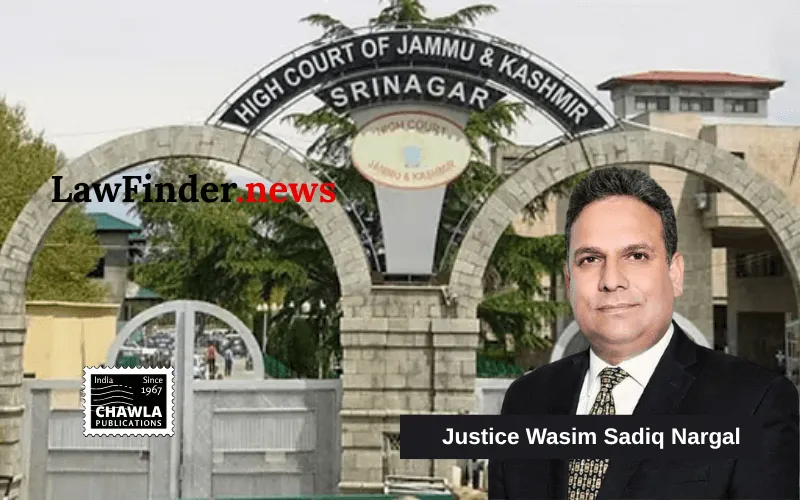
Justice Wasim Sadiq Nargal holds that District Bar Association Shopian is not "State" under Article 12 and its internal electoral disputes lack the public-law element required to invoke Article 226
SRINAGAR, August 29, 2026 — The Jammu & Kashmir and Ladakh High Court has dismissed a writ petition filed by Advocate Abdul Basit Bhat challenging amendments to the Constitution of the District Bar Association, Shopian, holding that Bar Associations are voluntary private bodies not amenable to writ jurisdiction under Article 226 of the Constitution of India for disputes concerning their internal governance and elections.
Justice Wasim Sadiq Nargal, delivering the judgment in WP(C) 3245/2025, ruled that the District Bar Association, Shopian is neither "State" nor an instrumentality of the State within the meaning of Article 12 of the Constitution, and that the impugned action — an amendment to the Association's eligibility criteria for office-bearers — lacked the requisite public-law element necessary for judicial review under Article 226.
The Dispute
Advocate Bhat, enrolled with the Bar Council of Jammu & Kashmir and Ladakh since 2012 and a member of the District Bar Association, Shopian, had challenged amendments made in 2023 to the Association's Constitution. The amendments enhanced the eligibility criteria for contesting the post of President and Vice-President from ten years to fifteen years of standing at the Bar, and for the post of Secretary from seven years to ten years. Bhat, who had previously contested the presidential election in 2022, argued that the amendments were introduced without following any prescribed procedure, without convening a valid General Body Meeting, and were designed to exclude younger advocates like himself from the democratic process.
The petitioner also challenged Election Notification No. 01 dated December 11, 2025, issued under the amended Constitution, contending that the enhancement was arbitrary, lacked rational nexus with the office functions, and violated Article 14 of the Constitution. He argued that since the Association performs functions of public character — including representation of public opinion and legal aid to the poor — it should be amenable to writ jurisdiction.
Respondents' Defence
The respondents, represented by Advocate Mohammad Mubashir Gatoo, raised a preliminary objection on maintainability. They contended that the Association is a voluntary body governed by its own Constitution and Bye-laws, not a statutory body, and that its internal affairs are not subject to writ jurisdiction. They further argued that a General Body Meeting was duly convened in 2023 after notice was circulated through the Association's official WhatsApp group, and the amendment was approved by majority resolution. The respondents also submitted that the petitioner had acquiesced to the amended Constitution for a substantial period and raised objections only when the eligibility criteria rendered him ineligible to contest.
Court's Reasoning
Justice Nargal undertook an extensive legal analysis, tracing the jurisprudential evolution of the definition of "State" under Article 12 through landmark Supreme Court decisions including Rajasthan State Electricity Board v. Mohan Lal (1967), Ajay Hasia v. Khalid Mujib Sehravardi (1981), and Pradeep Kumar Biswas v. Indian Institute of Chemical Biology (2002).
The Court found that the Association owes neither its origin nor existence to any statute, is not created under the Advocates Act, 1961, does not exercise statutory powers, and does not discharge governmental functions. The Court further held that even under the broader scope of Article 226 — which extends to "any person or authority" performing a public duty — the impugned action did not qualify as a public function.
The judgment relied on several recent precedents, including the Delhi High Court's decision in Sangita Rai v. New Delhi Bar Association (upheld by the Supreme Court in SLP dismissal), the Bombay High Court's ruling in Abhijeet Appasaheb Bachhe Patil v. Bar Council of Maharashtra and Goa (2025), the Calcutta High Court's decision in Secretary, Alipore Bar Association v. Subir Sengupta (2024), and the Kerala High Court's ruling in Adv. Sangeetha Lakshmana v. Registrar General (2026) — all of which consistently held that Bar Association elections and internal affairs are not amenable to writ jurisdiction.
The Court also invoked the doctrine of acquiescence and the principle against approbation and reprobation, citing Union of India v. N. Murugesan (2022) and Rajasthan State Industrial Development & Investment Corpn. v. Diamond & Gem Development Corpn. Ltd. (2013), observing that the petitioner allowed the amended Constitution to operate for a substantial period without challenge and approached the Court only when it became personally inconvenient.
Justice Nargal further noted that the petition raised seriously disputed questions of fact regarding the convening of meetings, issuance of notices, and adoption of resolutions, which cannot be adjudicated in writ proceedings.
The petition was dismissed as not maintainable, with the Court noting that the petitioner's remedy, if any, lies before the competent Civil Court.
Bottom Line:
A Bar Association, being a voluntary association of advocates governed by its own Constitution and Bye-laws, is not a "State" under Article 12 of the Constitution of India and is not amenable to writ jurisdiction under Article 226 for matters pertaining to its internal governance and electoral processes.
Statutory Provision(s): Article 12 of the Constitution of India, Article 14 of the Constitution of India, Article 32 of the Constitution of India, Article 226 of the Constitution of India, Article 13(2) of the Constitution of India, Advocates Act, 1961, Societies Registration Act, 1860