Court holds that timely objection to Government Analyst’s report under Section 25 of the Drugs and Cosmetics Act displaced its conclusiveness; delay allowed drug’s shelf life to expire, defeating accused’s defence.
The Jammu and Kashmir and Ladakh High Court has quashed criminal proceedings against Maxmed Life Sciences Pvt. Ltd. and its directors in a drug quality case, holding that the prosecution failed to preserve the petitioners’ statutory right to challenge the Government Analyst’s report through re-analysis by the Central Drugs Laboratory.
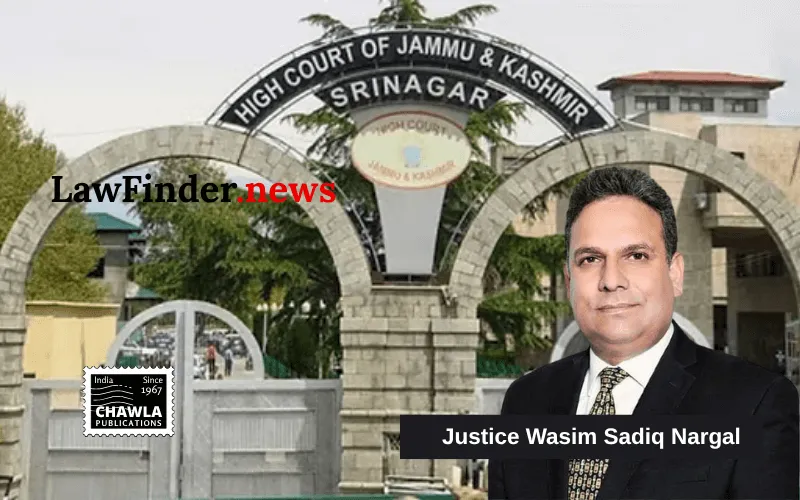
Justice Wasim Sadiq Nargal ruled that once the manufacturer, within the prescribed 28-day period, notified its intention to controvert the Government Analyst’s report, the report ceased to be conclusive evidence under Section 25(3) of the Drugs and Cosmetics Act, 1940. The Court said the statutory mechanism under Section 25(4) then had to be followed, and the accused could not be denied that safeguard merely because their reply referred to testing by an NABL-accredited laboratory instead of expressly naming the Central Drugs Laboratory.
The case arose from a sample of the drug “Amzone,” batch MLI-386, lifted on January 16, 2014 from M/s Chest and Disease Hospital, Jammu. The Government Analyst later reported on February 11, 2014 that the sample was “Not of Standard Quality” as it failed the test for particulate matter. The petitioners were thereafter issued notice and promptly disputed the report, stating that they intended to adduce evidence in controversion and requested re-analysis.
The petitioners argued that they had exercised their right under Section 25(3) in time, and that the Drug Inspector ought to have initiated the statutory process for sending the sample to the Central Drugs Laboratory under Section 25(4). They contended that the sample was never so sent, and by the time summons were received in November 2016, the drug’s shelf life had already expired in November 2015, making any meaningful re-analysis impossible.
The State, however, maintained that the petitioners had asked for testing by an NABL-accredited laboratory, which is not the laboratory contemplated under the Act, and therefore they had not properly invoked their right to re-test the sample.
Rejecting that contention, the High Court held that the substance of the petitioners’ communication was a clear challenge to the Government Analyst’s report and a request for independent re-analysis. The Court relied on Supreme Court precedents, including Northern Mineral Ltd. v. Union of India and M/s Medicamen Biotech Ltd. v. Rubina Bose, to emphasize that a mere notification of intention to controvert the report is enough to trigger the statutory safeguard; no specific demand for the Central Drugs Laboratory is required.
The Court also interpreted the word “may” in Section 25(4) as mandatory in context, observing that a discretionary reading would make the accused’s statutory protection illusory. It noted that the right to re-analysis is a valuable one, especially where delay causes the sample to expire before the accused can effectively seek judicial recourse.
Finding that the petitioners had been deprived of their statutory remedy due to the authorities’ failure to act in time, the Court held that continuing the prosecution would cause manifest prejudice and amount to abuse of process. Accordingly, the complaint and all consequential proceedings against the petitioners were quashed.
Bottom Line :
Drugs and Cosmetics Act, 1940 - Once the accused/manufacturer, within 28 days, notifies intention to controvert the Government Analyst's report, the report loses its conclusive character and the statutory mechanism for re-analysis under Section 25(4) must be followed - Mere reference in the reply to testing by an NABL-accredited laboratory does not amount to waiver of the statutory right to re-analysis through the Central Drugs Laboratory - If, before such statutory safeguard is availed, the shelf life of the drug expires and summons are received thereafter, continuation of prosecution causes prejudice and proceedings are liable to be quashed.
Statutory provision(s): Section 18(a)(i), Section 25(3), Section 25(4), Section 27(d) of the Drugs and Cosmetics Act, 1940, Section 561A of the Code of Criminal Procedure, 1898 (corresponding to Section 528 of BNSS)