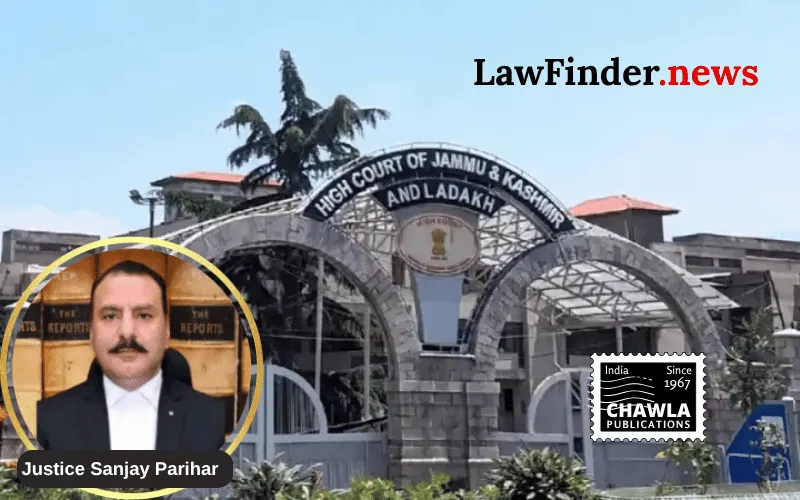
Court Rules Denial of Date of Birth Correction Violates Fundamental Rights and Ministry's Circular; Orders Issuance of Fresh Passport for Medical Student
In a significant judgment dated September 2, 2026, the Jammu & Kashmir and Ladakh High Court (Srinagar Bench), presided over by Justice Sanjay Parihar, ordered the Union of India and the Passport Authority to issue a fresh passport to Mohammad Fazli Illahi with his correct date of birth. The Court held that the petitioner, who was a minor when the initial passport was issued with an incorrect date of birth, is entitled to correction under the Ministry of External Affairs' Circular No. VI/401/2/5/2001 dated November 26, 2015. The denial of correction was held arbitrary, unreasonable, and violative of Articles 14 and 21 of the Constitution of India.
The petitioner's grievance arose from an inadvertent clerical error in school records, which recorded his birth date as July 12, 2004, instead of the correct date, May 25, 2008. This error was perpetuated in his first passport issued in 2012, when he was only four years old. The petitioner discovered the mistake in 2018 and successfully had his birth date corrected in school records and other official documents, including a new Birth Certificate issued in January 2026 by the competent authority.
Despite submitting all valid documents reflecting the correct date of birth, the Passport Authority issued a fresh passport in November 2024 retaining the incorrect date. Subsequent representations requesting correction were ignored. The petitioner, having qualified for NEET 2025 and secured admission to the International Higher School of Medicine, Bishkek, faced the risk of losing his medical seat abroad due to the passport discrepancy.
The Court meticulously examined the relevant provisions of the Passports Act, 1967, and the Ministry's Circular dated November 26, 2015. The Circular explicitly exempts minors from the usual five-year restriction on date-of-birth corrections in passports, allowing such corrections after attaining majority, if supported by valid documents. The Court found that the Passport Officer failed to apply this exemption and neglected to consider the corrected official records, thereby acting arbitrarily and violating the petitioner's fundamental rights to free movement and education.
Citing the landmark Supreme Court decision in Maneka Gandhi v. Union of India (1978) 1 SCC 248, which underscored the importance of the right to free movement, the Court emphasized that denying a corrected passport adversely impacts the petitioner's constitutional rights. It further noted that the respondents' reliance on an earlier, now-cancelled Birth Certificate was legally unsustainable.
Consequently, the Court issued a writ of mandamus directing the respondents to reconsider the petitioner's application and issue a fresh passport reflecting the correct date of birth within two weeks. The judgment reinforces the principle that administrative authorities must exercise due diligence and fairness, especially when dealing with minors and fundamental rights.
This judgment is expected to provide relief to many similarly placed minors facing passport and identity document discrepancies and underscores the binding nature of government circulars and the principles of natural justice.
Bottom Line:
Passport Authority must allow correction of the date of birth in passports for applicants who were minors at the time of issuance of the earlier passport, as per the guidelines of Circular No. VI/401/2/5/2001 dated 26.11.2015.
Statutory provision(s):
Passports Act, 1967, Constitution of India Articles 14, 21, Circular No. VI/401/2/5/2001 dated 26.11.2015
Mohammad Fazli Illahi v. Union of India, (J&K and Ladakh)(Srinagar) : Law Finder Doc Id # 2975230