Court Upholds Trial and Revisional Courts' Orders, Emphasizing Limits on Second Revision and Timely Filing under Bharatiya Nagarik Suraksha Sanhita, 2023
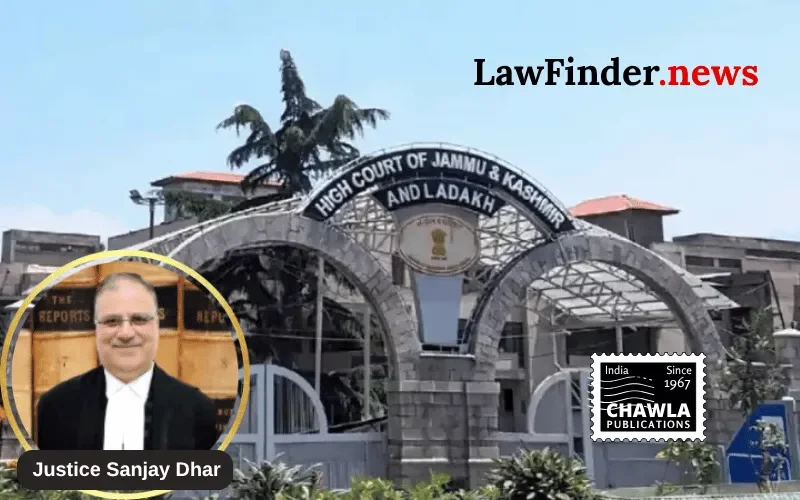
In a significant judgment dated October 22, 2026, the Jammu and Kashmir and Ladakh High Court, presided over by Justice Sanjay Dhar, dismissed a petition filed by Bansi Lal Bhardwaj seeking to quash orders restricting the number of defence witnesses in a criminal complaint under Section 138 of the Negotiable Instruments Act, 1881.
The case arose from a complaint filed by S. Gagandeep Singh against Bhardwaj concerning dishonour of a cheque amounting to Rs. 10,00,000 drawn on Jammu Rural Bank. The petitioner accused sought to summon 19 defence witnesses to prove his assertion that the complainant was involved in property transactions with his friends and relatives, aimed at evidencing the defence that no debt was owed.
However, the trial Magistrate limited the defence witness list to three essential witnesses, citing the risk of protracting proceedings. The petitioner challenged this restriction through a revision petition before the Sessions Court, which upheld the trial court's order. Subsequently, Bhardwaj filed a petition under Section 528 of the Bharatiya Nagarik Suraksha Sanhita (BNSS), 2023, effectively a second revision petition disguised as an inherent powers petition, to challenge both the trial and revisional court orders.
Justice Dhar held that the petition was not maintainable as a second revision is barred under Section 438(3) BNSS. The Court underscored that inherent powers under Section 528 BNSS cannot be used to circumvent statutory bars on second revisions. Furthermore, the petition was dismissed for delay and laches, as it was filed approximately eleven months after the revisional court's order without any plausible explanation for the delay. The Court observed that while no fixed limitation period exists for Section 528 petitions, a reasonable time analogous to the 90-day period for revisions must be adhered to.
On merits, the Court affirmed that an accused in a Section 138 case is only required to probabilise his defence rather than prove it beyond reasonable doubt. The petitioner could establish the defence by producing original or certified copies of sale deeds instead of examining all listed witnesses. The Court found no prejudice caused by restricting the witness list to essential witnesses, thus upholding the orders of the lower courts.
This judgment clarifies procedural limits on second revisions and reinforces judicial discretion in managing witness lists in cheque bounce trials, providing guidance on balancing fair trial rights with judicial efficiency under the BNSS framework.
Bottom Line:
Bharatiya Nagarik Suraksha Sanhita, 2023 - Petition under Section 528 BNSS cannot be used as a substitute for a second revision after dismissal of revision by Sessions Court - Such petition is also liable to be rejected on ground of delay and laches if filed beyond reasonable time without explanation - In complaint under Section 138 of Negotiable Instruments Act, trial Court can restrict defence witnesses to only essential witnesses, as accused is only required to probabilise his defence.
Statutory provision(s):
Bharatiya Nagarik Suraksha Sanhita, 2023 Sections 438(3), 528; Negotiable Instruments Act, 1881 Section 138
Bansi Lal Bhardwaj v. S. Gagandeep Singh, (J&K and Ladakh) : Law Finder Doc Id # 3004101