Court holds that mere receipt of communication or involvement of local BSF authorities does not confer jurisdiction when cause of action arises outside territorial limits
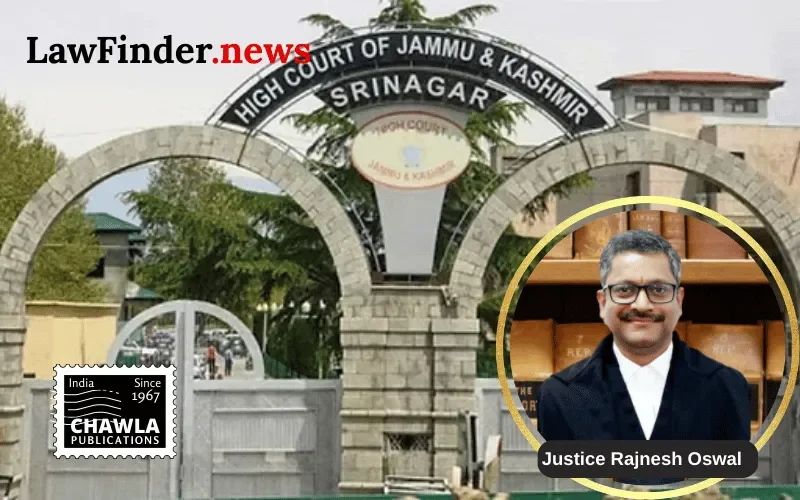
In a recent judgment dated September 30, 2026, the Jammu & Kashmir and Ladakh High Court, Srinagar Bench, presided over by Justice Mr. Rajnesh Oswal, dismissed a writ petition filed by Khursheed Ahmad Khan challenging the acceptance of his voluntary retirement from the Border Security Force (BSF). The petition was dismissed on the ground that the High Court lacked territorial jurisdiction to entertain the matter.
The petitioner, Khursheed Ahmad Khan, had applied for voluntary retirement from the BSF on June 16, 2023, the very day his permission to maintain a neatly trimmed beard was revoked by the Commandant of 50 BN BSF, Praharinagar, Tura (Meghalaya). The petitioner contended that this revocation was vindictive and that he was compelled to seek retirement. He further claimed that his request to withdraw the voluntary retirement was rejected, and his pension was fixed without his consent.
The respondents, representing the Union of India and BSF authorities, countered by stating that the petitioner's voluntary retirement was accepted by the competent authority at Tura, Meghalaya, outside the territorial jurisdiction of the Jammu & Kashmir High Court. They submitted that the petitioner had a record of misconduct and medical issues, and the retirement was accepted after due procedure and with the petitioner's explicit consent.
The Court examined the issue of territorial jurisdiction under Article 226 of the Constitution of India. It was noted that both the application for voluntary retirement and the impugned acceptance order were executed outside the territorial limits of the Jammu & Kashmir and Ladakh High Court. The Court emphasized that the mere inclusion of the Inspector General BSF Kashmir as a party or the receipt of communication within Jammu & Kashmir does not establish jurisdiction if the cause of action did not arise wholly or partly within the local limits of the Court.
Citing precedents including Rajesh Kumar Tomar v. Union of India and Zahoor Ahmad Baba v. Union of India, the Court reiterated that for a High Court to exercise jurisdiction under Article 226, the cause of action must arise, even in part, within its territorial jurisdiction and that such cause of action must be material and integral to the dispute. The Court also rejected the petitioner's contention that the Director General BSF in New Delhi is amenable to the jurisdiction of any High Court in India.
Accordingly, the Court concluded that no material cause of action accrued within the territorial jurisdiction of the Jammu & Kashmir High Court. Therefore, it dismissed the petition, leaving the petitioner free to approach the jurisdictional High Court in Meghalaya for relief.
This judgment underscores the significance of territorial jurisdiction in administrative and service matters, particularly those involving central armed forces, and highlights the limitations of High Courts in entertaining writ petitions when the cause of action arises outside their territorial limits.
Bottom Line:
Territorial jurisdiction under Article 226 - Mere impleadment of local BSF authority or receipt of communication within Jammu & Kashmir does not confer jurisdiction when the impugned order accepting voluntary retirement was passed outside the territorial jurisdiction and no material part of cause of action arose within the jurisdiction of the Court.
Statutory provision(s): Constitution of India 1950 Article 226