Legal Maxims and Absence of Final Investigation Halt Corruption Proceedings Against Deceased Public Servant
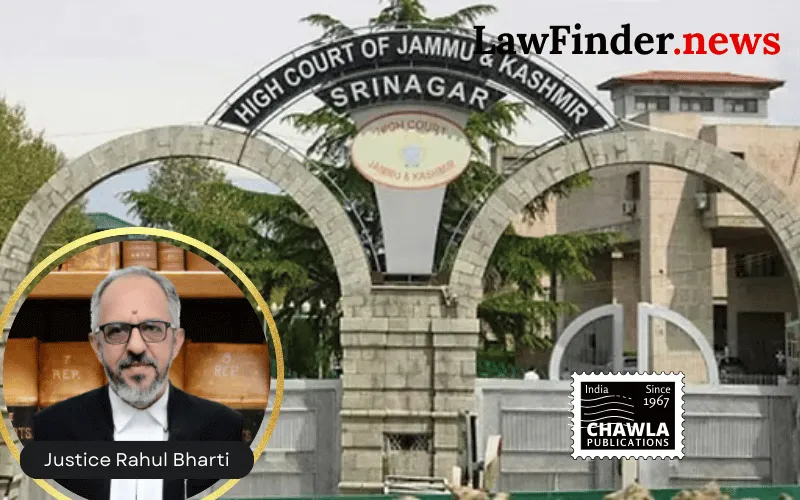
In a significant ruling, the Jammu & Kashmir and Ladakh High Court has quashed FIR No. 01/2020 and related property attachment proceedings against the late Rakesh Kumar Pargal, a former government servant, following his death. The judgment, delivered by Justice Rahul Bharti, underscores the legal principle that criminal liability extinguishes with the death of the accused, leaving no grounds for penal actions against the deceased's heirs.
Rakesh Kumar Pargal, who served as a Junior Assistant in the Food, Civil Supplies & Consumer Affairs Department, was under investigation by the Anti-Corruption Bureau (ACB) for allegedly amassing disproportionate assets. The preliminary inquiry, initiated in 2015, led to the registration of an FIR in 2020 after allegations surfaced that Pargal had acquired significant properties and assets beyond his known sources of income.
The court's decision came in response to writ petitions filed by Dheeraj Pargal, the son of the deceased, and other parties affected by the property attachments. The petitions challenged the legitimacy of the prolonged investigation and the subsequent attachment orders under the Jammu & Kashmir Prevention of Corruption Act, Svt. 2006.
Justice Bharti emphasized that proceedings under sections 8-B to 8-E of the Act are inherently dependent on the continuation of criminal investigations and their outcomes. With no final police report or trial initiated against Rakesh Kumar Pargal before his death, the court noted that the entire legal exercise must cease.
The judgment also drew upon legal maxims such as "crimina morte extinguuntur" (crimes are extinguished by death) and "poena ex delicto defuncti, haeres teneri non debet" (heirs should not be penalized for the wrongs of the deceased), reinforcing that penal actions do not pass to heirs.
The court ordered the restoration of all attached properties to their original owners, including Dheeraj Pargal and other petitioners, quashing the attachment orders as infructuous. This decision marks an end to the long-standing legal battle over the properties once linked to alleged corruption charges against the deceased public servant.
Bottom line:-
Proceedings under sections 8-B to 8-E of the Jammu & Kashmir Prevention of Corruption Act, Svt. 2006, are dependent on the continuation of criminal investigations and trial. The death of the accused extinguishes these proceedings, and attached properties must be restored to their rightful owners.
Statutory provision(s): Sections 8-B to 8-E of the Jammu & Kashmir Prevention of Corruption Act, Svt. 2006, Section 5 of the Jammu & Kashmir Prevention of Corruption Act, Svt. 2006.
Dheeraj Pargal v. UT of J&K, (J&K and Ladakh) : Law Finder Doc id # 2944483