Court rules that postponement of certified copies until confirmation of finding and sentence does not violate Article 21; right to inspection during trial deemed sufficient for fair trial under the special statutory regime of Border Security Force
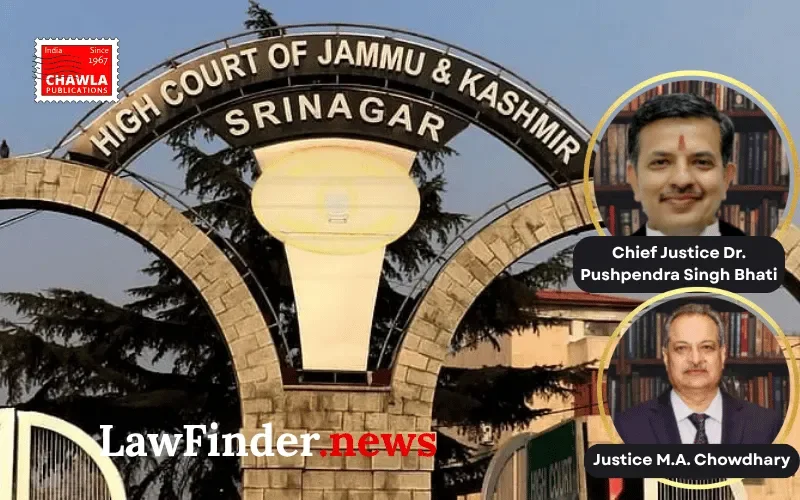
In a significant judgment dated October 22, 2026, the Jammu & Kashmir and Ladakh High Court (Division Bench, Srinagar) upheld the constitutional validity of Rule 129 of the Border Security Force (BSF) Rules, 1969. The appeal was filed by the Union of India challenging a Single Judge's order which had struck down Rule 129 as unconstitutional for violating the fundamental right to a fair trial under Article 21 of the Constitution of India.
The case originated from criminal proceedings against Rovinder Singh, a BSF personnel accused of shooting a colleague within the BSF campus at Bandipora in 2017. The trial was conducted before a General Security Force Court (GSFC) under the BSF Act, 1968. During the trial, the accused requested certified copies of the proceedings and statements of prosecution witnesses. The request was refused on the basis of Rule 129, which postpones the supply of such copies until after confirmation of the finding and sentence by the competent authority.
The Single Judge had held that denial of certified copies before confirmation impaired the accused's ability to prepare his defense, thereby violating Article 21. However, the Division Bench overturned this ruling. The court emphasized that the BSF Act and Rules constitute a special statutory scheme designed for the disciplined armed force, integrating trial, evidence, confirmation, and review processes uniquely applicable to BSF personnel.
Section 87 of the BSF Act provides that the Indian Evidence Act applies to Security Force Court proceedings "subject to the provisions of this Act." The court interpreted this to mean that special procedural rules like Rule 129 that regulate the timing for supply of copies are valid and prevail over general provisions. The court highlighted Rule 120, which grants the accused the right to inspect the proceedings at all reasonable times before the court closes for considering the finding, ensuring meaningful access to evidence during the trial.
Relying on the Supreme Court precedent in Union of India v. Ex. Flt. Lt. G.S. Bajwa (2003), the High Court held that the right to inspection, coupled with representation, participation, and cross-examination rights, satisfies constitutional fairness requirements. The court rejected the argument that possession of certified copies at every stage is an absolute constitutional right.
Further, the court discussed the special constitutional status of BSF personnel under Article 33 of the Constitution, which empowers Parliament to restrict or abrogate fundamental rights of armed forces members to ensure discipline and proper discharge of duties. The statutory scheme, including the confirmation mechanism under Sections 107 and 108 of the BSF Act, was found to have a rational nexus with maintaining discipline in the Force.
The judgment clarified that Rule 129 does not deny access to proceedings or the right to a defense but only regulates the timing of providing certified copies until the findings and sentence are confirmed. The court also noted the availability of review and appeal mechanisms under the Act and emphasized that non-supply of copies during the trial does not equate to deprivation of a fair trial.
Consequently, the appeal was allowed, the Single Judge's order set aside, and Rule 129 was upheld as constitutionally valid. The court directed that the trial and related proceedings continue in accordance with the BSF Act and Rules. The judgment explicitly refrained from commenting on the merits of the underlying criminal case.
This ruling affirms the constitutional legitimacy of specialized procedural rules applicable to armed forces trials and underscores the balance between individual rights and the unique requirements of discipline and security within the BSF.
Bottom Line:
Border Security Force Act and Rules - Rule 129 of the Border Security Force Rules, 1969, postponing supply of copies of Security Force Court proceedings till confirmation of finding and sentence, is constitutionally valid - Right of inspection under Rule 120, along with other statutory safeguards, satisfies requirements of fair trial under Article 21 - Non-supply of certified copies during pendency of trial does not by itself violate Article 21.
Statutory provision(s):
Border Security Force Act, 1968 Sections 4, 64, 68, 71, 87, 107, 108, 117, 118; Border Security Force Rules, 1969 Rules 119, 120, 121, 122, 128, 129, 130; Constitution of India Articles 21, 33
Union of India v. Rovinder Singh, (J&K)(DB)(Srinagar) : Law Finder Doc Id # 3001700