Court emphasizes the need for satisfactory explanation for delay in legal challenges; rules that minority and residence outside Valley do not justify decades-long inaction in mutation dispute
In a significant judgment delivered on September 28, 2026, the Jammu & Kashmir and Ladakh High Court upheld the decision of the Financial Commissioner (Revenue), J&K, rejecting a writ petition filed by Mrs. Kareena Jamwal (also known as Zulikha Hussain). The petitioner had challenged mutation No. 488 dated December 7, 1970, which pertained to the estate of her deceased father, alleging that the mutation was attested without her knowledge or consent, thereby excluding her from her rightful share.
The petitioner argued that she was a minor at the time of attestation and resided outside the Valley for a considerable time, only coming to know of the mutation in 2022. She sought condonation of delay for challenging the mutation after more than five decades, asserting that the prevailing law and order situation in the Valley, her minority, and absence of notice constituted sufficient cause for the delay.
However, the Financial Commissioner, whose order was challenged in the High Court, had set aside earlier orders of the Sub-Divisional Magistrate and Additional Commissioner that had condoned the delay, finding that the explanation for the prolonged silence was unsatisfactory. The revisional authority highlighted that while minority and residence outside the Valley could explain only limited periods, they failed to justify the decades of inaction, especially after the petitioner attained majority and when the situation in the Valley had improved.
Moreover, the Court took note of the fact that the mutation had remained operative for over 50 years, during which third-party interests had allegedly been created, including a 2003 transaction involving the property. Reopening such a long-standing mutation could unsettle settled rights and create further litigation.
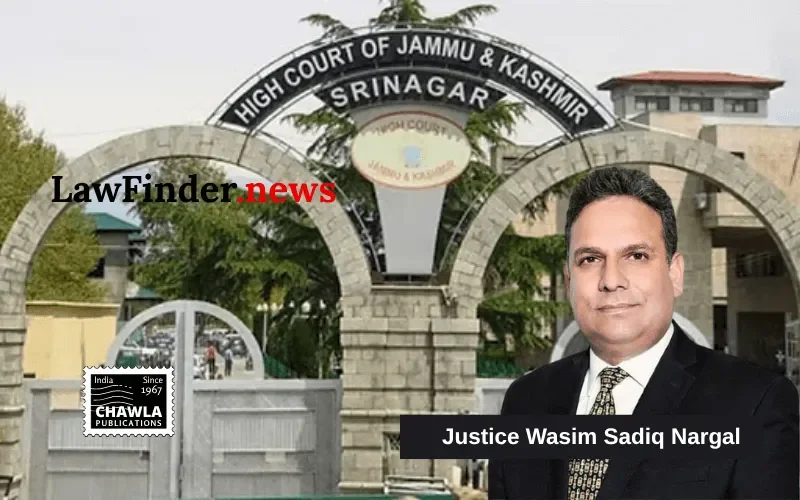
The High Court, presided over by Justice Wasim Sadiq Nargal, reiterated established principles from Supreme Court precedents emphasizing that the law of limitation is a statutory prescription designed to ensure finality and certainty in legal proceedings. While the expression "sufficient cause" for condonation of delay is to be liberally construed, this cannot extend to condoning inordinate and unexplained delay as a matter of course. The Court underscored the distinction between genuine explanations and mere excuses for delay.
Referencing the Supreme Court's ruling in Sheo Raj Singh v. Union of India (AIR 2023 SC 5109), the judgment explained that courts must critically examine the sufficiency and acceptability of the cause shown for delay. Mere excuses do not merit condonation, especially when the delay spans several decades.
Accordingly, the High Court found no merit in the petitioner's challenge, affirmed the reasoned and speaking order of the Financial Commissioner, and dismissed the writ petition. The Court's decision reinforces the importance of timely assertion of rights and cautions against reopening settled mutations without satisfactory explanations for delay, particularly when third-party interests have intervened.
Bottom Line:
Limitation - Challenge to mutation after more than five decades - Condonation of delay cannot be granted in absence of satisfactory explanation covering entire period of delay - Minority at time of mutation, residence outside Valley and disturbed conditions may explain only limited period and not prolonged inaction for decades - Financial Commissioner justified in setting aside orders condoning delay and upholding long-standing mutation.
Statutory provision(s):
Article 226 of the Constitution of India, Hindu Succession Act, Limitation Act.