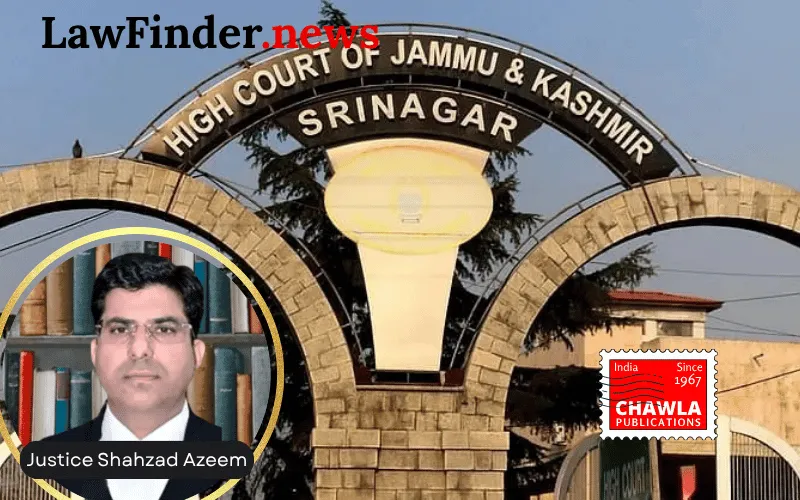
Court rules that employees have no vested right to demand promotion or compel cadre expansion, reinforcing the government's administrative autonomy.
In a significant ruling, the Jammu & Kashmir and Ladakh High Court has dismissed a writ petition by Mohammad Yaseen Khan, reinforcing that government employees do not possess an inherent right to demand promotions or compel structural changes such as cadre expansion. The judgment, delivered by Justice Shahzad Azeem, emphasizes the discretionary powers of the government in determining cadre strength and administering promotions based on existing vacancies, eligibility, and administrative policy.
Mohammad Yaseen Khan, a retired driver from the state's transport department, sought a writ of mandamus to compel the government to promote him to the next higher post of Chauffeur, arguing that the existing cadre rules, particularly the note appended to Rule 1 of SRO 28 of 1996, were arbitrary and unconstitutional. He contended that upon completing five years of service, he should be automatically eligible for promotion, irrespective of the availability of posts.
The court, however, found that Khan had already been granted three financial upgradations during his service through in-situ promotions, which enhanced his pay scale. The court noted that Khan failed to demonstrate any financial loss resulting from the lack of functional promotion, particularly since he had retired on March 31, 2025. Furthermore, it was highlighted that promotion is not an automatic entitlement but is contingent upon various factors, including vacancy and eligibility criteria.
The judgment also cited the Supreme Court's rulings in State of Odisha v. Sreepati Ranjan Dash and Union of India v. Ilmo Devi, affirming that employees cannot compel the government to create posts or restructure cadres to facilitate promotions. The court maintained that such matters fall within the executive domain and are not subject to judicial mandates unless there is a clear violation of constitutional provisions like Articles 14 and 16.
Justice Azeem reiterated that the only right available to employees is the right to be considered for promotion, not the right to be promoted. The court found no evidence of discrimination or arbitrary application of the cadre rules that would warrant judicial intervention. The note to Rule 1 of SRO 28 was deemed constitutionally valid, with the availability of posts being a legitimate condition for promotion.
In conclusion, the court dismissed the petition, underscoring the principle that administrative discretion in cadre management and promotions remains within the government's purview unless constitutional violations are evident. This ruling reaffirms the boundaries of judicial intervention in administrative and policy matters concerning government employment.
Bottom line:-
Government employees do not have a vested right to demand promotion or compel structural changes like cadre expansion. The right is limited to being considered for promotion, as per Articles 14 and 16 of the Constitution.
Statutory provision(s): Articles 14 and 16 of the Constitution, Rule 1 of SRO 28 of 1996, SRO 14 of 1996