Court affirms detention order citing repeated criminal antecedents affecting public order; emphasizes strict compliance with constitutional safeguards and effective communication of grounds
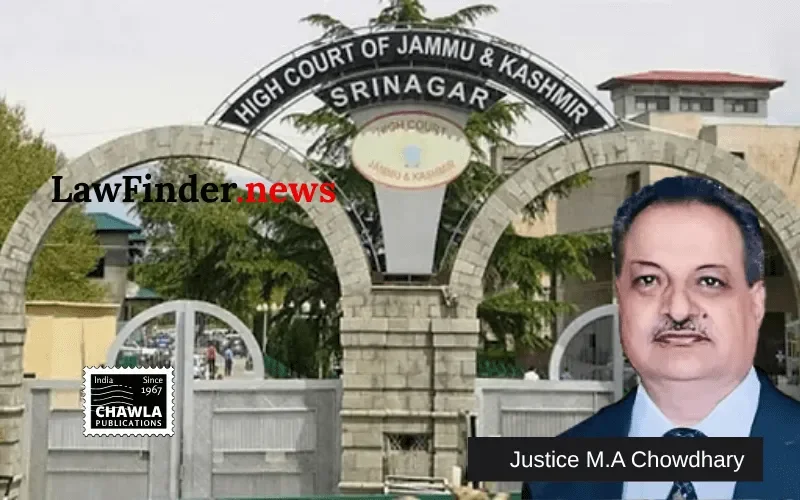
In a significant judgment dated September 25, 2026, the Jammu & Kashmir and Ladakh High Court, Srinagar Bench, presided over by Justice M.A. Chowdhary, upheld the preventive detention of Tariq Ahmad Dar under Section 8 of the Jammu and Kashmir Public Safety Act, 1978. The detention order, issued on December 13, 2025, by the District Magistrate of Kulgam, was challenged by the petitioner on multiple grounds including alleged violation of constitutional safeguards and ineffective communication of detention grounds.
The petitioner, Tariq Ahmad Dar, was detained with the stated objective of preventing him from engaging in activities prejudicial to public order. The detaining authority cited his involvement in eleven FIRs related to theft of livestock and cattle, noting that despite bail granted in several cases, the petitioner's conduct reflected a continuous pattern of behavior that disturbed the "even tempo of public life." The petitioner's counsel argued that his acts were at best violations of ordinary law and order, and that he had been deprived of an effective opportunity to represent his case since the detention grounds were in English, a language he purportedly did not understand.
Justice Chowdhary, after thorough examination of the material, reiterated that preventive detention is an exceptional measure requiring strict adherence to constitutional provisions, particularly Article 22(5) of the Constitution of India and Section 13 of the Public Safety Act. The Court acknowledged the petitioner's contention regarding language but observed that the records and counter affidavits demonstrated that the detention grounds were effectively communicated to the petitioner in a language he understood, and he was informed of his right to make a representation. The Court noted that mere physical service of grounds in English does not suffice unless the detenue has actual knowledge and understanding, a standard met in this case.
Importantly, the Court distinguished between "law and order" and "public order," highlighting that the petitioner's repeated involvement in similar offences transcended ordinary criminal law and posed a threat to public order. The Court emphasized that preventive detention is preventive and precautionary, not punitive, and that it operates independently of ongoing criminal proceedings. The existence of bail in criminal cases did not negate the validity of the detention order, as the detaining authority had consciously considered the petitioner's release status and apprehended the recurrence of offenses.
Rejecting the petitioner's plea, the Court held that the subjective satisfaction of the detaining authority was based on relevant and sufficient material, including multiple FIRs and continuing tendencies. The judgment clarified that the Court's role in preventive detention matters is limited to ensuring compliance with procedural safeguards and not to assess the merits of the underlying criminal allegations.
Consequently, the High Court dismissed the habeas corpus petition and upheld the detention order, affirming the legality of preventive detention in this case as a necessary measure to maintain public order.
Bottom Line:
Preventive detention is an exceptional measure and must strictly comply with the constitutional and statutory safeguards. The distinction between 'law and order' and 'public order' is determined by the nature, frequency, and impact of activities on public life, and the Court's review is limited to examining the subjective satisfaction of the detaining authority based on relevant material.
Statutory provision(s): Jammu and Kashmir Public Safety Act, 1978 Section 8, Section 13; Constitution of India, 1950 Article 22(5)