Court holds that Family Court must verify foundational facts and voluntariness of consent before granting divorce by mutual consent under Section 13-B of Hindu Marriage Act, 1955; appeal against such decree is maintainable where statutory requirements are disputed.
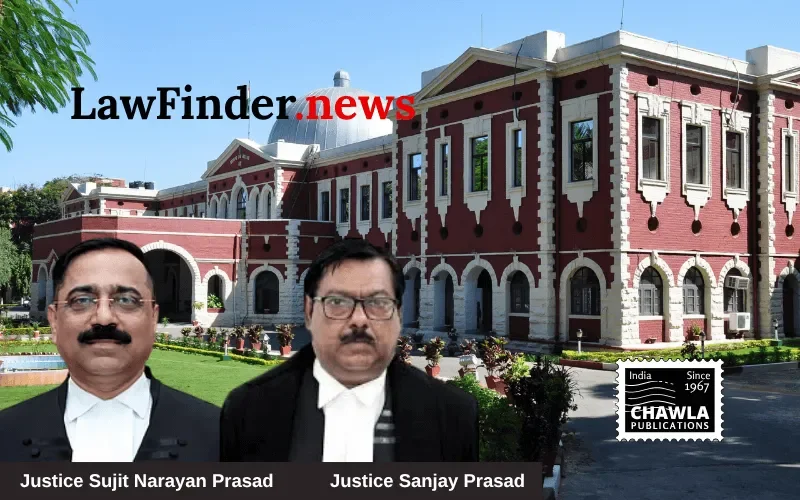
In a significant judgment dated October 13, 2026, the Jharkhand High Court (Division Bench comprising Justices Sujit Narayan Prasad and Sanjay Prasad) set aside a decree of divorce by mutual consent passed by the Family Court, Ranchi, in Original Suit No. 457 of 2024, involving the parties Champa Kumari (appellant-wife) and Vishant Sagar (respondent-husband).
The case pertained to a divorce decree granted under Section 13-B of the Hindu Marriage Act, 1955, whereby the Family Court allowed a joint petition for divorce on mutual consent, dissolving the marriage solemnized on April 21, 2023. However, the appellant challenged the decree on the grounds that the actual date of marriage was April 21, 2024, and that the decree had been obtained without fulfilling the mandatory statutory requirement of living separately for one year before filing the petition. Further, the appellant alleged coercion in obtaining her consent, including signing documents under duress while hospitalized and forced miscarriage following physical assault by the respondent and his family.
The Court thoroughly analyzed the facts and legal provisions, emphasizing that under Section 13-B of the Hindu Marriage Act, parties must have been living separately for at least one year before filing a petition for divorce by mutual consent. The Court noted that the Family Court had recorded the marriage date as April 21, 2023, but the appellant claimed it was April 21, 2024, which if true, meant the petition filed on June 12, 2024, was premature and non-compliant with statutory requirements.
The Court further stressed the Family Court's statutory duty to verify the foundational facts like the date of marriage and ensure that the consent for divorce was free, voluntary, and subsisting at the time of the decree. Mere filing of a joint petition or a recorded settlement before a Mediation Centre could not replace the judicial scrutiny required under Sections 13-B(1) and 23(1)(bb) of the Hindu Marriage Act.
Additionally, the Court clarified the maintainability of an appeal under Section 19(1) of the Family Courts Act, 1984 against a decree of divorce by mutual consent, especially where the foundational facts or voluntariness of consent are disputed. It rejected the contention that the bar under Section 19(2) applies in such cases, holding that appeals are permissible when there is an error apparent on the face of the record or where the consent decree was passed without proper inquiry.
Given the appellant's serious allegations of coercion, fraud, and the disputed date of marriage, the Court found that the Family Court had mechanically passed the decree without adequate inquiry. Consequently, it quashed and set aside the divorce decree and remitted the matter to the Family Court for a fresh inquiry into the actual date of marriage, voluntariness of consent, and genuineness of the financial settlement, directing the parties to appear and lead evidence.
The Court also restored the parties to their legal position before the impugned decree and observed that the Family Court's failure to verify basic statutory facts was a grave error causing prejudice to the appellant.
This judgment reinforces the principle that divorce by mutual consent under the Hindu Marriage Act must strictly comply with statutory safeguards, and courts must exercise due diligence before dissolving a marriage. It also underscores that consent decrees can be challenged on grounds of coercion or procedural irregularity, and the appellate courts have jurisdiction to entertain such appeals.
Bottom Line:
Hindu Marriage Act, 1955 - Divorce by mutual consent - Appeal against consent decree is maintainable where foundational facts and voluntariness of consent are in dispute - Family Court must verify actual date of marriage, statutory requirement of one year separation under Section 13-B(1), and free, informed and subsisting consent of parties - Decree passed without such scrutiny is unsustainable and liable to be set aside.
Statutory provision(s):
Hindu Marriage Act, 1955 Sections 13-B(1), 13-B(2), 14, 23(1)(bb), 28; Family Courts Act, 1984 Section 19
Champa Kumari v. Vishant Sagar, (Jharkhand)(DB) : Law Finder Doc Id # 2996472