Supreme Court Restores UPSSSC Answer Key, Sets Aside High Court Order Granting Extra Mark to VDO Candidate, Court says judicial review of competitive exam answer keys is limited to glaring errors; benefit of doubt must go to examining authority
The Supreme Court has ruled in favour of the Uttar Pradesh Subordinate Service Selection Commission (UPSSSC) in a dispute over an answer key used in the 2016 Village Development Officer recruitment examination, holding that courts should interfere with competitive exam answer keys only in cases of clear and obvious mistakes.
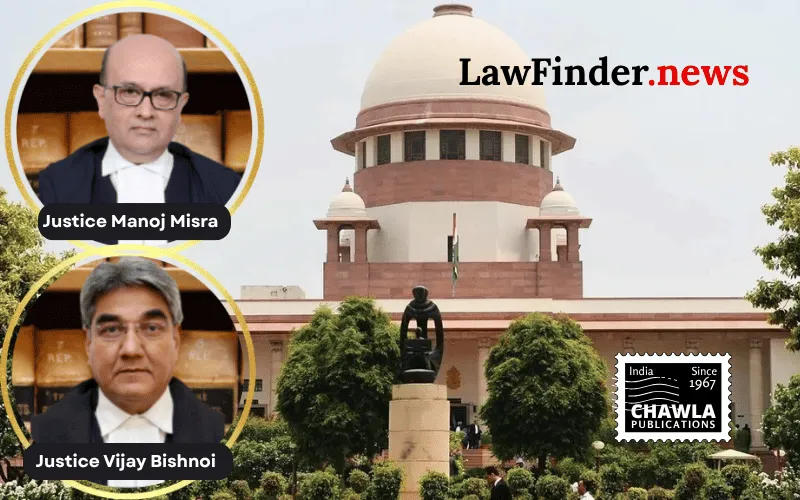
A Bench of Justices Manoj Misra and Vijay Bishnoi allowed the Commission’s appeal and set aside an Allahabad High Court order that had granted one additional mark to candidate Ashok Yadav. The High Court had directed the Commission to revise his result and recommend him for appointment.
The case arose from a question in the General Knowledge section of the examination asking candidates to identify the incorrect pair among four options: “Baburnama-Babur”, “Shahjahannama-Mohd. Taahir”, “Humayunnama-Humayun”, and “Tuzuk-e-Jahangiri-Jahangir”. The Commission’s answer key treated option “B” as correct, while the candidate had selected option “C”, arguing that “Humayunnama” was authored by Gulbadan Begum and not Humayun.
The candidate’s writ petition was initially dismissed by a Single Judge of the Allahabad High Court on the ground of delay. His intra-court appeal was also dismissed. However, in review proceedings, the Division Bench relied on an expert report dated August 10, 2020, and held that the candidate was entitled to one mark because option “C” could also be treated as correct. Based on that finding, the High Court ordered declaration of his result and consequential appointment.
The Supreme Court disagreed with that approach. It held that the expert report was not categorical that option “C” was the only correct answer. Instead, the report said that if the question was understood as a “book-author” pairing, option “C” would be correct, but if understood as referring to the subject or person the book was about, option “B” would be correct.
The Bench noted that the question itself did not specify the basis on which the pairing had to be judged. In such a situation, the Commission’s adoption of a commonsense approach—matching the title of the book with the person it concerned—could not be called arbitrary or irrational. On that interpretation, “Shahjahannama-Mohd. Taahir” was the incorrect pair, making option “B” a valid answer.
The Court said the candidate had read into the question a parameter of authorship that was not expressly stated. Such inferential reasoning, it held, cannot be the basis for judicial interference with an answer key. “Misreading a question, or reading something into a question, often results in a wrong answer,” the Bench observed, adding that courts must assess the question as it stands and not as it ought to have been framed.
Reiterating earlier precedents including Ran Vijay Singh v. State of U.P. and U.P. Public Service Commission v. Rahul Singh, the Supreme Court said there is a presumption of correctness in favour of answer keys prepared by examining bodies. A candidate challenging an answer key must show a glaring and apparent error that does not require any inferential process. In cases of doubt, the benefit must go to the examining authority rather than the candidate.
The Court also cautioned against excessive judicial interference in examination matters, saying such interventions create uncertainty and undermine finality in public recruitment processes. It held that the High Court had overstepped its jurisdiction, especially while exercising review powers, since neither the question nor the Commission’s selected answer was patently wrong.
Allowing the appeal, the Supreme Court set aside the High Court’s review order and dismissed Ashok Yadav’s writ petition. The ruling reinforces judicial restraint in exam-related disputes and underscores that courts should not substitute their interpretation for that of expert examining bodies unless the error is unmistakable.
Bottom Line:
Judicial review of answer keys in competitive exams must be limited to cases of glaring and apparent mistakes that do not require inferential reasoning. Courts should be cautious in interfering with the decisions of examining bodies in such matters
Statutory provision(s): Article 226 of the Constitution of India, Article 136 of the Constitution of India