Court Holds That At Cognizance Stage, Complainant Need Not Always Produce Witnesses Testifying Directly to Reputation Harm; Nature of Imputation and Circumstances May Suffice
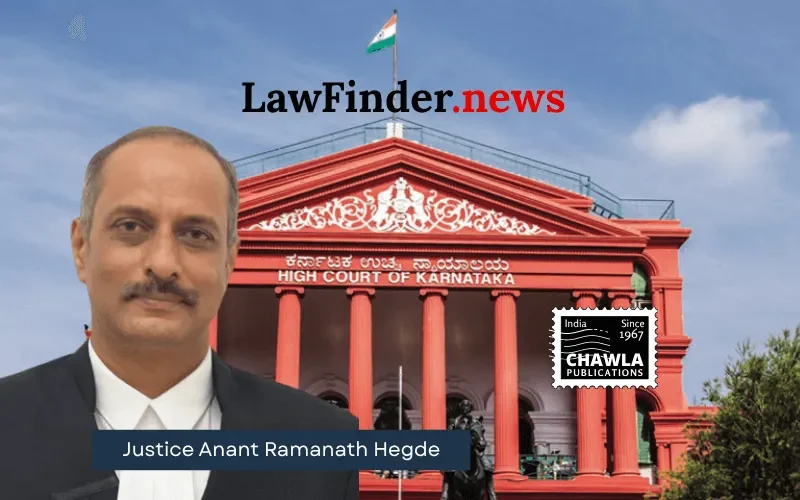
In a significant judgment delivered on November 12, 2026, the Karnataka High Court, presided over by Justice Anant Ramanath Hegde, addressed a critical procedural question concerning defamation cases under the newly enacted Bharatiya Nyaya Sanhita, 2023 (BNS) and related laws. The Court ruled that at the stage of taking cognizance for offences under Section 499 of the Indian Penal Code (IPC) or Section 356 of BNS, it is not mandatory for the complainant to examine a witness who personally testifies that the complainant’s reputation has been lowered in that witness’s own estimation.
The case arose from a complaint filed by Sri. Shivananda S Patil against Sri. Basanagouda Ramanagouda Patil Yatnal, alleging defamatory statements made in a public gathering and broadcast over YouTube. The Trial Court had taken cognizance under Section 356(2) of BNS, and the Sessions Court upheld this decision on revision. The petitioner challenged these orders arguing that the procedural requirement under Explanation-4 to Section 499 IPC or Section 356(1) of BNS mandates that a witness other than the complainant must explicitly testify that in his or her own opinion, the complainant’s reputation is lowered. Since such testimony was absent, the courts erred in taking cognizance.
Justice Hegde, after analyzing the provisions and various Supreme Court precedents, observed that Explanation-4 to Section 499 IPC defines defamation as imputations that lower a person’s reputation “in the estimation of others.” However, this phrase does not necessarily mean that the person “others” whose estimation is affected must be examined as a witness at the cognizance stage. The Court explained that the prima facie nature of the imputation and the attendant circumstances may suffice to infer reputational harm.
The Court further clarified that while in some cases it may be necessary to examine witnesses who testify directly to the lowering of reputation, this is not a rigid requirement universally applicable at the initial stage of cognizance. Where the imputations are “per se defamatory” and inherently capable of lowering the complainant’s moral or intellectual character or credit, the court may proceed without insisting on such specific testimony.
The judgment also discussed scenarios where witnesses may testify about reputational harm based on statements made by others, distinguishing between direct evidence and hearsay. The Court emphasized that mere assertions without prima facie defamatory imputations would not suffice, and in such cases, further evidence might be required before proceeding.
This ruling aligns with the recent legislative changes under the Bharatiya Nyaya Sanhita, 2023, and Bharatiya Nagarik Suraksha Sanhita, 2023, which have replaced the IPC and CrPC for such offences, reflecting the evolving approach towards defamation jurisprudence in India.
The petition filed by the accused was dismissed, upholding the Trial and Sessions Courts’ orders taking cognizance of the offence. The Court made clear that its observations were limited to the cognizance stage and did not reflect any opinion on the merits of the complaint or the defence.
This decision provides important guidance for courts dealing with defamation complaints under the new statutory framework, balancing the need to protect reputation with procedural efficiency at the initial stage of criminal proceedings.
Bottom Line:
Defamation - At the stage of taking cognizance and issuing process for offences under Section 499 IPC or Section 356(1) of Bharatiya Nyaya Sanhita (BNS), it is not mandatory for the complainant to examine a witness stating that the complainant's reputation has been lowered in that witness's own estimation. The nature of the imputation and surrounding circumstances may suffice to take cognizance.
Statutory provision(s): Section 499 IPC, Section 500 IPC, Section 356(1) and 356(2) Bharatiya Nyaya Sanhita, 2023, Section 223 Bharatiya Nagarik Suraksha Sanhita, 2023