Court Emphasizes Exclusive Jurisdiction of NCLAT in Appeals Under Insolvency and Bankruptcy Code, 2016; Upholds Need to Exhaust Statutory Remedies Before Invoking Writ Jurisdiction
Bengaluru, 3rd November 2026 – In a significant ruling reinforcing the appellate structure under the Insolvency and Bankruptcy Code, 2016 (IBC), the Karnataka High Court has dismissed a writ petition filed by M/s. Shree Basaveshwar Sugars Limited challenging the National Company Law Tribunal’s (NCLT) order dated 14th November 2024. The impugned order had recalled an earlier disposal and restored the Section 7 petition filed by Indian Renewable Energy Development Agency Limited (IREDA) against the sugar company, thereby reinstating the Corporate Insolvency Resolution Process (CIRP).
The dispute arose when IREDA, a financial creditor, filed a petition under Section 7 of the IBC for initiation of CIRP against the petitioner company for a substantial debt exceeding INR 178 crore. Concurrent insolvency proceedings initiated by another creditor, Canara Bank, led to the NCLT disposing of IREDA’s petition with liberty to file claims in the Canara Bank’s CIRP. However, following a One-Time Settlement (OTS) between the petitioner and Canara Bank, the Canara Bank’s CIRP was withdrawn, leaving IREDA unable to file its claim before the Interim Resolution Professional.
Subsequently, IREDA approached the NCLT seeking recall of the earlier order and revival of its petition, which was allowed by the NCLT. Aggrieved, M/s. Shree Basaveshwar Sugars Limited filed a writ petition in the High Court challenging the NCLT’s order on grounds of jurisdictional overreach and procedural delay in filing the revival application.
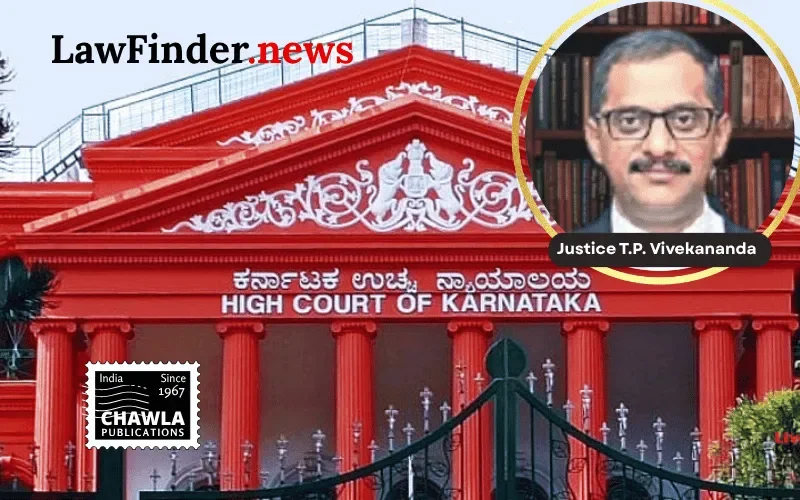
Presiding Justice T.P. Vivekananda undertook a detailed scrutiny of the matter, focusing first on the maintainability of the writ petition in light of the alternative statutory remedy available under Section 61 of the IBC. The Court underscored that the IBC is a self-contained Code providing a comprehensive appellate mechanism through the National Company Law Appellate Tribunal (NCLAT).
The Court observed that the order restoring the petition by the NCLT is appealable before the NCLAT, and that writ jurisdiction under Article 226 of the Constitution should not be invoked to circumvent the statutory appellate remedy unless exceptional circumstances exist. Such exceptions include enforcement of fundamental rights, violation of principles of natural justice, orders passed without jurisdiction, or challenges to the vires of a statute. The Court found that none of these exceptions applied in the present case.
Further, the Court noted that the NCLT had inherent jurisdiction to entertain the application for recall and restoration of the petition, particularly given the unforeseen termination of the Canara Bank CIRP, which rendered the earlier disposal order untenable. The petitioner’s contention that the NCLT lacked jurisdiction to restore the petition was thus rejected.
Relying on precedents including the Supreme Court’s judgments in Embassy Property Developments Private Limited v. State of Karnataka (2020) and Budhia Swain v. Gopinath Deb (1999), the Court held that the writ petition was not maintainable and that the petitioner must exhaust the statutory appeal remedy before the NCLAT. The Court also extended the interim protection previously granted, allowing the petitioner three weeks to approach the NCLAT for interim relief.
The judgment clarifies that challenges to orders passed under the IBC, including those involving procedural recall and restoration of insolvency petitions, are to be resolved within the Code’s appellate framework, preserving the integrity of the insolvency resolution process.
Bottom Line:
Insolvency and Bankruptcy Code, 2016 - Order of NCLT recalling earlier disposal order and restoring Section 7 petition is appealable under Section 61 of IBC - Writ petition under Article 226 challenging such order is not maintainable when efficacious alternative remedy before NCLAT exists and case does not fall within recognised exceptions.
Statutory provision(s):
Insolvency and Bankruptcy Code, 2016 Sections 7, 60(5), 61; National Company Law Tribunal Rules, 2016 Rule 11; Constitution of India Article 226; Limitation Act, 1963 Section 14