State directed to refund withheld income tax and VAT amounts totaling Rs. 15.41 lakh along with 8% interest on Rs. 2.89 crore paid for non-existent iron ore, citing principles of restitution and unjust enrichment.
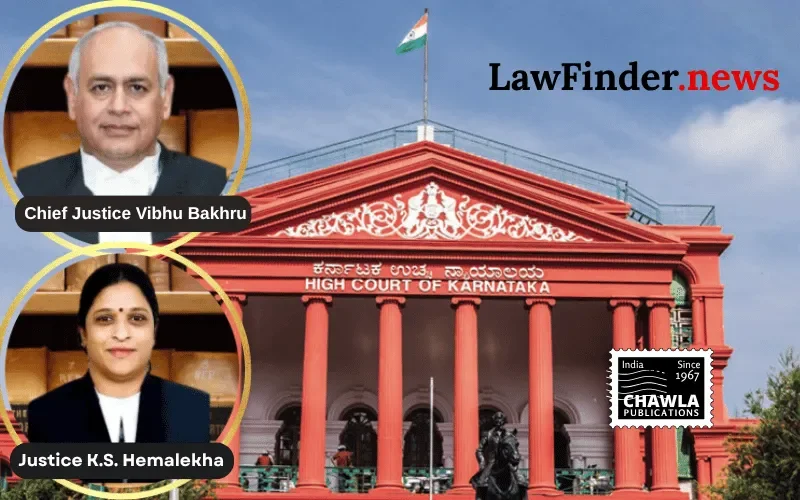
In a significant judgment delivered on October 14, 2026, the Karnataka High Court (Division Bench) upheld the rights of an auction purchaser who had paid Rs. 2.89 crore for iron ore that was subsequently found to be non-existent at the auction site. The court set aside the State's decision to withhold Rs. 15,41,436, which included Rs. 5,57,436 towards income tax and Rs. 9,84,000 towards Value Added Tax (VAT), from the refundable amount on the ground that these tax components had already been remitted to the tax authorities.
The case arose after the Department of Mines and Geology (DMG), Karnataka, auctioned approximately 20,000 metric tonnes of old iron ore dumps located at Doddabyaladakere Village, Chitradurga District. Sri Shashi Kumar emerged as the highest bidder and deposited the entire bid amount along with royalty and taxes as demanded. However, subsequent inspections revealed that the iron ore was not available at the site, and the transaction could not be completed. Despite this, the State initially refunded only Rs. 2.73 crore, deducting the tax components, citing that those amounts had been transferred to the respective tax departments.
The petitioner, through his legal representatives, challenged this partial refund, arguing that since the sale did not materialize and no taxable event occurred, the State had no right to retain any portion of the amount paid. The court agreed, emphasizing that inter-departmental tax remittances could not prejudice the purchaser's right to a full refund. It held that the State's continued retention of the tax amounts amounted to unjust enrichment and violated the principle of restitution.
Critically, the court also addressed the petitioner's claim for interest on the refundable amount. Relying heavily on the Supreme Court's precedent in Dr. Poornima Advani v. Government of NCT, the court observed that interest is compensatory in nature and not a penalty. It recognized that the petitioner had been deprived of the use of his money without any fault on his part and was thus entitled to interest as compensation for this deprivation. The Karnataka High Court directed the State to pay interest at the rate of 8% per annum on the entire amount from July 31, 2023 (the date of the court's earlier order recognizing the refund entitlement) until March 31, 2025. Thereafter, interest would be payable on the balance amounts until actual payment was made.
The court also noted that the State's own Law Department had opined in favor of refunding the entire amount along with interest, underscoring the correctness of the petitioner's claim. While the State had initiated proceedings for the refund of the tax components from the respective tax authorities, the court clarified that such inter-departmental adjustments could not delay or deny the petitioner's rightful refund.
The judgment reinforces the legal principle that when a transaction fails to fructify, any amounts paid must be refunded in full, including taxes and interest, to prevent unjust enrichment by the State. It also clarifies that the mere remittance of taxes by one government department to another does not extinguish the payer's right to a refund if the underlying transaction is invalid.
This ruling has broader implications for public auctions and government transactions involving deposits and tax components, emphasizing fairness and restitution as foundational legal doctrines.
Bottom Line:
Auction of iron ore - Where auctioned mineral was found not available at site and transaction did not fructify, State could not withhold refund of bid amount, royalty and taxes on ground that tax components had been remitted to tax departments - Principle of restitution and unjust enrichment attracted - Petitioner held entitled to refund of withheld income tax and VAT components and interest at 8% per annum.
Statutory provision(s):
Principles derived from common law doctrines of restitution, unjust enrichment, and precedents under Indian civil law and tax law. Key references include:
N.S. Ganesh v. State of Karnataka, (Karnataka)(DB) : Law Finder Doc Id # 2999858