Court rules that mere refusal to return a volleyball and verbal scolding do not constitute abetment to suicide under IPC Section 305; benefit of doubt extended to accused due to lack of cogent evidence.
In a significant judgment delivered on September 11, 2026, the Karnataka High Court (Division Bench) dismissed the appeal challenging the acquittal of accused persons in a high-profile case involving the suicide of a minor child, Master Kiran. The child had committed suicide allegedly after an altercation with the accused over a volleyball that had accidentally broken a shop window.
The complainant, represented by Sri Puttaraju B., had sought to overturn the acquittal passed by the Additional City Civil and Sessions Judge, Children's Court, Bengaluru, where the accused were charged under Sections 305 read with 34 of the Indian Penal Code (IPC) for abetment to suicide. The prosecution's case was that the accused refused to return the ball and verbally abused the child, which purportedly led to the child's mental distress and subsequent suicide by hanging.
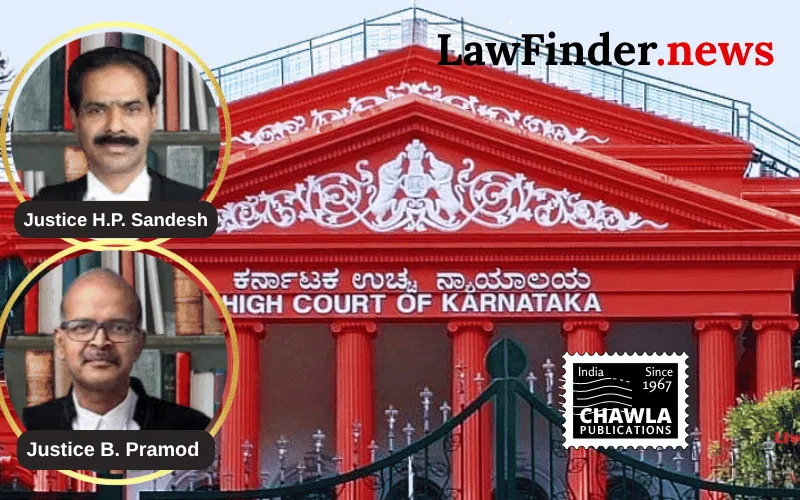
However, the High Court bench comprising Justices H.P. Sandesh and B. Pramod upheld the trial court's verdict, stating that the prosecution failed to prove the essential ingredients of Section 107 IPC (abetment) which are vital to sustain a conviction under Section 305 IPC (abetment to suicide). The Court observed that the prosecution did not establish any direct or indirect incitement, nor was there evidence of mens rea (guilty intention) on the part of the accused.
Notably, the Court emphasized that allegations of mere harassment or refusal to return a ball, without clear evidence of instigation or abetment, are insufficient to hold accused persons guilty of abetment to suicide. The evidence from eyewitnesses was inconsistent, and the key witnesses, including the deceased's parents, admitted they were unaware of the exact nature of the conversation between the child and the accused. Even CCTV footage failed to capture any incriminating interaction.
The Court relied heavily on precedents, including the Supreme Court judgment in Mariano Anto Bruno v. Inspector of Police (AIR 2022 SC 4994), which held that there must be proof of direct or indirect acts of incitement for conviction under Section 305 IPC. Similarly, the Court referred to Karnataka High Court rulings in Ramesh v. State of Karnataka (2019) and M. Arjunan v. State (2019), reiterating that the prosecution must prove abetment beyond reasonable doubt.
The judgment further clarified that in criminal cases, especially those hinging on circumstantial evidence or inconsistent prosecution witnesses, the benefit of doubt must always be given to the accused. The Court noted that mere suspicion or possibility of guilt does not suffice to overturn an acquittal unless there is cogent and convincing evidence.
Consequently, the appeal was dismissed, reaffirming the trial court's acquittal of the accused. This judgment serves as a reminder that criminal liability for abetment to suicide demands stringent proof of intentional incitement or abetment, which cannot be presumed from trivial or isolated acts.
Bottom Line:
To sustain conviction under Section 305 IPC, the prosecution must prove the ingredients of Section 107 IPC, including evidence of incitement and mens rea. Mere allegations of harassment or refusal to return a ball without clear evidence of instigation or abetment cannot constitute abetment to suicide.
Statutory provision(s):
Indian Penal Code, 1860 - Sections 305, 107, 34, 313 of the Code of Criminal Procedure (CrPC)
Gnanashekar M. v. State of Karnataka, (Karnataka)(DB) : Law Finder Doc Id # 2977722