Court affirms validity of clause disqualifying bidders with defaulting promoters; emphasizes limited scope of judicial review in tender matters.
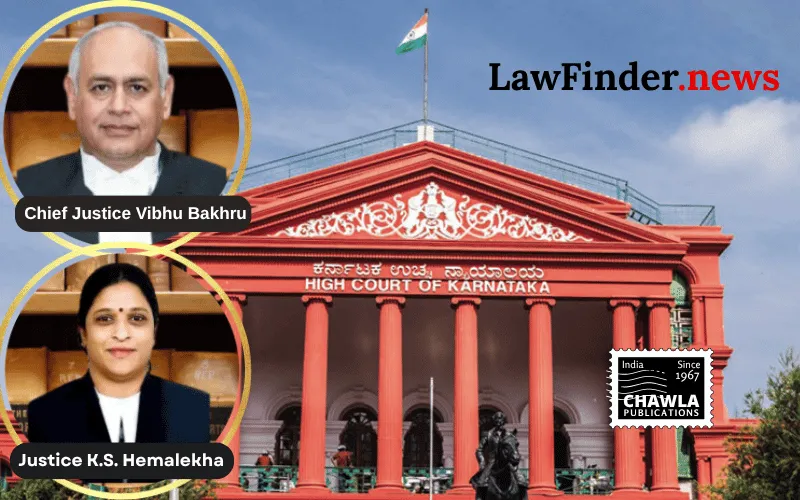
In a significant ruling, the Karnataka High Court has upheld the validity of an exclusionary clause in the tender conditions issued by Bank of Baroda (BoB) that disqualifies entities whose promoters or directors are defaulters or whose credit facilities are classified as non-performing accounts (NPAs). The division bench, comprising Chief Justice Vibhu Bakhru and Justice K.S. Hemalekha, dismissed the appeal filed by Manipal Technologies Limited (MTL) challenging the interim order of a single judge that declined to grant interim relief against their disqualification from a tender process.
The case emerged when MTL's bid for the empanelment of vendors for printing and supplying self-service passbooks was rejected by BoB based on a pre-qualification criterion. MTL contended that the disqualification was arbitrary and challenged the exclusionary clause under Article 14 of the Constitution of India. They argued that the clause was exclusionary and had no nexus with the tender's objective of inviting competitive bids.
BoB defended the clause, asserting its relevance in ensuring the financial stability and credibility of bidders, and argued that the involvement of MTL's promoter director, Sri T. Gautham Pai, who was associated with a defaulting entity, justified the disqualification.
The High Court, in its detailed judgment, emphasized that the exclusionary clause was designed to ensure that bidders possess strong financial credentials and creditworthiness. The court observed that the financial health of a promoter directly impacts the company's standing and that the clause did not violate Article 14 as it was neither arbitrary nor irrational.
The judgment also highlighted the limited scope of judicial review in tender matters, noting that courts should exercise restraint and not interfere in administrative decisions unless there is evidence of arbitrariness, mala fides, or irrationality. The court cited several Supreme Court precedents, underscoring that the terms of a tender are within the contractual realm and not open to judicial scrutiny unless overwhelming public interest necessitates intervention.
The bench further concluded that MTL could not challenge the tender conditions after participating in the process without objection. It upheld BoB's determination that Sri T. Gautham Pai remained a promoter director due to his substantial control over MTL's management and policy decisions, despite re-categorization efforts.
The ruling reaffirms the principles of commercial prudence in tender processes and the necessity for tendering authorities to maintain discretion and flexibility in contractual matters.
Bottom line:-
Tender Process - Validity of exclusionary clause in tender conditions examined - Judicial review in contractual matters limited to arbitrariness, mala fides, or irrationality.
Statutory provision(s): Article 14 of the Constitution of India, Companies Act, 2013 Sections 2(27) and 2(69), Insolvency and Bankruptcy Code, 2016 Section 95