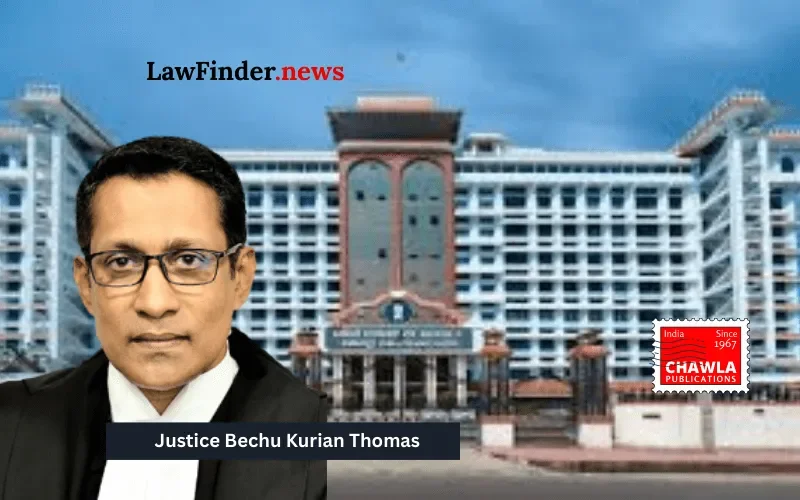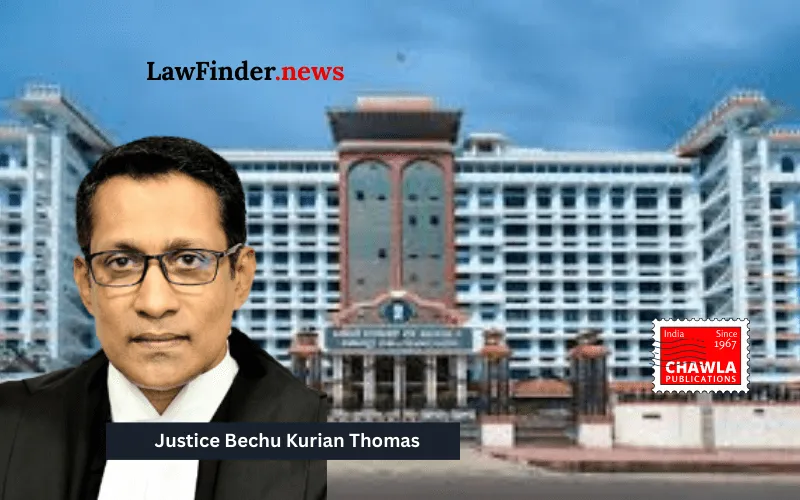
Justice Bechu Kurian Thomas rules that MV authorities cannot probe criminal offences like rash driving on their own; directs department not to harass or summon vehicle owner without following due process of law
KOCHI, July 23, 2026 — The Kerala High Court has come down heavily on the Motor Vehicles Department for summoning a vehicle owner over telephone based on an anonymous complaint alleging rash and dangerous driving, ruling that such actions without proper legal procedures amount to arbitrariness and are impermissible under law.
Justice Bechu Kurian Thomas, hearing a writ petition filed by Nirmal Mathew Babu, the registered owner of a motor vehicle bearing registration number KL-69/D-9002, directed the Regional Transport Officer (RTO), Ernakulam, and all officials acting under him, not to harass, intimidate, or summon the petitioner except in accordance with law.
The Case:
The petitioner, Nirmal Mathew Babu, approached the High Court alleging that he had been telephonically asked by the Motor Vehicles Department to appear before it along with his driving licence, RC book, and other documents relating to his vehicle. He sought protection from what he termed as harassment and intimidation by the authorities.
In response, the second respondent — the Regional Transport Officer, Ernakulam — filed a statement explaining that a complainant, who wished to remain anonymous, had personally submitted a written complaint alleging that the petitioner's vehicle was driven in a rash and dangerous manner, causing obstruction and inconvenience to other road users. The RTO stated that the Motor Vehicle Inspector (MVI) was directed to conduct a preliminary enquiry and had contacted the petitioner over telephone, requesting him to appear with relevant documents. The department described this as a "purely preliminary, non-coercive administrative step" and maintained that the complainant's request for confidentiality was honored by not disclosing his identity.
The Court's Findings:
Justice Thomas found multiple fundamental flaws in the approach adopted by the Motor Vehicles Department.
First, the Court held that when a complaint alleging an offence punishable under the Bharatiya Nyaya Sanhita, 2023 (BNS 2023) — such as rash and dangerous driving — is received by any authority, it is solely for the police to investigate the matter. The respondents failed to point out any provision under the Motor Vehicles Act, 1988 that empowers the RTO or the Motor Vehicle Inspector to investigate complaints alleging rash or dangerous driving. The Court specifically observed that offences specified in Chapter XIII of the Motor Vehicles Act, 1988 can only be investigated by the police, and that too only after the registration of a First Information Report (FIR).
Second, regarding Sections 19 and 53 of the Motor Vehicles Act — which deal with the power to disqualify persons from holding driving licences and suspension of registration respectively — the Court clarified that even these proceedings cannot be initiated on the basis of a hidden complaint or without proper notice to the affected party.
Third, and most significantly, the Court rejected the department's justification for maintaining the anonymity of the complainant and withholding the complaint itself. Justice Thomas observed in strong terms: "Anonymity for a complainant or hiding a complaint are matters unknown to law. Such an approach amounts to arbitrariness."
The Court acknowledged that the circumstances of the case — being summoned telephonically without proper notice, based on an unseen complaint from an undisclosed complainant — were capable of creating genuine apprehension in the mind of the petitioner.
The Verdict:
Allowing the writ petition, the Court directed the second respondent and anyone acting under him not to harass, intimidate, or summon the petitioner except in accordance with law.
The judgment assumes significance as it firmly delineates the boundaries of the powers of Motor Vehicles Department authorities, making it clear that criminal investigations into road safety offences must follow established legal procedures involving the police and proper FIR registration, and cannot be conducted through informal or administrative channels. Legal experts note that this ruling serves as an important precedent preventing the misuse of administrative machinery to harass vehicle owners on the basis of unverifiable anonymous complaints.
Bottom Line:
Authorities under the Motor Vehicles Act, 1988 cannot investigate complaints regarding rash or dangerous driving without proper legal procedures, such as filing of an FIR and involvement of the police. Anonymous complaints and withholding the identity of the complainant are contrary to the principles of law and amount to arbitrariness.
Statutory Provision(s): Section 19 of the Motor Vehicles Act, 1988; Section 53 of the Motor Vehicles Act, 1988; Chapter XIII of the Motor Vehicles Act, 1988; Bharatiya Nyaya Sanhita, 2023 (BNS 2023); Article 226 of the Constitution of India
Nirmal Mathew Babu v. State of Kerala, (Kerala) Law Finder Doc id # 2970373