Court holds postmortem age assessment more reliable than Aadhaar; applies Supreme Court precedent to determine compensation at Rs. 8.25 lakh, increasing original award by Rs. 2.8 lakh.
In a significant judgment delivered on November 3, 2026, the Madhya Pradesh High Court (Gwalior Bench) in Miscellaneous Appeal No. 6071 of 2022 has enhanced the compensation awarded for the death of a minor in a motor vehicle accident. The case involved the death of Harendra Singh Baghel, a minor who tragically lost his life in an accident on December 24, 2019.
The appellants, Rajesh Singh and another, challenged the Motor Accident Claims Tribunal's award of Rs. 5,45,000, seeking enhancement on the grounds that the Tribunal erred in calculating the notional income and applying an incorrect multiplier for the minor's age. The Tribunal had fixed the deceased's age at approximately 14 years and applied a multiplier of 18, resulting in a compensation amount based on a monthly notional income of Rs. 25,000.
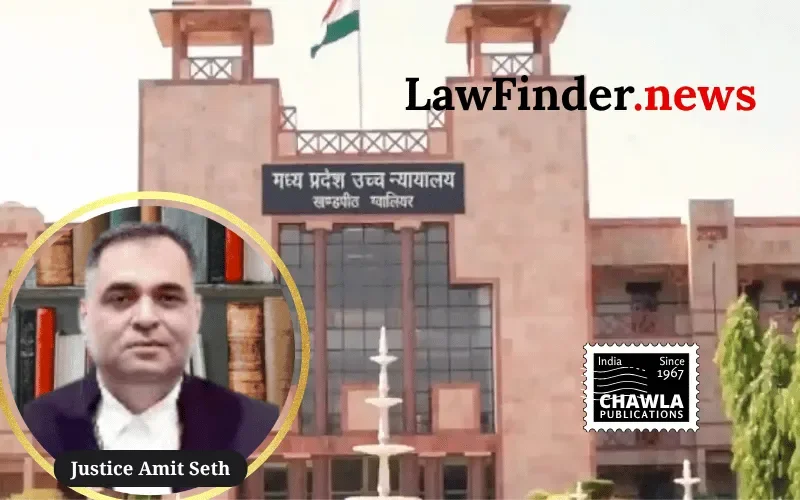
The High Court, presided by Justice Amit Seth, undertook a detailed examination of the legal principles governing compensation for death of minors under Section 173 of the Motor Vehicles Act, 1988. The Court observed that the age of the deceased as per the postmortem report was 13 years, which was medically determined and thus more reliable than the age stated in the Aadhaar card. This finding was crucial as the age bracket directly influenced the multiplier to be applied in the compensation calculation.
In reviewing the applicable jurisprudence, the Court referred extensively to Supreme Court decisions, notably Reshma Kumari v. Madan Mohan (2013), Divya v. National Insurance Company Limited (2022), and Meena Devi v. Nunu Chand Mahto (2022). The Court emphasized that for minors under 15 years of age, the multiplier should be 15 rather than 18. This aligns with the Supreme Court's established guidelines, which aim to standardize compensation calculations and ensure fairness.
Further, the Court recalculated the notional income of the deceased based on the minimum wages payable to an unskilled worker as Rs. 7,950 per month, contrary to the Rs. 25,000 used by the Tribunal. It applied a 50% deduction for personal and living expenses, which is standard for minors, arriving at an annual loss of dependency of Rs. 47,700. Multiplying this by 15, the Court computed the total loss of dependency as Rs. 7,15,500.
Additionally, the Court awarded Rs. 80,000 towards loss of parental consortium (Rs. 40,000 each to the parents), Rs. 15,000 for funeral expenses, and Rs. 15,000 for loss of estate-amounts not considered in the original award. The total compensation thus amounted to Rs. 8,25,500, enhancing the previous award by Rs. 2,80,500.
The Court also clarified that the entire enhanced compensation would carry interest at the rate of 6% per annum from the date of filing of the claim petition till realization. The cross-objections filed by the insurance company regarding the age determination and multiplier application were partly allowed, resulting in modification of the original award.
This judgment reiterates the judiciary's commitment to adhering to Supreme Court precedents and ensuring just compensation, especially in cases involving minors. It also highlights the importance of relying on medically supported evidence like postmortem reports over identity documents for critical determinations such as age in compensation claims.
Bottom Line:
Motor Vehicle Accident - Determination of compensation for death of a minor - The multiplier for minors under 15 years of age is to be taken as 15 and not 18, following the judgment of the Supreme Court in Reshma Kumari v. Madan Mohan and subsequent clarifications.
Statutory provision(s):
Motor Vehicles Act, 1988 Section 173
Rajesh Singh v. Rahul Singh, (Madhya Pradesh)(Gwalior Bench) : Law Finder Doc Id # 3015985