Court directs bank to restore possession of locked residential property to appellant facing severe medical and financial hardships, emphasizing protection of litigant rights during administrative vacancies.
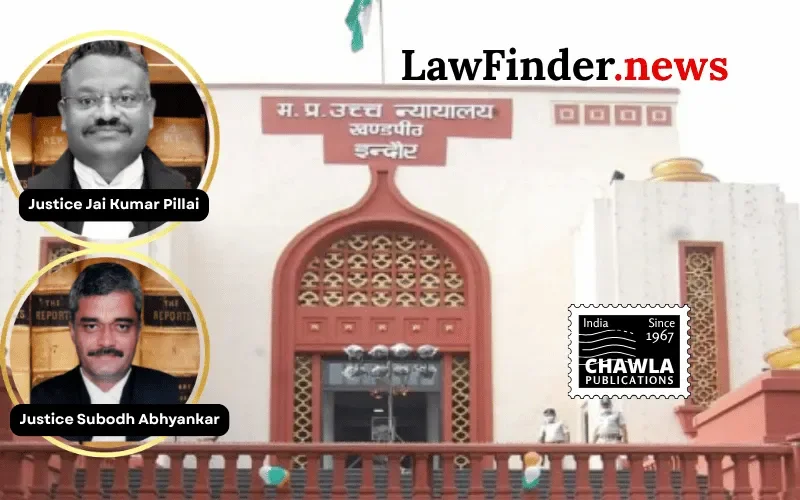
In a significant judgment delivered by the Division Bench of the Madhya Pradesh High Court, comprising Justices Subodh Abhyankar and Jai Kumar Pillai, the court granted interim relief to Mr. Vinod Dwivedi, a borrower who was denied statutory remedies due to the non-functionality of the Debt Recovery Tribunal (DRT), Jabalpur. The judgment highlights the High Court's crucial role in stepping in to protect litigants facing grave personal and financial hardships when statutory forums are unavailable.
The appellant, Mr. Dwivedi, had availed a housing loan of Rs. 13,61,902 from IIFL Housing Finance Limited in 2017 and maintained regular payments until the disruptions caused by the Covid-19 lockdown in 2020 severely impacted his transport business. During this period, he faced compounded distress with the tragic loss of his wife, who succumbed to cancer in 2024, and his own ongoing heart condition. These hardships left him unable to maintain loan repayments despite his best efforts.
Following a default, the respondent bank initiated recovery proceedings under the Securitisation and Reconstruction of Financial Assets and Enforcement of Security Interest (SARFAESI) Act, 2002. An ex-parte eviction order was obtained from the Chief Judicial Magistrate, and the bank subsequently locked the appellant's residential property without serving proper legal notices or affording an opportunity to be heard, violating principles of natural justice.
Mr. Dwivedi's recourse to the Debt Recovery Tribunal for interim relief was futile because the tribunal's presiding officer position was vacant, rendering it non-functional. The Single Judge of the High Court dismissed his writ petition seeking protection, prompting the present intra-court appeal.
The Division Bench observed that the appellant had deposited Rs. 1,16,000 as directed by the Court and was ready to settle his dues but was denied justice due to administrative vacancies at the Tribunal. The court emphasized that litigants cannot be left remediless due to such vacancies and that extraordinary personal and financial hardships warrant equitable interim relief.
Accordingly, the High Court set aside the Single Judge's order and directed the bank to immediately unlock and restore possession of the property to Mr. Dwivedi, subject to his furnishing a written undertaking. The undertaking ensures that if the tribunal ultimately refuses interim relief, the appellant must vacate the premises without delay. The court clarified that this order is an exception based on the appellant's unique circumstances and does not constitute a precedent.
The judgment reinforces the principle that where statutory forums fail to function, courts have a duty to protect fundamental rights and ensure justice. It also underscores adherence to natural justice, especially the right to be heard before eviction.
This decision provides a ray of hope to borrowers and litigants encountering procedural roadblocks in statutory forums, affirming the judiciary's role as a protector of citizens' rights amidst administrative lapses.
Bottom Line:
In cases where the statutory forum for redressal of grievances is non-functional due to administrative reasons, the High Court can exercise its jurisdiction to grant interim relief, especially in exceptional cases involving grave personal and financial hardship.
Statutory provision(s):
SARFAESI Act, 2002; Principles of Natural Justice
Vinod Dwivedi v. Principal Secretary, (MP)(DB)(Indore) : Law Finder Doc Id # 3033557