Court says compulsory medical testing in matrimonial disputes can be ordered only on strong prima facie material, not at the stage of final arguments to fill gaps in evidence.
The Madhya Pradesh High Court at Gwalior has quashed an order of the District Judge, Ashoknagar, which had directed a woman to undergo medical examination in a divorce case filed by her husband on grounds of cruelty.
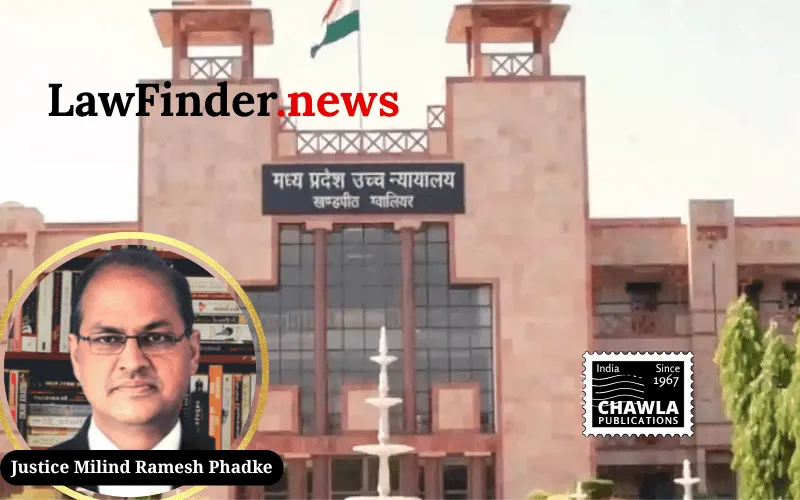
Justice Milind Ramesh Phadke held that while matrimonial courts do have the power to order medical examination of a spouse in appropriate cases, such power must be exercised cautiously and only when there is sufficient foundational material showing a strong prima facie case. The Court said the power cannot be used mechanically, nor can it be invoked at the stage of final arguments merely to collect additional evidence or fill lacunae in the case.
The dispute arose out of a marriage solemnized on 28 April 2004. The husband later filed a petition under Section 13 of the Hindu Marriage Act, 1955, alleging cruelty. After both sides had led evidence and the matter had been fixed for final arguments, the husband moved an application under Section 151 of the Code of Civil Procedure seeking medical examination of his wife. He relied mainly on allegations that she had undergone three operations and had allegedly refused normal matrimonial relations.
The trial court allowed the application, but the wife challenged that order before the High Court under Article 227 of the Constitution. She argued that the husband had not laid any proper foundation for such a request during the trial, and that no witness had proved the alleged operations or their relevance to the divorce case. She also contended that the application was filed too late, after the evidence had already closed.
The High Court agreed with her. Referring to the Supreme Court’s decision in Sharda v. Dharampal, the Court observed that although a matrimonial court may direct medical examination in suitable cases, such a direction must be supported by sufficient material and cannot amount to a roving inquiry. The Court further noted that there was no evidence that the husband had ever asked the wife to undergo medical consultation or treatment and that she had refused. The mere allegation about prior operations, without more, was held insufficient to justify compulsory medical examination.
The Court also rejected the husband’s reliance on Samar Ghosh v. Jaya Ghosh and Ramesh Chandra Agrawal v. Regency Hospital Limited, saying those rulings do not dispense with the need for a factual foundation before ordering such an intrusive step. Expert medical evidence may be relevant where a genuine medical issue arises, the Court said, but the necessity for such evidence must first be established.
Observing that the trial court had not recorded any specific reason showing why the wife’s medical examination was necessary, the High Court held that the impugned order suffered from material irregularity. It said allowing the request after the closure of evidence would prejudice the wife and effectively permit the husband to fill gaps in his case.
Accordingly, the High Court allowed the petition, set aside the District Judge’s order dated 2 July 2012, and dismissed the husband’s application for medical examination. The matrimonial case will now proceed on the basis of the existing pleadings and evidence.
Bottom Line :
Hindu Marriage Act - Matrimonial Court may direct medical examination of a spouse only in an appropriate case where strong prima facie case and sufficient foundational material exist - Such power cannot be exercised at stage of final arguments to permit a roving inquiry or to fill lacunae in evidence - Order directing wife's medical examination after closure of evidence set aside.
Statutory provision(s): Article 227 of the Constitution of India, 1950, Section 13 of the Hindu Marriage Act, 1955, Section 151 of the Code of Civil Procedure, 1908
Smt. Sadhna @ Priya v. Santosh Kumar Ojha, (MP)(Gwalior) : Law Finder Doc id # 2984432