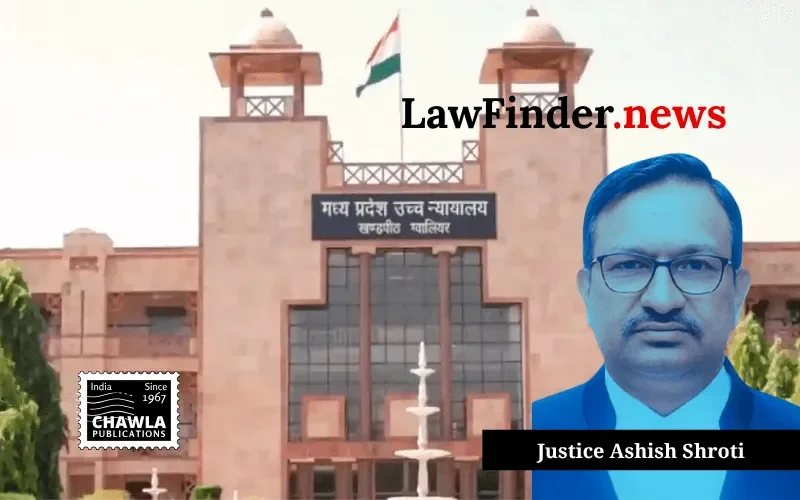
Court Rules Debt Recovery Tribunal Lacks Authority to Adjudicate Validity of Sale and Mortgage Deeds, Rejects Finance Company's Plea to Dismiss Suit on Jurisdictional Grounds
In a significant judgment delivered on October 23, 2026, the Madhya Pradesh High Court (Gwalior Bench), presided by Justice Ashish Shroti, clarified the jurisdictional boundaries between civil courts and the Debt Recovery Tribunal (DRT) under the Securitisation and Reconstruction of Financial Assets and Enforcement of Security Interest Act, 2002 (SARFAESI Act). The Court ruled that civil courts retain exclusive authority to adjudicate disputes concerning the title and validity of sale deeds and mortgage deeds, even when recovery proceedings under the SARFAESI Act are underway.
The case arose when Axis Finance Limited, a financial institution, sought to dismiss a civil suit filed by Meeta Garg challenging the validity of a sale deed and mortgage deed relating to a suit property. The plaintiff claimed title to the property through a Will executed by her mother-in-law and alleged that the sale deed executed by her father-in-law in favor of the finance company was unauthorized and thus void. The plaintiff's suit sought a declaration of title, declaration that the sale deed and mortgage were null and void, and permanent injunction against the defendants.
Axis Finance Limited filed an application under Order 7, Rule 11 of the Code of Civil Procedure (CPC) to reject the plaint on the ground that Section 34 of the SARFAESI Act barred civil courts from entertaining suits that fall within the jurisdiction of the DRT. The finance company contended that since it had initiated recovery proceedings before the DRT under the SARFAESI Act, the plaintiff's remedy lay exclusively before the Tribunal, not the civil court. The applicant also raised objections regarding the payment of insufficient court fees.
Justice Ashish Shroti, after hearing learned counsel for both sides and examining relevant precedents, notably the Supreme Court's ruling in Central Bank of India v. Prabha Jain (2025) 4 SCC 38, emphasized that the SARFAESI Act and the DRT's jurisdiction are confined to examining the validity of recovery measures taken under Section 13(4) of the Act. The Court reiterated that the DRT does not possess jurisdiction to finally adjudicate questions of title or the validity of sale or mortgage deeds. Such substantive reliefs fall squarely within the exclusive domain of civil courts.
The Court further explained that partial rejection of the plaint is impermissible under Order 7 Rule 11 CPC. Even if some reliefs in the suit overlap with matters triable by the DRT, as long as the principal reliefs are within the civil court's jurisdiction, the entire plaint must be allowed to proceed. Additionally, the Court rejected the finance company's argument regarding court fees, holding that a non-executant plaintiff challenging the validity of a deed is not liable to pay ad-valorem court fees based on the sale consideration, citing the Supreme Court's decision in Suhrid Singh @ Sardool Singh v. Randhir Singh (2010) 12 SCC 112.
The Court also addressed the contention that the plaintiff's concurrent approach to the DRT for protection against coercive recovery proceedings barred the civil suit. The judgment clarified that resorting to the DRT for limited protection does not amount to abandonment of civil remedies, especially when the substantive relief sought exceeds the Tribunal's jurisdiction.
Consequently, the High Court dismissed the revision petition filed by Axis Finance Limited, affirming the trial court's order rejecting the application to dismiss the suit. The judgment reinforces the principle that while the SARFAESI Act provides an expedited mechanism for debt recovery, it does not oust the jurisdiction of civil courts in disputes related to ownership and the validity of property documents.
This decision is expected to provide clarity to litigants and financial institutions on the demarcation of jurisdiction under the SARFAESI Act and CPC, ensuring that title disputes continue to be resolved through the established civil court process.
Bottom Line:
SARFAESI Act, 2002 Section 34 does not bar a civil suit seeking declaration of title and declaration that a sale deed/mortgage is illegal or not binding, as DRT cannot finally adjudicate title or validity of such documents; further, plaint cannot be partially rejected under Order 7, Rule 11 CPC, and a non-executant in possession seeking declaration against a sale deed is not liable to pay ad-valorem court fees.
Statutory provision(s):
Securitisation and Reconstruction of Financial Assets and Enforcement of Security Interest Act, 2002 Section 13(4), Section 17, Section 34; Code of Civil Procedure, 1908 Order 7, Rule 11
Axis Finance Limited v. Meeta Garg, (Madhya Pradesh)(Gwalior Bench) : Law Finder Doc Id # 3005681