Court rules compassionate appointment granted after due consideration cannot be cancelled years later without fraud or suppression; directs continuation of service with full benefits.
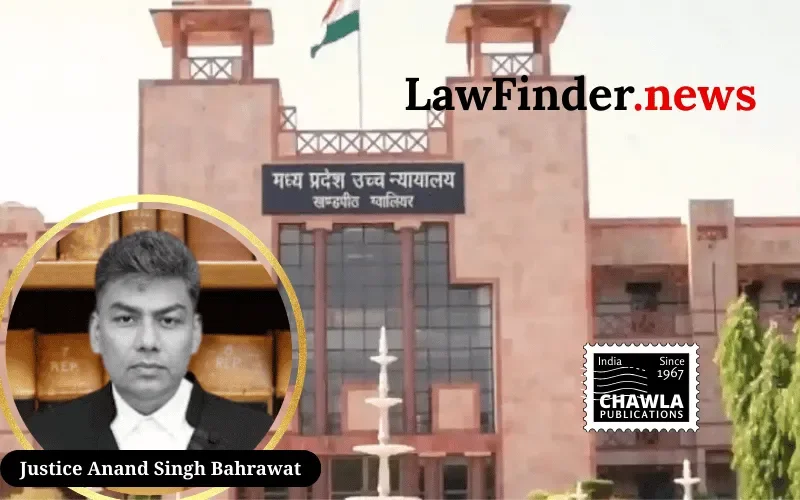
In a significant judgment delivered on 15th October 2026, the Madhya Pradesh High Court, Gwalior Bench, presided by Justice Anand Singh Bahrawat, ruled in favor of Suraj Sagar, who challenged the cancellation of his compassionate appointment following the death of his grandmother, a government employee. The Court held that once a compassionate appointment is granted after full disclosure and considered approval by the competent authority, it cannot be rescinded years later on the same known facts, especially in the absence of fraud, misrepresentation, or suppression of material facts.
Background:
Suraj Sagar, a member of the Scheduled Caste category, was appointed on compassionate grounds to the post of Dawasaj in 2016 after the death of his grandmother, Late Smt. Krishna Devi, who served as a Dai in the Government Ayurvedic Dispensary. His father had passed away earlier in 2008, and the petitioner along with his widowed mother and siblings were dependent on his grandmother. The petitioner was nominated in his grandmother's service records as a dependent family member.
The appointment was made following a recommendation by the Screening Committee under the State Government policy dated 29.09.2014, which governs compassionate appointments to families of deceased government employees. Suraj Sagar successfully completed his probation and served the government dispensary. However, in 2019, his appointment was cancelled on the grounds that as a grandson through a widowed daughter, he was not eligible under the policy.
Legal Arguments and Court's Analysis:
The petitioner argued that his relationship and dependency were fully disclosed and considered at the time of appointment, and no fraud or suppression was involved. He contended that the cancellation order was passed without proper hearing, inquiry, or application of mind, violating procedural requirements and principles of natural justice.
The State contended that compassionate appointments are governed strictly by policy and that the petitioner did not fall within the eligible dependent categories, hence the cancellation was justified.
The Court examined the facts and noted that the petitioner's relationship and family circumstances were known and considered by the competent authority before granting the appointment. There was no evidence of any false document or misrepresentation by the petitioner. The cancellation was effectively a re-interpretation of eligibility under the policy without any new factual basis.
The Court relied on the Supreme Court decision in Md. Zamil Ahmed v. State of Bihar (2016), where it was held that termination of compassionate appointment after many years on the same known facts without fraud is unjustified. The Court also referred to Union of India v. K.P. Tiwari (2003), which emphasized the relevance of long continuation in service under interim protection in deciding final relief.
Considering that Suraj Sagar had continued to serve for over seven years under the Court's interim protection and had completed his probation, the Court held that uprooting him from service at this stage would seriously affect his livelihood and unsettle a long-standing position.
Order:
The Madhya Pradesh High Court quashed the impugned cancellation order dated 18.02.2019 and directed the respondents to allow the petitioner to continue in service as Dawasaj. The Court declared the petitioner's service continuous from the date of initial appointment, including the period under interim protection, and directed the authorities to grant all consequential benefits including monetary dues.
The Court clarified that this relief was granted based on the peculiar facts of the case, including full disclosure, absence of fraud, consideration by competent authority, and long continuation in service.
Significance:
This judgment reinforces the principle that compassionate appointments, once granted after due consideration of all relevant facts and without any fraud, cannot be arbitrarily cancelled after many years. It highlights the importance of procedural fairness, the relevance of continued service under interim orders, and the welfare aspect underlying compassionate appointments.
Bottom Line:
Compassionate appointment once granted after full disclosure and consideration by the competent authority cannot be cancelled after several years on the same known facts, in absence of fraud, misrepresentation or suppression; long continuation in service under interim protection is a relevant factor for granting final relief.
Statutory provision(s):
Article 226, Constitution of India; Civil Services (Classification, Control and Appeal) Rules, 1966; State Government Policy on Compassionate Appointment dated 29.09.2014.
Suraj Sagar v. State of Madhya Pradesh, (MP)(Gwalior) : Law Finder Doc Id # 3001070