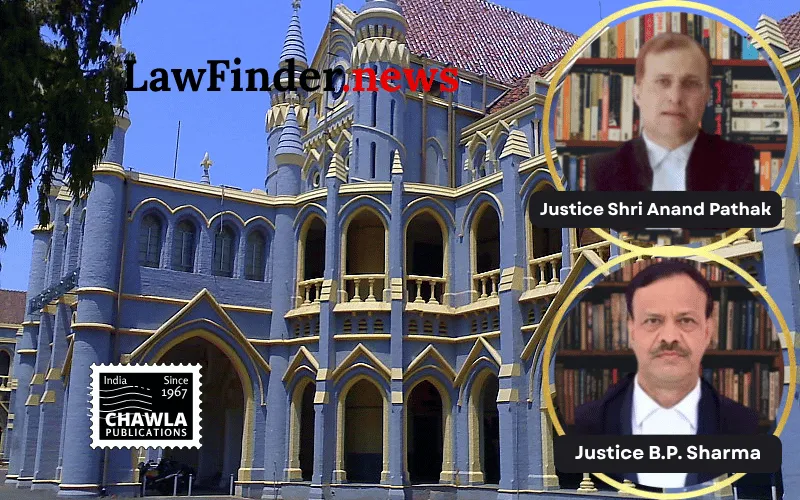
Court dismisses PIL seeking appointment of new Governor, citing constitutional proviso preventing vacancy until successor assumes office
In a significant judgment dated 15th September 2026, the Madhya Pradesh High Court (Division Bench at Jabalpur) dismissed a Public Interest Litigation (PIL) filed by Dr. M.A. Khan, a retired professor, seeking the appointment of a new Governor for Madhya Pradesh. The petitioner contended that the incumbent Governor had exceeded the constitutionally mandated five-year term and thus should be replaced.
The Court, comprising Justices Anand Pathak and B.P. Sharma, thoroughly examined the constitutional provisions relating to the appointment and tenure of the Governor under Articles 153, 154, 155, 156, and 160 of the Indian Constitution. Central to the decision was the proviso to Article 156(3) which explicitly states that a Governor shall continue to hold office notwithstanding the expiration of the five-year term until his successor enters upon office. This clause is designed to prevent any constitutional vacuum in the state's executive leadership.
The petitioner's argument that the Governor's term had expired on 7th July 2026 and that a new Governor should be appointed was refuted by the Court. It relied on the authoritative Supreme Court precedent in Krishna Ballabh Sahay v. Commission of Inquiry (AIR 1969 SC 258), where it was held that the Governor's continuation beyond the five-year term is constitutionally valid and necessary. The Court emphasized that the term "notwithstanding the expiration of his term" excludes any illegality in the Governor continuing in office until the successor assumes charge.
Further, the Court scrutinized the procedural aspects of the PIL, noting that the petitioner failed to comply with the mandatory disclosure requirements under Chapter 10 Rule 27 and Chapter 13A Rule 13 of The High Court of Madhya Pradesh Rules, 2008. The petitioner did not adequately disclose his bona fides, social standing, or public-spirited antecedents, which are prerequisites for maintaining a PIL in the High Court. This procedural deficiency formed an additional ground for dismissal.
The Bench reiterated that the Governor is a vital constitutional functionary who acts as the Kuladhipati (Chancellor) of state universities and holds appellate authority over state government orders. However, the constitutional design ensures continuity and stability in governance, preventing any interregnum at the gubernatorial level. The Court held that the Governor's continuance in office is not only legal but constitutionally mandated until a successor takes over.
In conclusion, the Madhya Pradesh High Court dismissed the petition as misconceived, reaffirming the constitutional safeguards that prevent any vacancy in the office of the Governor and underscoring the importance of adherence to procedural requirements in filing PILs.
Bottom Line:
A Governor shall continue to hold office beyond the expiration of his five-year term until his successor enters upon the office, as mandated by the proviso to Article 156(3) of the Constitution of India.
Statutory provision(s):
Articles 153, 154, 155, 156(3), 160 of the Constitution of India; Chapter 10 Rule 27, Chapter 13A Rule 13 of The High Court of Madhya Pradesh Rules, 2008