Court reiterates that police cannot deny permission on previously disapproved grounds; sets clear guidelines for route marches and public meetings to uphold constitutional freedoms
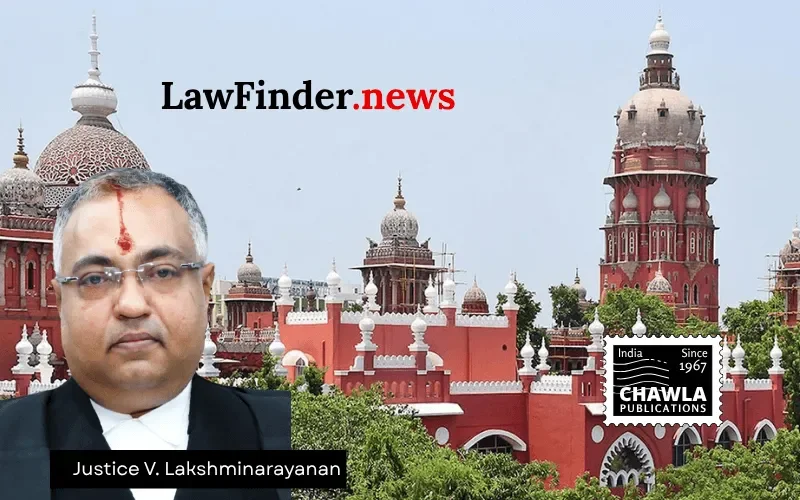
In a significant judgment dated October 16, 2026, the Madras High Court, presided over by Justice V. Lakshminarayanan, directed the Tamil Nadu Police to grant permission to the Rashtriya Swayamsevak Sangh (RSS) for conducting route marches and public meetings on specified dates. The case arose after the police repeatedly rejected the RSS's applications citing reasons that the Court found to be without legal merit and in violation of constitutional freedoms.
The petitioner, V.G. Jagadeesan, State Secretary of the RSS, had applied to the Director General of Police on October 3, 2026, seeking approval for route marches scheduled on October 18, October 25, and November 1, 2026. The police denied permission on multiple grounds such as presence of religious places of other communities on the route, statues of rationalist leaders, traffic congestion, use of loudspeakers, and possible law and order issues.
The Court meticulously examined the history of litigation surrounding the RSS's right to hold such marches in Tamil Nadu, noting a series of judgments by itself and the Supreme Court. It emphasized that the right to form associations and hold processions is a fundamental right under Article 19(1)(b) of the Constitution, and restrictions can only be imposed by valid legislation consistent with Article 19(3). The Tamil Nadu Police Act was scrutinized and previously held not to be a bar to route marches by the courts.
Rejecting the police's grounds for denial, the Court held that roads are secular public spaces and cannot be deemed off-limits due to the presence of religious structures or statues of individuals with differing ideological views. This principle upholds the constitutional guarantee of equal treatment to all citizens irrespective of religion, caste, or creed.
To ensure smooth conduct of the marches, the Court mandated the RSS to submit detailed information including route plans, names and numbers of organizers, number of participants, and venue details of the public meetings following the marches. Upon receipt of such details, the State expressed no objection for the marches on October 25 and November 1, 2026, subject to possible route modifications based on local conditions.
The organizers also provided an affidavit undertaking strict compliance with court-mandated "Do's and Don'ts," which include prohibitions on inflammatory speech, use of weapons, and causing public inconvenience. The Court cautioned police authorities against last-minute rejections and instructed them to process applications with a view to approval, seeking clarifications where necessary to avoid unnecessary litigation.
The judgment underscores the judiciary's role in safeguarding constitutional freedoms against administrative overreach and reaffirms the secular character of public spaces. It also highlights the need for cooperation between law enforcement and organizers to balance public order with fundamental rights.
This ruling comes after years of litigation, including review petitions, contempt proceedings, and Special Leave Petitions to the Supreme Court, which consistently upheld the rights of the RSS to conduct such marches under reasonable restrictions.
The Court's order is expected to pave the way for smoother conduct of processions by organizations across Tamil Nadu, provided they adhere to the prescribed guidelines, and signals a firm stance against misuse of police powers to arbitrarily deny fundamental rights.
Bottom Line:
Police cannot repeatedly reject permission for RSS route marches on grounds already disapproved by the High Court and Supreme Court; permission to conduct route marches on specified dates can be granted subject to local route modifications, prior intimation, and strict compliance with court-framed guidelines and "Do's and Don'ts".
Statutory provision(s):
Article 19(1)(b) of the Constitution of India, Article 19(3) of the Constitution of India, Tamil Nadu Police Act
V.G.Jagadeesan v. State of Tamil Nadu, (Madras) : Law Finder Doc Id # 3001797