Court holds that mere demand for repayment of loan does not amount to abetment of suicide without positive evidence of intent; Bail granted with stringent conditions.
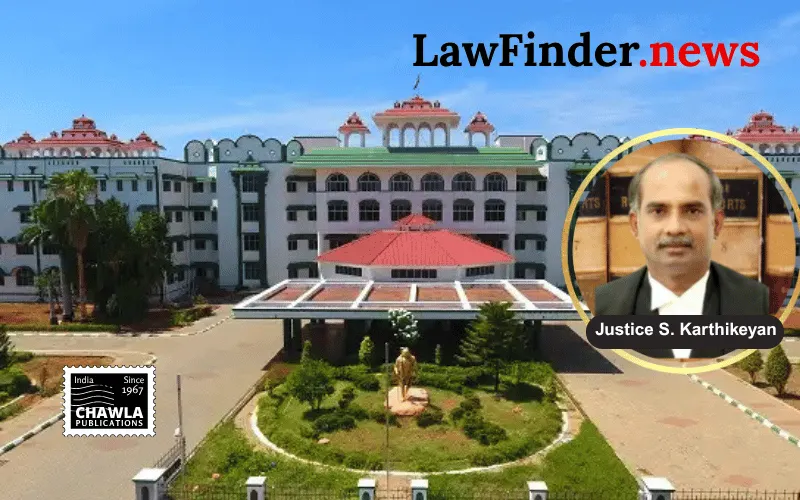
In a significant judgment delivered on August 14, 2026, the Madurai Bench of the Madras High Court, presided over by Justice S. Karthikeyan, allowed the criminal appeal filed by Sathiyaraj, who was accused of abetment of suicide and caste-based intimidation under the Bharatiya Nagarik Suraksha Sanhita, 2023 (BNSS), Tamil Nadu Prohibition of Charging Exorbitant Interest Act, 2003 (TNPCEI Act), and the Scheduled Castes and Scheduled Tribes (Prevention of Atrocities) Act, 1989.
The appellant, Sathiyaraj, and the deceased were business partners in a lath manufacturing business. The deceased had borrowed Rs. 4,00,000 from Sathiyaraj, which remained unpaid. According to the prosecution, on the night of May 15, 2026, the appellant along with two others allegedly visited the deceased's residence and intimidated him by threatening to kill if the loan was not repaid within a week. Subsequently, the deceased consumed poison on May 17, 2026, and died the same day. Based on the complaint filed by the deceased's wife, a case was registered under Section 108 and 351(2) of the BNSS, Section 4 of the TNPCEI Act, and Sections 3(1)(r), 3(1)(s), and 3(2)(va) of the SC/ST (PoA) Act.
The trial court had earlier declined bail to the appellant. However, on appeal, the High Court carefully examined the facts and the evidence on record. It was noted that the demand for repayment of a loan, even if accompanied by threats, does not automatically amount to instigation or intentional aid to the suicide of the debtor unless there is positive evidence demonstrating intent to cause death. The Court observed that no such material was placed before it indicating that the appellant intended or instigated the deceased's suicide.
Further, the investigation was complete, and the final report had been filed before the trial court. Considering these factors and the absence of incriminating evidence establishing the intent to abet suicide, the High Court set aside the lower court's order and granted bail to the appellant.
The bail was granted subject to specific conditions:
- The appellant must execute a bond of Rs. 20,000 with two sureties of the same amount.
- The sureties are required to provide photographs and left thumb impressions, with identity verification through Aadhaar or bank passbook copies.
- The appellant must report daily to the Vattathikkottai Police Station at 10:30 a.m. until further orders, except when required to appear before the trial court.
- Any violation of these conditions would enable the police to seek cancellation of bail.
This judgment highlights the careful judicial balancing between protecting the rights of the accused and addressing serious allegations under multiple legislations, including the newly enacted BNSS and existing laws protecting marginalized communities.
Bottom Line:
Granting of bail in a case under Bharatiya Nagarik Suraksha Sanhita (BNSS) and SC/ST (Prevention of Atrocities) Act - Demand for repayment of a loan does not amount to instigation or intentional aid to abet suicide in absence of positive evidence of intent to cause death.
Statutory provision(s):
Bharatiya Nagarik Suraksha Sanhita, 2023 Sections 108, 351(2); Tamil Nadu Prohibition of Charging Exorbitant Interest Act, 2003 Section 4; SC/ST (Prevention of Atrocities) Act, 1989 Sections 3(1)(r), 3(1)(s), 3(2)(va)
Sathiyaraj v. State of Tamilnadu, (Madras)(Madurai Bench) : Law Finder Doc Id # 2970380