Court dissolves marriage after finding relationship beyond repair, waives cooling-off period, and makes divorce conditional on husband’s financial commitments to wife and two minor children.
The Madras High Court’s Madurai Bench has dissolved the marriage between two doctors by mutual consent after concluding that their relationship had broken down beyond repair and that they had been living separately for over five years.
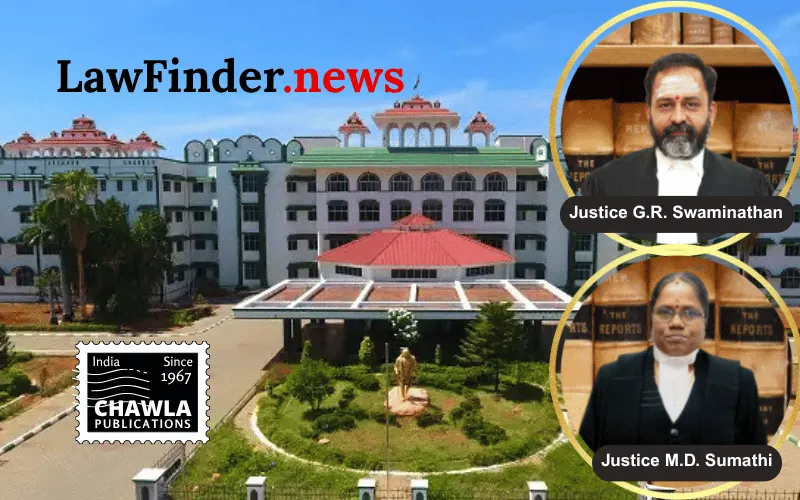
A Division Bench of Justices G.R. Swaminathan and M.D. Sumathi set aside the Family Court’s order that had dismissed both the wife’s plea for restitution of conjugal rights and the husband’s petition for divorce on the ground of cruelty. The High Court instead converted the dispute into a mutual consent divorce under Section 13B of the Hindu Marriage Act, 1955.
The marriage between Dr. K. Venkatesan and Dr. V. Aarthi was solemnised on 9 February 2011 at Tiruvannamalai. The couple initially lived and worked together in Puducherry, and two children were born from the wedlock. The court noted that the wife stayed back with her parents in Theni to support the husband’s higher studies and to care for the children while he pursued advanced medical qualifications. According to the judgment, the husband continued to visit the family regularly until the COVID-19 period, after which the relationship deteriorated.
The court observed that the dispute worsened when the husband, after becoming professionally successful, wished to move out of his in-laws’ house, which allegedly led to friction and even a physical altercation. The wife had filed a petition for restitution of conjugal rights, while the husband sought divorce on the ground of cruelty. Both petitions were dismissed by the Family Court, prompting cross-appeals before the High Court.
During the hearing, the Bench called both parties in person and found that the marriage had “broken down beyond repair.” The judges noted that the husband himself described the relationship as dead. The court also stressed the wife’s contribution in raising the children and supporting the husband’s career, observing that her role as a homemaker and mother had immense value.
The court further recorded that the husband agreed to pay a total of Rs. 2.5 crore as permanent settlement—Rs. 1.5 crore to the wife and Rs. 50 lakh each for the two minor children. Accepting this settlement, the wife agreed to the divorce.
Finding that all statutory requirements under Section 13B of the Hindu Marriage Act stood satisfied, the High Court waived the six-month cooling-off period in view of the long pendency of litigation and the parties’ prolonged separation.
The court ordered the husband to deposit Rs. 1.5 crore in the wife’s bank account within three months. It also directed him to deposit Rs. 50 lakh each in the names of the minor children within one year. The wife was permitted to withdraw the interest accrued on the children’s deposits every six months, while the principal amounts would be available to the children upon attaining majority.
Significantly, the court held that the decree of divorce would come into force only after the husband fulfilled his financial obligations. With these directions, the appeals were disposed of without costs.
Bottom Line :
Hindu Marriage Act - Appeals arising from dismissal of petition for divorce on ground of cruelty and petition for restitution of conjugal rights - High Court, on satisfaction that marriage had broken down beyond repair and parties agreed before Court, set aside common order of Family Court and granted decree of divorce by mutual consent by treating statutory requirements under Section 13B as satisfied and waiving cooling period - Husband directed to pay permanent financial settlement to wife and make deposits for minor children and decree made operative only on fulfilment of said obligations.
Statutory provision(s): Hindu Marriage Act, 1955 Sections 9, 13, 13B, 25
K. Venkatesan v. V. Aarthi, (Madras)(DB)(Madurai Bench) : Law Finder Doc id # 2986144