Court says it cannot direct Election Commission or Legislature to create a new “Election Expenditure Security” or impose a five-year disqualification without statutory backing.
The Madras High Court has dismissed a public interest writ petition seeking a new electoral mechanism to deter elected MLAs from resigning and later contesting bye-elections. The petition asked the court to direct the Election Commission of India and the Chief Electoral Officer, Tamil Nadu, to frame an “Election Expenditure Security” scheme, under which a voluntarily resigning MLA would have to deposit an amount equal to the public money spent on the bye-election caused by the resignation. It also sought a five-year disqualification from contesting elections for any MLA who resigns without a compelling reason.
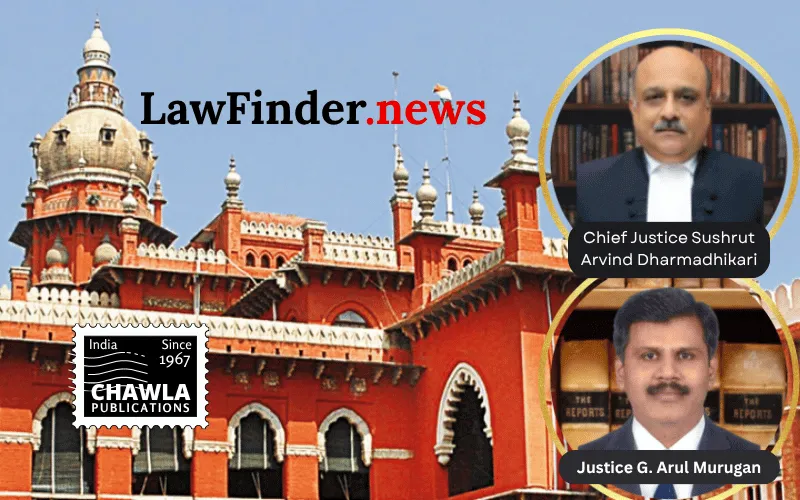
A Division Bench comprising Chief Justice Sushrut Arvind Dharmadhikari and Justice G. Arul Murugan refused to grant the reliefs, holding that such measures do not exist in the Constitution or the Representation of the People Act, 1951, and cannot be introduced through judicial directions. The court said it was not being asked to fill a gap in an existing legal framework, but to create an entirely new punitive and financial regime, which lies within the legislative domain.
The petitioner, a practising advocate, argued that six MLAs had resigned soon after the 2026 Tamil Nadu Assembly elections, leading to bye-elections funded from the public exchequer. He contended that the public should not bear the cost of repeated elections caused by political resignations and claimed that a mechanism should be evolved to prevent such misuse. He also relied on earlier Supreme Court rulings on voters’ right to information and transparency in elections.
However, the court found those precedents distinguishable. Referring to the Supreme Court’s decision in Union of India v. Association for Democratic Reforms (2002), the Bench observed that the case only dealt with disclosure of existing facts such as criminal antecedents, assets and educational qualifications of candidates. It did not create any new disqualification or financial burden. The court also distinguished the 2024 Electoral Bonds judgment, noting that it dealt with transparency in political funding and the invalidation of an existing statutory scheme, not the creation of fresh disqualifications for resigning legislators.
The Bench relied heavily on the principle that courts cannot direct Parliament or the Government to enact a particular law or introduce a Bill in a particular manner. It cited recent Supreme Court and High Court rulings to reiterate that while courts may interpret law, fill temporary gaps, or recommend reforms, they cannot legislate from the bench. The court noted that the Election Commission has no independent power under Article 324 to add new disqualifications or impose financial conditions on candidates, and therefore the court cannot confer such power through a writ of mandamus.
The court also referred to a recent Madras High Court decision in K. Mani v. Chief Election Commissioner, which had rejected a similar plea involving election expenses. In that case too, the court had held that recovery of election costs from candidates is a matter for the legislature, not the judiciary.
Further, the Bench said that even if such a mechanism were desirable as a matter of policy, a court-ordered scheme aimed at named individuals would raise concerns under Article 14 of the Constitution. The judges observed that the right to resign a legislative seat forms part of the constitutional scheme and cannot be burdened with extra-statutory conditions by judicial order.
Ultimately, the court held that the proposed “Election Expenditure Security” and five-year disqualification were matters of legislative policy, not judicial command. The writ petition was dismissed, and all connected miscellaneous petitions were closed with no order as to costs.
Bottom Line :
Election law - Court cannot direct Election Commission or Legislature to create new electoral disqualifications or financial liabilities for MLAs voluntarily resigning seats - Framing of mechanism requiring reimbursement of bye-election expenditure and imposing five-year disqualification is matter of legislative policy and not judicial direction.
Statutory provision(s): Article 14, Article 19(1)(a), Article 226, Article 324, Representation of the People Act, 1951 Section 151A
K. Suthan v. Union of India, (Madras)(DB) : Law Finder Doc id # 2984953