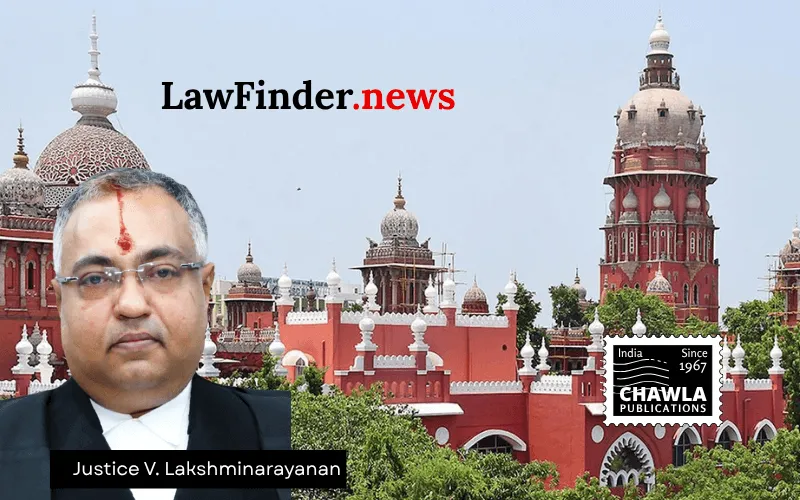
Court says freedom of press cannot extend to media trial; directs removal of existing content and weekly police press releases
The Madras High Court on 25 September 2026 passed an interim injunction restraining media outlets, intermediaries and digital platforms from publishing or circulating any video connected with a child sexual exploitation and abuse case being investigated by the Central Crime Branch in Chennai.
Justice V. Lakshminarayanan passed the order on a writ petition filed by Tulir Charitable Trust, a child protection NGO appointed as a support person for the victims in the case. The petitioner told the court that explicit materials linked to Crime No. 174 of 2025 were being discussed on mainstream media and widely circulated on social media, even as the investigation was at a crucial stage.
According to the petition, the police had initially filed a closure report in February 2026, but the POCSO Court refused to accept it and ordered further investigation. During the fresh probe, additional material surfaced, leading to arrests and the identification of several other victims whose statements were recorded. The petitioner argued that continued publication of the material was not only in violation of the Protection of Children from Sexual Offences Act, 2012 and its rules, but also attracted Section 67B of the Information Technology Act, 2000, which prohibits publishing or transmitting child sexual abuse material in electronic form.
The State informed the court that a Special Investigation Team had been formed to handle the matter and that efforts were already underway to have URLs and online content blocked. It was also stated that notices had been sent to Google and Meta seeking immediate suspension or blocking of the relevant content. The Union government said it would take prompt steps to block any URL carrying explicit material related to the case.
The court noted that the investigation was at an advanced and sensitive stage and that police were still trying to identify whether more victims existed. Justice Lakshminarayanan observed that if further debates, videos or photographs continued to be uploaded, other victims may be discouraged from coming forward due to fear and stigma.
While acknowledging that freedom of speech and the freedom of the press are valuable constitutional rights, the court held that they are not absolute and cannot be used to justify “media trial” or the circulation of child sexual abuse content. The judge also referred to the need to balance press freedom with the rights of children and the accused, and stressed that every right carries a corresponding duty.
Bottom Line :
POCSO - At crucial stage of investigation into child sexual exploitation and abuse case, media outlets, intermediaries and digital platforms can be injuncted from publishing or circulating videos touching upon the specific crime, in order to protect victims, secure fair investigation and prevent media trial, while still permitting general discussion on child abuse issues and requiring periodic police press releases.
As an interim measure, the court ordered a blanket restraint on media outlets, entities, intermediaries and digital platforms from publishing, broadcasting, uploading, transmitting, sharing, circulating, reproducing or otherwise disseminating any video touching