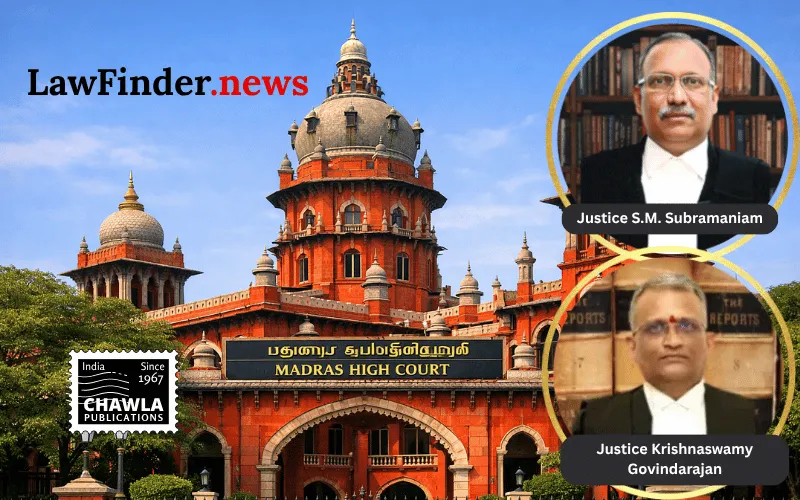
Court Rules Compassionate Appointment Scheme is a Concession, Not a Right, and Must Be Applied Only to Families in Genuine Penury to Protect Equal Employment Opportunities
In a landmark judgment dated August 25, 2026, the Madras High Court (Division Bench comprising Justices S.M. Subramaniam and Krishnaswamy Govindarajan) delivered a significant ruling on the scheme of compassionate appointments in public employment. The court underscored that the scheme is a concession, not a constitutional right, and must be implemented strictly to mitigate genuine financial distress caused by the death of a government employee, without undermining constitutional principles of equality and meritocracy.
The case arose from a writ petition filed by B. Arunpragadheesh, the third legal heir of Late Balasubramanian, a government school teacher who passed away while in service in 2011. Arunpragadheesh sought a compassionate appointment under the government's scheme. However, the application was rejected by the authorities on the ground that his elder brother was employed at Indian Bank, Royapettah Branch, Chennai, and hence the family was not in indigent circumstances. The appellate authority upheld the rejection, prompting Arunpragadheesh to approach the High Court.
The writ court initially granted relief to Arunpragadheesh, but the State government challenged this decision, arguing that the family was financially stable and therefore ineligible for compassionate appointment. The Madras High Court, upon detailed examination, set aside the writ court's order and allowed the State's appeal.
The judgment elaborately discussed the constitutional implications of the compassionate appointment scheme. The court observed that while the scheme is designed to provide relief to families who lose their sole breadwinner, it is not an absolute right and must be applied sparingly. The court emphasized that the scheme cannot be misused as a backdoor entry into public employment, which is governed by Articles 14 (Right to Equality) and 16 (Equality of Opportunity in Public Employment) of the Constitution of India.
The court highlighted the potential adverse impact of indiscriminate compassionate appointments on meritorious candidates, including Scheduled Castes and Scheduled Tribes, who compete through a rigorous and merit-based recruitment process. It noted that the scheme bypasses merit assessment, reservation policies, and eligibility criteria, thus posing a threat to the principles of social justice and efficiency in public administration as enshrined in Article 335 of the Constitution.
Further, the court clarified that the penurious condition of the family is the paramount consideration for granting compassionate appointment. If the family has alternate means of livelihood, such as employed family members who are not supporting the household separately, the claim for compassionate appointment cannot be sustained. The delay in processing the application was also taken into account, with the court observing that protracted delays may erode the financial hardship initially suffered by the family.
In conclusion, the court directed that compassionate appointments must be restricted to deserving families to prevent misuse of the scheme and protect the constitutional rights of other candidates. The judgment reinforces that courts should exercise caution and avoid being swayed by misplaced sympathy while adjudicating such matters.
This ruling is a crucial precedent emphasizing that compassionate appointments are a limited concession aimed at social welfare and not a substitute for the constitutional recruitment framework.
Bottom Line:
Compassionate appointment - Scheme of compassionate appointment is a concession and not a constitutional right - It is to be implemented strictly in terms of its objectives to mitigate the penurious circumstances of the family of a deceased employee, and not as a routine or misplaced sympathy - Equal opportunity in public employment under Articles 14 and 16 of the Constitution must be preserved.
Statutory provision(s):
Constitution of India, 1950 - Articles 14, 16, 335