Supreme Court Orders Reassessment of Adultery Allegations in Maintenance Case, Apex Court Remands Case to Trial Court, Highlights Need for Regulation of Private Investigators
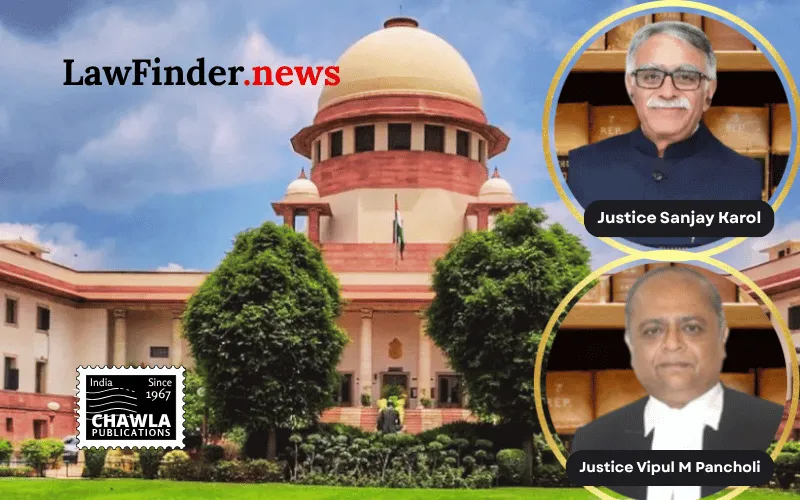
In a significant ruling, the Supreme Court of India has remanded the case of Himanshu Chordia vs. State of Rajasthan back to the Trial Court for a reassessment of adultery allegations made by the husband against his wife, which could potentially affect her entitlement to interim maintenance. The judgment, delivered by a bench comprising Justices Sanjay Karol and Vipul M. Pancholi, underscores the importance of addressing allegations of adultery at an intermediate stage if prima facie evidence is present, rather than deferring them for final adjudication.
The case revolved around the appellant, Himanshu Chordia, who contended that his wife, Arushi Jain, was involved in an adulterous relationship, thus barring her from receiving interim maintenance under Section 125(4) of the Criminal Procedure Code (CrPC). The Trial Court had previously dismissed Chordia's application, stating that the evidence could only be assessed at the final adjudication stage. However, the Supreme Court clarified that if adultery allegations are substantiated with clear and cogent evidence, they can indeed bar interim maintenance at the outset.
The judgment also delved into the procedural aspects of maintenance under Section 125 CrPC, emphasizing the summary and civil nature of such proceedings aimed at preventing destitution and ensuring social justice. The Court reiterated that the provision must be interpreted liberally, given its beneficent nature.
Additionally, the Supreme Court raised concerns over the unregulated operations of private investigators, which came to light due to the nature of evidence presented in this case. The bench noted the necessity for a legislative framework to oversee private investigation practices, highlighting issues of privacy, data protection, and the authenticity of evidence. The Court's judgment pointed to the Private Detective Agencies (Regulation) Bill, 2007, which was introduced but not enacted, as a starting point for such regulation.
In a broader context, the judgment directs the Ministry of Law and Justice and the Law Commission of India to consider the formulation of regulations governing private investigators, drawing insights from international jurisdictions like Australia, Canada, and Singapore.
The Supreme Court's decision marks a pivotal step in refining the adjudication process of maintenance cases involving allegations of adultery, while simultaneously advocating for necessary legal frameworks to regulate private investigation practices in India.
Bottom Line:
Section 125(4) of the CrPC mandates that interim maintenance to the wife can be denied if adultery is ex-facie proved with clear and cogent evidence. Adultery allegations should not be deferred for final adjudication but can be decided at an intermediate stage if evidence establishes prima facie adultery.
Statutory provision(s): Section 125 of the Criminal Procedure Code, 1973, Section 65B of the Evidence Act, 1872
Himanshu Chordia v. State of Rajasthan, (SC) : Law Finder Doc id # 2951103