Court Rules Minor Variations in Form-26 Affidavit Concerning Educational Qualifications and Land Details Not Substantial Enough to Affect Election Outcome
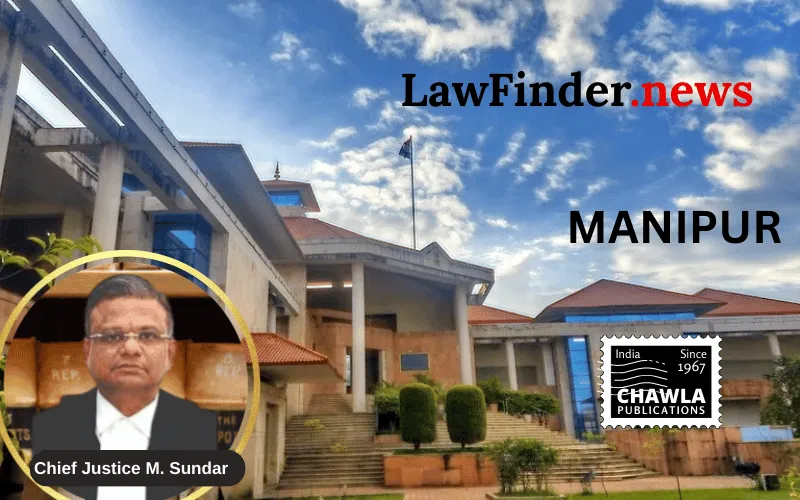
In a significant judgment delivered on July 14, 2026, the Manipur High Court, presided over by Chief Justice Mr. M. Sundar, dismissed an election petition challenging the election of Shri Karam Shyam from the 20-Langthabal Assembly Constituency in Manipur. The petition, filed by Shri Okram Joy Singh and others, alleged non-disclosure of non-agricultural land and misrepresentation of educational qualifications by the returned candidate, Shri Karam Shyam of the Bharatiya Janata Party (BJP).
The election in question was a four-cornered contest held on February 28, 2022, with a voter turnout of over 26,000 from an electorate of 28,128. Shri Karam Shyam won with a margin of 2,053 votes over the petitioner from the Indian National Congress (INC).
The core issues before the Court pertained to two claims: first, that the returned candidate failed to disclose two parcels of homestead land as non-agricultural land in the prescribed Form-26 affidavit submitted during nomination; and second, that he misrepresented his educational qualification by stating it as a Bachelor of Textile Engineering instead of Bachelor of Textile Technology from Government Central Textile Institute, Kanpur.
The Court examined the statutory Form-26, which requires candidates to disclose detailed information about assets and educational qualifications in specified columns. It was observed that while the candidate marked “NIL” under the “non-agricultural land” column, he had disclosed ownership of the said homestead land with residential buildings under a different column titled “residential buildings.” Importantly, the Court noted that Manipur’s revenue records do not classify land as “non-agricultural” but rather as agricultural, homestead, or shop-site plot. This classification was supported by evidence from the Sub-Deputy Collector of Lilong, Chajing.
Regarding the educational qualification, the Court recognized that although the candidate had a 4-year bachelor’s degree from the institute in 1987, the degree was technically in “Textile Technology” while he had listed it as “Textile Engineering” in the affidavit. The Court referred to documentary proof including RTI responses and testimonies confirming the degree and the nature of the course.
After a detailed analysis of relevant Supreme Court precedents, including Association for Democratic Reforms (2002), PUCL (2003), Karikho Kri vs. Nuney Tayang (2024), and Ajmera Shyam vs. Kova Laxmi (2026), the Court emphasized the distinction between substantial and insubstantial non-disclosures. It underscored that not every defect or omission in nomination papers amounts to substantial mis-disclosure that materially affects the election outcome.
The Court held that the failure to duplicate the land details under “non-agricultural land” column did not amount to non-disclosure, as the candidate had adequately disclosed ownership and residence in the “residential buildings” section. Likewise, the minor variation between “Textile Technology” and “Textile Engineering” was held to be insubstantial and did not infringe upon the voters' fundamental right to an informed choice under Article 19(1)(a) of the Constitution.
Furthermore, the Returning Officer’s acceptance of the nomination papers was found to be proper, as there was substantial compliance with the prescribed format, and the alleged defects were not substantial enough to warrant rejection under Section 36(4) of the Representation of the People Act, 1951.
Consequently, the High Court dismissed the election petition and disposed of the recrimination petition as otiose, holding that the petitioner failed to demonstrate grounds sufficient to dislodge the returned candidate. No order as to costs was made.
This judgment reinforces the principle that minor discrepancies in electoral affidavits, which do not materially impact the outcome or voters’ fundamental rights, should not invalidate elections, thereby upholding electoral stability and respecting the statutory framework governing election disputes.
Bottom line:-
Election Petition dismissed due to lack of substantial non-disclosure or mis-disclosure of educational qualification and immovable assets. Minor variations in disclosure do not materially affect the election outcome.
Statutory provision(s):
Representation of the People Act, 1951 Sections 19(1)(a), 33, 33A, 36(2), 36(4), 100(1)(d); Conduct of Election Rules, 1961 Rule 4A
Shri Okram Joy Singh v. Shri Karam Shyam, (Manipur) : Law Finder Doc id # 2940895