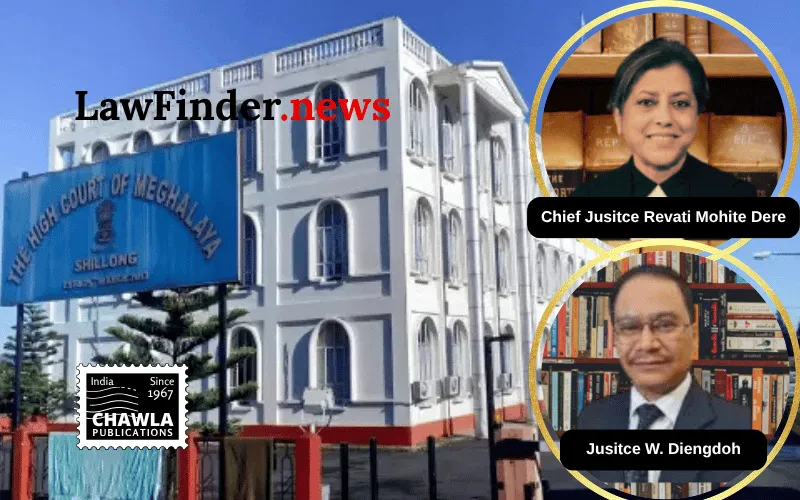
Court emphasizes adherence to Supreme Court guidelines in Tehseen S. Poonawalla case; Bar Council of Meghalaya establishes complaint portals and initiates disciplinary proceedings
In a significant judgment delivered on September 1, 2026, the Meghalaya High Court (Division Bench comprising Chief Justice Mrs. Revati Mohite Dere and Justice W. Diengdoh) addressed a grave incident involving the assault and public parading of an advocate by non-State actors in Shillong. The petition was filed by the High Court of Meghalaya Bar Association and the Shillong Bar Association, highlighting the failure of police authorities to promptly intervene or register an FIR against the assailants.
The Court underscored the constitutional violation of fundamental rights when an advocate was unlawfully apprehended from his professional chambers and subjected to physical assault and public humiliation. Drawing heavily on the Supreme Court's landmark judgment in Tehseen S. Poonawalla v. Union of India (2018) 9 SCC 501, the bench reiterated the necessity for State authorities to implement preventive, remedial, and punitive measures to curb actions by non-State actors that undermine the rule of law.
During the hearing, the Advocate General of Meghalaya assured the Court of immediate registration of an FIR and a thorough investigation into the incident. He further committed to ensuring strict adherence to the Apex Court's guidelines to prevent recurrence of such lapses. Subsequently, the police registered the FIR and commenced investigation proceedings against the perpetrators.
The Court also examined steps taken by the Bar Council of Meghalaya and various Bar Associations in response to grievances, particularly concerning allegations of sexual harassment within the legal fraternity. The Bar Council has established mandatory drop box facilities at all Bar Associations and the Bar Council's office to facilitate confidential complaints. Furthermore, an online complaint portal has been launched to streamline the grievance redressal process.
In a notable development, the Shillong Bar Association suspended the advocate against whom sexual harassment allegations were made. Concurrently, the Bar Council of Meghalaya initiated a Disciplinary Committee (DC) enquiry in accordance with the Bar Council of India Rules, reflecting a commitment to uphold professional ethics and safeguard the rights of women lawyers and interns.
Affidavits filed by the Secretary General of the High Court of Meghalaya Bar Association and the Honorary Secretary of the Bar Council of Meghalaya confirmed the adoption and implementation of resolutions aimed at strengthening internal mechanisms to address such issues. The Court observed that most Bar Associations have complied with the directives issued by the Bar Council, indicating positive institutional response.
Concluding the proceedings, the Meghalaya High Court disposed of the petition, acknowledging the steps taken by the State and Bar bodies while emphasizing the need for continued vigilance to protect advocates and maintain the rule of law.
This judgment serves as a critical reminder of the State's responsibility to act decisively against extrajudicial actions by non-State actors and reinforces the ongoing efforts within the legal community to ensure a safe and respectful working environment.
Bottom Line:
The court addressed the issue of an Advocate being assaulted and paraded by non-State actors, highlighting the failure of police to act promptly and emphasizing compliance with preventive, remedial, and punitive measures as directed by the Supreme Court in Tehseen S. Poonawalla v. Union of India. The court further noted steps taken by the Bar Council of Meghalaya and Bar Associations to address grievances, including sexual harassment complaints.
Statutory provision(s): Constitution of India - Fundamental Rights, Bar Council of India Rules