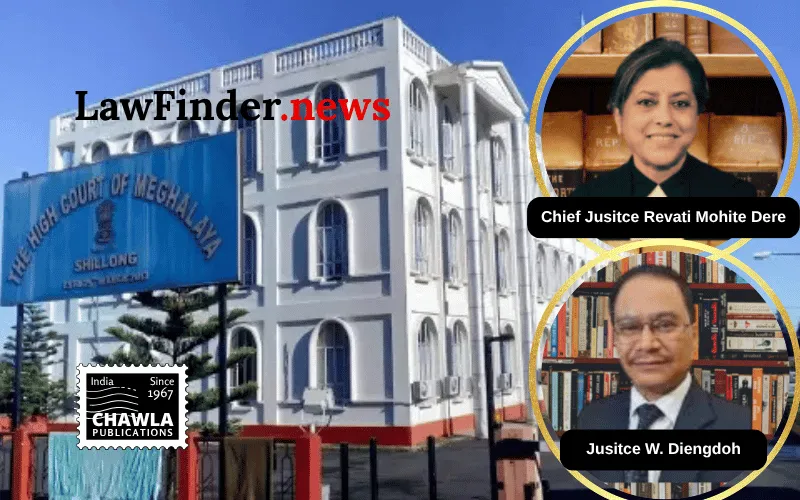
High Court constitutes Special Investigation Team and directs senior police officials to remain present in court; emphasizes need to identify miscreants and comply with Supreme Court guidelines in Tehseen Poonawalla case
The Meghalaya High Court has expressed strong displeasure over the State's handling of a rally that resulted in widespread violence, property damage, and assaults on public figures, including attacks on High Court vehicles. In a judgment delivered on September 1, 2026, the Division Bench comprising Chief Justice Mrs. Revati Mohite Dere and Justice W. Diengdoh has directed a comprehensive investigation while pointing out critical lapses in police administration and enforcement.
The core issue at hand stems from a procession organized by the KSU (Khun Iawbei Students' Union) where permission was granted subject to specific conditions. However, the court found that the police failed to enforce these conditions, allowing the rally to proceed despite glaring breaches. Participants wore masks and face covers in direct violation of the organizers' undertaking that no such coverings would be permitted. Additionally, participants carried sticks and dangerous weapons, breaching Clause 8 of the permission conditions. Significantly, vehicle registration numbers were also covered during the rally.
The court observed that had the police intervened at the initial stage when these breaches became apparent, the subsequent escalation of violence could have been entirely prevented. According to the Advocate General's status report, 22 FIRs have been registered across five police stations in Shillong, including cases involving damage to High Court vehicles and assaults on a PSO (Personal Security Officer) and driver. The incidents resulted in destruction of property, vandalization of statues, and physical assault on citizens.
A significant concern highlighted by the court is the disproportionate identification rate of miscreants. Despite hundreds of individuals participating in the rally, police have managed to identify and arrest only four persons, all of whom are office bearers of KSU. The court expressed dissatisfaction with this limited progress, emphasizing that the police must identify and prosecute all miscreants involved in the violence and property destruction.
The court has constituted a Special Investigation Team (SIT) under the leadership of Inspector General of Police Mr. Marak to investigate the incidents. The court has directed the SIT to take prompt and appropriate steps to identify all perpetrators and ensure compliance with the Supreme Court's guidelines established in the landmark case of Tehseen S. Poonawalla v. Union of India (2018) 9 SCC 501. This reference is particularly significant as the Poonawalla judgment laid down comprehensive guidelines for police action during public processions and protests, including requirements for videography, proper documentation, and proportionate police response.
Investigative progress to date includes collection of Call Detail Records (CDRs) from eight suspected mobile numbers currently under analysis, seizure of two vehicles involved in the incidents, and collection of CCTV footage from 27 locations along the rally route. However, the court has sought specific clarifications regarding whether videography of the procession was conducted as per Supreme Court directives, and whether police officers made any attempt to intervene or stop the assaults and property destruction as the incidents unfolded.
The bench has issued a directive requiring the Inspector General of Police, the Superintendent of Police of East Khasi Hills District, and the Officers-in-Charge of Sadar and Lumdiengjri Police Stations to remain present in court on the next hearing date scheduled for September 7, 2026. This requirement ensures direct accountability of senior police officials for the investigation's progress and quality. The court has also mandated submission of a fresh status report detailing investigation developments by the next hearing date.
The judicial criticism extends beyond mere procedural lapses. The court's observations underscore a fundamental failure in preventive police action—the police were aware of the condition violations from the outset but failed to take corrective action. This allowed a situation that could have been managed at its genesis to escalate into widespread public disorder involving violence and property damage. The court's remarks suggest that such failures constitute a dereliction of police duties under the Bharatiya Nyaya Sanhita, 2023, and the Bharatiya Nagarik Suraksha Sanhita, 2023, which emphasize preventive police action and proportionate response to public assemblies.
The reference to Tehseen S. Poonawalla's case throughout the judgment indicates the court's expectation that police should follow established Supreme Court protocols for managing public processions, including mandatory videography, real-time monitoring, and documented interventions. The repeated emphasis on compliance with this judgment suggests that the police's actions during this rally fell short of constitutional standards for public order management.
Looking ahead, this case appears to set a precedent for police accountability in Meghalaya regarding crowd management and investigative efficiency. The court's insistence on identification of all miscreants and its direct monitoring of the investigation through presence requirements of senior police officials demonstrates judicial determination to ensure that perpetrators of public violence are brought to justice and that systemic failures in police administration are remedied.
The judgment reflects broader judicial concerns about maintaining public order, protecting government property and personnel, and ensuring that police perform their constitutional duty of prevention and investigation with competence and diligence. The case will likely influence future police procedures during public demonstrations in Meghalaya and may serve as a reference point for evaluating police performance in similar situations.
Bottom Line:
State's failure to prevent breaches of permission conditions during a rally and its subsequent inadequate investigation into the incidents of violence, property damage, and assaults criticized. Court stresses on compliance with Supreme Court's directions in Tehseen S. Poonawalla case and expects swift identification and action against the miscreants.
Statutory Provisions
Section 144, Code of Criminal Procedure, 1973; Section 188, Indian Penal Code, 1860; Bharatiya Nagarik Suraksha Sanhita, 2023; Bharatiya Nyaya Sanhita, 2023