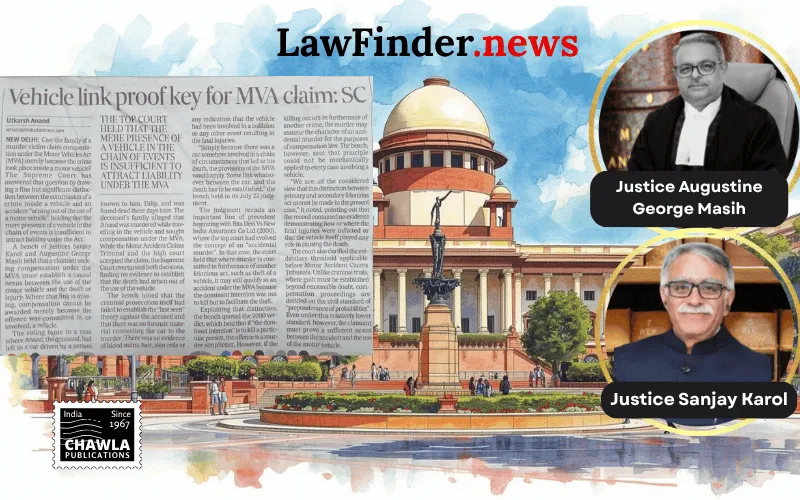
Supreme Court Overturns Lower Court Rulings in Motor Vehicle Liability Case, Supreme Court rules no liability under Motor Vehicles Act due to lack of causal link between vehicle use and death
In a landmark ruling, the Supreme Court of India has overturned the decisions of lower courts regarding the liability under the Motor Vehicles Act, 1988, in the case of Dilip Agarwal v. Rajshri Agarwal & Ors. The case revolved around the death of Anand, who was last seen in the vehicle driven by Dilip Agarwal, the appellant. Anand was found dead three days later, leading to both criminal charges against Dilip and a civil claim for compensation under the Motor Vehicles Act.
In the initial criminal proceedings, Dilip was convicted of kidnapping, murder, and conspiracy but was later acquitted by the High Court due to insufficient evidence regarding the "last seen" theory. Parallelly, a compensation claim under the Motor Vehicles Act was filed by Anand's widow, Rajshri Agarwal, claiming that Anand's death was related to the use of Dilip's vehicle.
The Fourth Additional Motor Accident Claims Tribunal (MACT) and the High Court held Dilip liable under Sections 165 and 166 of the Motor Vehicles Act, initially awarding Rs. 5,64,000, which was later enhanced to Rs. 8,60,832. The courts reasoned that the injuries leading to Anand's death arose from the use of the vehicle.
However, the Supreme Court, led by Justices Sanjay Karol and Augustine George Masih, emphasized the necessity of a direct causal link between the use of the motor vehicle and the incident. The Court noted that mere involvement of a vehicle does not automatically establish liability under the Motor Vehicles Act. The judgment highlighted the distinction between civil and criminal standards of proof, noting that civil cases require a preponderance of probabilities rather than proof beyond reasonable doubt.
The Supreme Court found no evidence suggesting that the vehicle played a direct role in Anand's death, as there was no forensic evidence or indication of a vehicular accident. Consequently, the Court concluded that the necessary causal relationship was absent, thereby negating liability under the Act. The judgments of the lower courts were set aside, and the appeals by Dilip Agarwal were allowed.
The Supreme Court also stated that any compensation already paid to the respondents would not be subject to recovery due to the peculiar circumstances of the case.
Bottom Line:
Motor Vehicles Act - Liability under Section 166 of the Motor Vehicles Act cannot be fastened merely due to the existence of a motor vehicle and an accident. A causal link between the vehicle and the injury or death is essential to establish liability under the Act.
Statutory provision(s): Motor Vehicles Act, 1988 Sections 165, 166, Indian Penal Code, 1860 Sections 365, 302, 201, 120B, Evidence Act, 1872 Section 3
Dilip Agarwal v. Rajshri Agarwal, (SC) : Law Finder Doc id # 2945143