Supreme Court Denies Default Bail in High-Profile Cyber Fraud Case, Filing of Chargesheet Within Statutory Period Extinguishes Right to Default Bail, Rules Apex Court
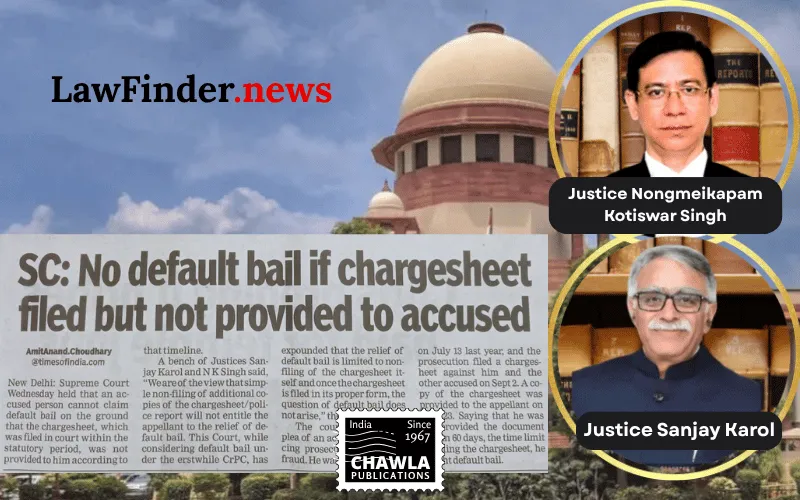
In a significant ruling, the Supreme Court of India has denied default bail to Shaurya Sunil Kumar Singh, an accused in a high-profile cyber fraud case involving SP Cargo and Courier Services Pvt. Ltd. The bench, comprising Justices Sanjay Karol and Nongmeikapam Kotiswar Singh, delivered the judgment affirming the Bombay High Court's decision to dismiss the bail plea.
The case stems from an FIR registered by the Central Bureau of Investigation (CBI) against several entities, including SP Cargo, its operator Sudhir Palande, and unknown bank officials. They are accused of using sophisticated digital means to extort money and aiding cyber criminals by opening and operating mule accounts with forged documents.
Shaurya Sunil Kumar Singh was implicated for allegedly providing logistical support in the conspiracy and was taken into custody on July 13, 2025. The CBI filed a chargesheet against him and other accused on September 2, 2025. Singh's plea for default bail was based on the non-supply of certain documents within the prescribed statutory period. However, the Special Judge, CBI, Mumbai, and subsequently the Bombay High Court dismissed his plea, leading to an appeal in the Supreme Court.
The Supreme Court, in its judgment dated July 1, 2026, clarified that the right to default bail, an indefeasible right under Article 21 of the Constitution, ceases upon the timely filing of a chargesheet. The Court emphasized that non-compliance with the requirement to file additional copies under Section 193(8) of the Bharatiya Nagarik Suraksha Sanhita, 2023, does not entitle the accused to default bail.
The judgment further stated that the object of default bail is to ensure expeditious investigation and prevent investigative laxity. The Court reiterated that once a valid chargesheet is filed within the statutory period, the right to default bail extinguishes, and any subsequent non-compliance with ancillary provisions does not revive this right.
The Supreme Court's decision is seen as a reinforcement of procedural rigor in criminal investigations, emphasizing that the filing of a chargesheet within the statutory period is crucial to extinguishing the right to default bail. This judgment sets a precedent for similar cases, highlighting the importance of timely legal processes in upholding the balance between personal liberty and the need for effective law enforcement.
Bottom Line:
The right to default bail under Section 187(3) of the Bharatiya Nagarik Suraksha Sanhita, 2023 (BNSS) is extinguished once a chargesheet is filed within the prescribed period, even if additional copies as required under Section 193(8) of BNSS are not filed.
Statutory provision(s):
Bharatiya Nagarik Suraksha Sanhita, 2023 - Sections 187(3), 193(8), 230; Article 21 of the Constitution of India.
Shaurya Sunil Kumar Singh v. Central Bureau of Investigation, (SC) : Law Finder Doc id # 2932981