Court Holds Writ Petition Maintainable Against Private Entities Performing Public Functions; Tata Motors Finance Ltd. Directed to Pay Rs. 25,000 as Litigation Cost and Compensate Petitioner
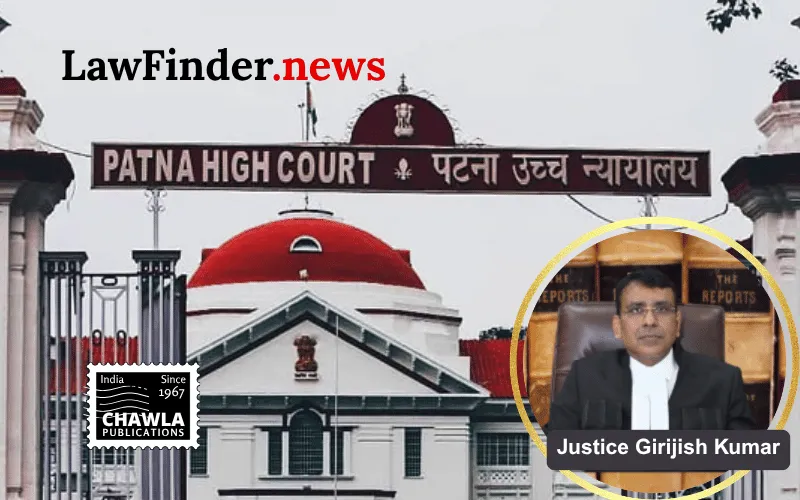
In a significant judgment delivered on September 10, 2026, the Patna High Court, presided over by Justice Girijish Kumar, declared that a writ petition challenging the illegal seizure and subsequent auction of a commercial vehicle by a Non-Banking Financial Company (NBFC) is maintainable under the Constitution of India. The case, Raj Karan Singh v. Union of India and others, involved the petitioner Raj Karan Singh, whose truck was seized and sold by Tata Motors Finance Limited (respondent No.7) without following due legal procedures or court orders.
The petitioner had availed a loan of Rs. 42,06,495/- from Tata Motors Finance Ltd. for purchasing a Tata LPT 4825 truck. Although he had defaulted on two installments due to financial hardships, he made the last payment on August 9, 2024. However, on August 11, 2024, the vehicle was seized by the NBFC without any prior notice or legal process. The petitioner also alleged physical assault by the NBFC's staff when he sought information regarding the seizure. At the time of seizure, the truck was carrying a consignment valued at Rs. 20,00,023/-, causing significant disruption to the petitioner's business and damage to third-party goods.
Despite an interim order dated September 25, 2024, restraining the respondents from selling the vehicle, Tata Motors Finance Ltd. sold the truck on October 19, 2024. The NBFC justified its actions by citing an arbitral award dated November 30, 2023, which the petitioner had not contested. However, the Court found the sale to be illegal and in violation of the interim order.
Respondent No.7 contended that as a private NBFC, it was not amenable to writ jurisdiction since the dispute arose from a contractual relationship. They argued that the petitioner should have challenged the arbitral award under Section 34 of the Arbitration and Conciliation Act, 1996, and that the NBFC had followed due process under the arbitration award.
The Court thoroughly examined the issue of writ petition maintainability against private entities and referred extensively to the Supreme Court's landmark ruling in Kaushal Kishore v. State of Uttar Pradesh (2023), which clarified that fundamental rights under Articles 19 and 21 of the Constitution can be enforced horizontally - even against private parties if their actions violate fundamental rights or public policy. The Court emphasized that Article 21 protects the right to life and livelihood, which includes the right to earn a living with dignity.
It was noted that the NBFC's seizure of the vehicle without adhering to the procedure established by law, including ignoring the SARFAESI Act, 2002, and failing to follow Section 36 of the Arbitration and Conciliation Act, constituted a violation of fundamental rights. The Court also highlighted the use of force and lack of due process, which further compounded the violation.
Given that the vehicle was sold to a third party and could not be restored, the Court ruled that Tata Motors Finance Ltd. is liable to compensate the petitioner to the extent of the insurance value of the vehicle on the date of seizure, adjusted against the outstanding loan amount. Any surplus amount will be paid to the petitioner. The petitioner was also awarded Rs. 25,000/- as litigation costs. The judgment permits the petitioner to challenge the accounts and claim further compensation before an appropriate forum if necessary.
This ruling underscores the judiciary's readiness to protect fundamental rights against private entities performing public functions and reinforces the principle that even NBFCs must act within the legal framework when enforcing contractual rights.
Bottom Line:
Writ petition maintainable against private entities performing public functions or violating fundamental rights. NBFC's seizure of a vehicle without adhering to legal procedures violates Article 21 of the Constitution.
Statutory provision(s):
Article 21 Constitution of India, Article 19 Constitution of India, Article 226 Constitution of India, Section 36 Arbitration and Conciliation Act, 1996, SARFAESI Act, 2002
Raj Karan Singh v. Union of India, (Patna) : Law Finder Doc Id # 2976789