Court holds that mismatch in affidavit signatures impacts document authenticity; grants no relief as petitioner failed to respond within stipulated time despite opportunity
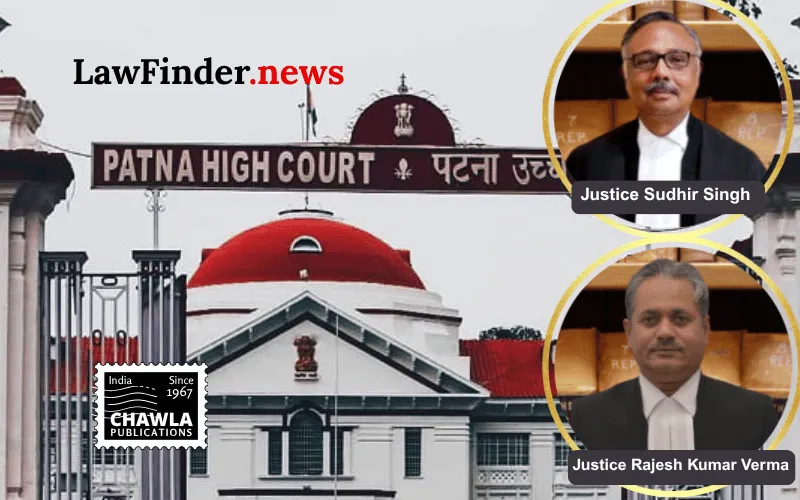
In a significant ruling delivered on August 25, 2026, a Division Bench of the Patna High Court comprising Mr. Sudhir Singh, Acting Chief Justice, and Justice Rajesh Kumar Verma dismissed the writ petition filed by M/s Shubhraj Construction challenging its technical disqualification from a tender process conducted by the Nagar Parishad, Mokama, Bihar. The petitioner was disqualified under Clause 21(1) of the Notice Inviting Tender (NIT) No. 03/2025-26 due to a mismatch between signatures on the affidavit uploaded on the e-procurement portal and the original affidavit submitted physically.
The case arose when M/s Shubhraj Construction participated in the tender for works under the Nal-Jal Scheme in eight groups. Although an earlier complaint against the petitioner alleging document manipulation was found baseless by a three-member enquiry committee, the petitioner's technical bid was later rejected by the Technical Tender Committee on the ground that the affidavit's signatures did not match. The petitioner contended that Clause 21(1) of the NIT did not contemplate signature mismatch as a disqualification ground and that it was denied a proper opportunity to explain the discrepancy.
The court meticulously examined the tender conditions and the facts, holding that the authenticity and due execution of documents are integral to the tender process. A material discrepancy in signatures cannot be dismissed as a trivial or curable defect. The Technical Tender Committee acted within its mandate by comparing the uploaded and original affidavits and rightly disqualified the petitioner for non-compliance. Importantly, the court observed that the petitioner was explicitly informed of the discrepancy and granted three days to file objections, but failed to do so within the stipulated period. The subsequent delayed representation submitted after expiry of the time limit did not amount to denial of the principles of natural justice.
Citing Supreme Court precedents such as Central Coalfields Ltd. v. SLL-SML (Joint Venture Consortium) (2016) and Silppi Constructions Contractors v. Union of India (2020), the bench reiterated that judicial interference in tender decisions is warranted only if the decision is arbitrary, mala fide, or irrational. Since the Technical Tender Committee's decision was based on a factual document comparison and followed tender rules, the court declined to substitute its own assessment.
The court dismissed the writ petition and upheld the technical disqualification of M/s Shubhraj Construction, emphasizing the importance of procedural compliance and document authenticity in public procurement.
Bottom Line:
Tender process - Disqualification of petitioner under Clause 21(1) of the Notice Inviting Tender (NIT) due to mismatch of signatures between the uploaded affidavit and the original affidavit - Held, material discrepancy in signatures affects the authenticity and due execution of the document, and cannot be treated as a mere technical variation - Decision of Technical Tender Committee, which acted within the tender conditions, does not warrant interference.
Statutory provision(s):
Clause 21(1) of the Notice Inviting Tender No. 03/2025-26, Article 226 of the Constitution of India (Writ Jurisdiction)
M/s Shubhraj Construction v. State of Bihar, (Patna)(DB) : Law Finder Doc Id # 2975257