Court says Chandigarh Administration cannot deny benefit to one similarly placed worker while continuing it for others; cites equal pay principle and later Supreme Court rulings on long service and regularisation.
The Punjab and Haryana High Court has dismissed a writ petition filed by the Chandigarh Administration and upheld an order granting the minimum of the pay scale to a part-time Class-IV employee who had served for more than 23 years.
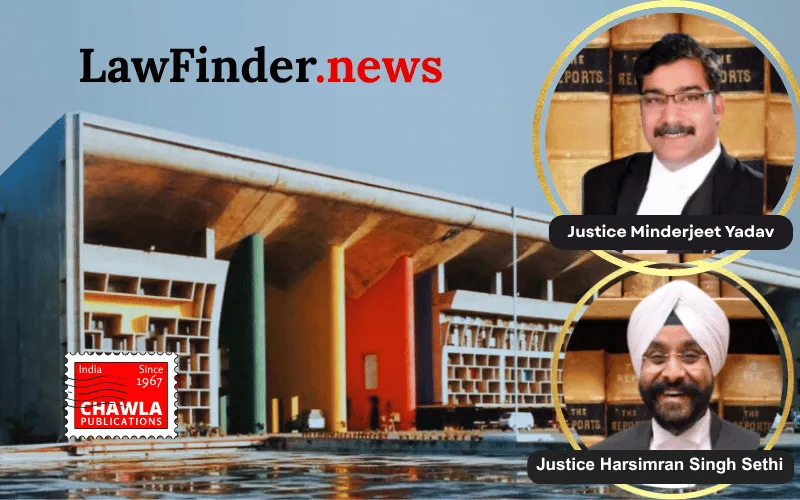
A Division Bench of Justice Harsimran Singh Sethi and Justice Minderjeet Yadav held that the Administration could not treat one part-time employee differently from other similarly situated employees who were already receiving the same benefit. The Court said that once the benefit had been extended to other comparable workers and was still being continued, there was no valid reason to deny it to the respondent.
The dispute arose after the Tribunal, by order dated 03.02.2025, directed that the respondent, a Class-IV employee working six hours a day, be paid the minimum of the pay scale attached to the post against which he was serving. The Chandigarh Administration challenged that decision, arguing that the benefit was inconsistent with the Supreme Court’s ruling in Union of India v. Ilmo Devi.
The High Court, however, noted that the respondent had been working for 23 years and had been paid only DC rates despite performing essential duties. The Court also observed that similarly placed part-time Class-IV employees had earlier been granted the same benefit and were still receiving it. In such circumstances, the Bench held, the principle of equal treatment required that the respondent not be singled out for denial.
Relying on State of Punjab v. Jagjit Singh, the Court reiterated the settled principle of “equal pay for equal work,” especially where temporary employees discharge the same duties and responsibilities as regular employees holding the same post. The Bench extracted the Supreme Court’s observations that such employees are entitled to wages at par with the minimum of the pay scale of regularly engaged employees.
The Court also dealt with the Administration’s reliance on Ilmo Devi. It noted that while the Supreme Court had observed that part-time wagers working four to five hours a day could not claim parity with Group-D posts, it had not disturbed the benefit already granted to the employees concerned in that case. Therefore, the High Court said, the Chandigarh Administration could not continue the benefit for one set of employees and deny it to another similarly situated worker without any reasonable basis.
Importantly, the Bench referred to later Supreme Court decisions in Jaggo, Shripal, and Dharam Singh, which recognised that long years of service by part-time workers could be considered even for regularisation-related benefits, including in cases where initial appointments suffered from procedural irregularities. In light of these developments, the Court held that denying even the minimum of the pay scale to an employee who had served for more than two and a half decades would be unjustified.
Finding no merit in the challenge, the High Court dismissed the writ petition and upheld the Tribunal’s order.
Bottom Line :
Part-time Class-IV employee who had rendered more than 23 years of service and was similarly situated to other part-time employees already receiving minimum of pay scale could not be denied same benefit merely on basis of Ilmo Devi, especially when parity had been continued for similarly placed employees and subsequent Supreme Court decisions recognised long part-time service for regularisation-related benefits.
Statutory provision(s):
Equal pay for equal work principle, Article 14 of the Constitution of India, Article 16 of the Constitution of India
Chandigarh Administration v. Nanu Ram, (Punjab And Haryana)(DB) : Law Finder Doc id # 2982772