Court holds Section 2(2) of Hindu Marriage Act, 1955 is protective, not an absolute bar; waives cooling-off period citing irreconcilable differences and long separation
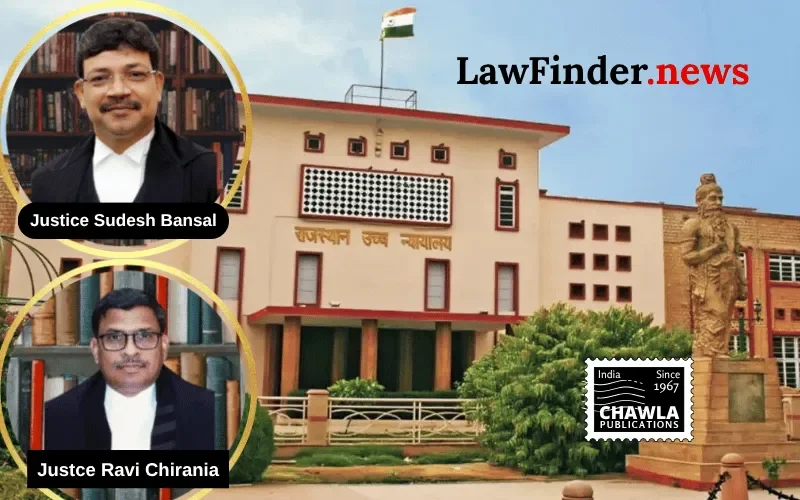
In a landmark judgment dated October 8, 2026, the Rajasthan High Court (Jaipur Bench) delivered a significant ruling in the case of Laxmi Meena v. Bahadur Singh Meena, allowing the dissolution of marriage by mutual consent between parties belonging to the Meena community, a Scheduled Tribe. The bench comprising Justices Sudesh Bansal and Ravi Chirania overturned the Family Court's dismissal of the divorce petition, emphasizing that the exclusion under Section 2(2) of the Hindu Marriage Act (HMA), 1955, is a protective provision intended to uphold customary tribal practices but does not bar Hinduised members of Scheduled Tribes from invoking the Act's provisions.
The couple, married on June 12, 2017, had followed Hindu rites and customs, including the ritual of Saptapadi (seven steps around the sacred fire), for their marriage solemnization. Subsequently, due to irreconcilable ideological differences, they separated in 2021 and mutually agreed to dissolve their marriage. A mutual consent agreement was executed in September 2024, certified by a tribal social reform body, the Hadoti Adivasi Meena Samajik Sudhar Sangh.
The Family Court had dismissed the petition on the ground that the parties did not plead or prove that the dissolution conformed to Meena community customs. However, on appeal under Section 19 of the Family Courts Act, 1984, the High Court noted that both parties followed Hindu traditions and that the protective exclusion under Section 2(2) applies only when the parties observe tribal customs rather than Hindu rites.
Citing Supreme Court precedents including Labishwar Manjhi v. Pran Manjhi (2000) and Amardeep Singh v. Harveen Kaur (2017), the Court clarified that when Scheduled Tribe members are Hinduised and voluntarily choose to follow Hindu customs, the HMA is applicable, and customary practices do not override codified law. The Court further held that the mandatory six-month cooling-off period under Section 13-B(2) of the HMA may be waived in cases where parties have been living separately for several years with no chance of reconciliation.
The Court observed the following admitted facts: no children were born of the marriage, the parties have lived apart for over five years, there is no collusion, and permanent alimony issues have been settled. Accordingly, the Court allowed the appeal, setting aside the Family Court's order and granting a decree of divorce by mutual consent under Section 13-B of the Hindu Marriage Act, 1955.
This judgment reinforces that members of Scheduled Tribes who are Hinduised and follow Hindu rites have the right to seek divorce under the Hindu Marriage Act, thus ensuring that tribal protective provisions do not unduly hinder access to statutory remedies. It also affirms the discretionary power of courts to waive the cooling-off period in appropriate cases, expediting relief for parties in irretrievable breakdown of marriage.
Bottom Line:
Hindu Marriage Act, 1955 Section 2(2) exclusion regarding Scheduled Tribes is a protective provision and not an absolute bar - Where parties belonging to Meena community are Hinduised, follow Hindu rites and customs, and marriage was solemnized by Saptapadi, they can invoke Section 13-B for divorce by mutual consent - Cooling-off period can be waived.
Statutory provision(s):
Hindu Marriage Act, 1955 Section 2(2), Section 13-B, Family Courts Act, 1984 Section 19
Laxmi Meena v. Bahadur Singh Meena, (Raj)(DB)(Jaipur Bench) : Law Finder Doc Id # 2996308